

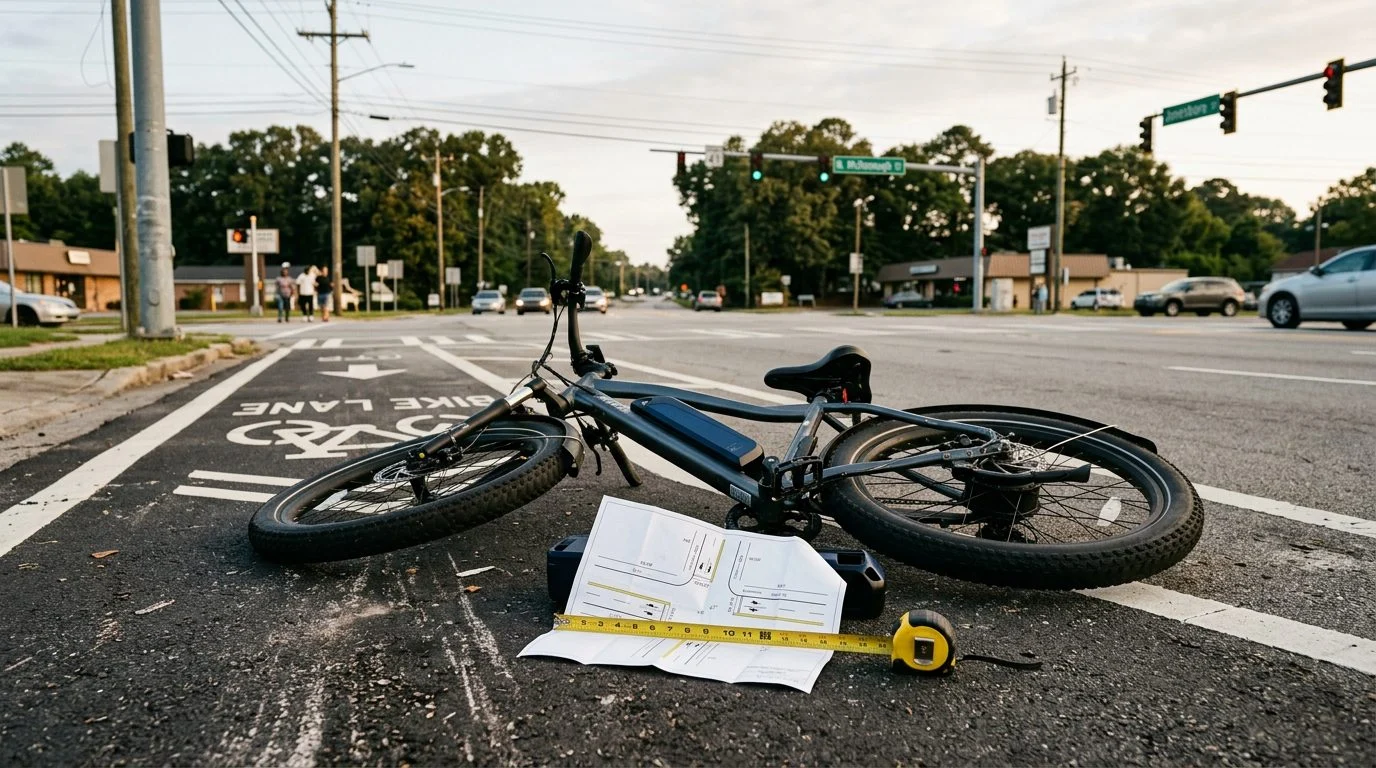
E-Bike Crashes | Georgia
E-Bike Crash in Georgia: How Fast Does Evidence Disappear?
Batteries, chargers and phone app data can be lost or changed quickly. Here is what to protect after a crash, and why it matters early.
The firm at a glance
1999
Year the firm has been in practice
5
Georgia offices: Jonesboro, Atlanta, Decatur, Macon and Augusta
By Terance Madden · Published November 25, 2026
Your family member is hurt, the bike is somewhere out of sight, and you’re wondering what will disappear next. Here’s the hard part: key evidence from an e-bike crash can start to disappear within hours or days, not months.
The Short Answer: Often Within Hours or Days
Evidence after an e-bike crash often starts to disappear within hours or days. How fast it goes depends on the facts, including where the crash happened and who controls the cameras, the bike and the scene.
Four ordinary things cause most of the loss:
- Camera footage gets written over.
- The bike goes to a shop, gets sold or gets thrown out.
- Rain, traffic and road work wipe away skid marks and debris.
- Witnesses move, change phone numbers or forget details.
None of these waits for a lawsuit. If your loved one is still in the hospital, the bike may be at the scene, at a repair shop or in your garage. Each place carries its own risk. The first week is when the most can go.
If your family member is still recovering and the bike, the video or the witness names are at risk, you don't have to sort it out alone. Reach out to our team to talk through your next steps. Talk it through with our team — the first consultation is free, confidential, and carries no obligation.
Video and Surveillance Footage: The Loop That Erases Itself
Many business and home camera systems record over old footage on a loop. Once the loop covers the crash window, that video is gone. Some systems hold footage for a short time and then start writing over it.
The fix is a preservation request. That’s a written letter asking the owner to save specific footage. A strong request names the date, the time window and the exact spot where the crash happened.
Start with the cameras most likely to be overwritten first. Those include storefront cameras, gas station systems and doorbell cameras on the block. Ask for footage that starts before the crash and runs until help arrived.
Don’t assume the footage exists. Ask for it in writing, and ask quickly. A request sent in week one is far more useful than one sent after the owner’s system has cycled through the day. Keep a copy of every request and the date you sent it. If the owner says the footage is gone, ask for that answer in writing too.
The Bike, the Helmet and the Scene
The bike is physical evidence. Its frame, wheels, brakes, handlebars and battery mounts can show where the impact happened and whether a part failed before the crash. The helmet and clothing can show where the head or body struck and whether paint or debris transferred.
Repairs can change or erase that proof. A shop may swap out the very parts that show the damage. A bike that gets sold, stripped for parts or thrown out can’t be examined later.
So keep the bike and helmet as they are. Don’t clean the frame, straighten the bars or replace the brakes. Write down where the bike is stored and who has touched it since the crash.
At the scene, rain, traffic and road work can wash away skid marks, gouges and debris. Take photos as soon as it’s safe. Note the lighting, the weather and where the bike came to rest.
Battery, Controller and Phone Data: What an Engineer Reads
Some e-bikes store data in the controller, in a battery management system (the circuit that tracks a battery’s charge and temperature), or in a companion app on a phone. That data can be lost, reset or overwritten. Charging the battery, updating the app or powering the system down can change what remains.
Phone records, app logs and ride-tracking data can show speed, timing and location. Carriers and apps keep these records for limited periods, so ask for them early.
Before law school, Terance Madden trained as an electrical engineer. Before law school, he trained as an electrical engineer. He starts a case by asking what the evidence shows and how the crash happened. He reads battery and electrical evidence with that training, and he asks which records exist and must be preserved.
Do not try to pull the data yourself. A careless download can alter the record. Preserve the device and tell the firm what exists.
Witnesses, Records and Memory
Witnesses move, change phone numbers and forget details within days and weeks. The person who saw the crash from a bus stop may be hard to find next month.
Write down names, phone numbers and what each person saw while it’s fresh. Note the time, the place and the exact words spoken at the scene. A note made the same day beats a clear memory a month later. Ask each witness the best way to reach them.
Medical records build over time. Keep every visit, test, bill and diagnosis, including the first emergency room record. Georgia requires providers to keep key items, such as evaluations and diagnoses, for at least ten years. That doesn’t make the paperwork easy to get. Under O.C.G.A. § 31-33-2, a provider must furnish a record within 30 days of receiving a written request from the patient or a person authorized to have access to the patient’s record under an advance directive for health care, a psychiatric advance directive, or a durable power of attorney for health care. The provider is not required to release records unless the requesting person has furnished a signed written authorization, and it may refuse if it reasonably determines that disclosure to the patient will be detrimental to the patient’s physical or mental health. The request needs a HIPAA authorization (a federal medical privacy release) and a signed written authorization.
If the patient has died, the request rights run in order. First, the executor, administrator or temporary administrator of the estate may ask, if one has been appointed; if none has been appointed, the surviving spouse may ask. If there is no surviving spouse, a surviving child may ask. If there is no surviving child, a parent may ask.
The person managing the recovery often holds this list. A spouse, parent or adult daughter often keeps the appointment notes, the bills and the witness names. That work is evidence. Keep it in one folder, and date every page.
How Big Insurance Uses a Gap in the Evidence
Big Insurance uses missing proof against the injured person. An insurer’s first offer is rarely what a claim is worth, and a gap in the evidence is one reason.
The tactics follow a pattern. An early, low offer arrives before the medical picture is clear. A recorded statement is requested, and a rushed answer can be quoted back later. Bill payments slow down. Treatment gets disputed as unneeded. A “low impact” argument tries to shrink a crash that caused real injury. When the video and the bike are gone, each of these gets easier to argue.
Your response has layers. Preserve the evidence early. Then look at every coverage layer that may apply: the at-fault driver’s liability coverage, your own uninsured or underinsured motorist coverage (UM/UIM, which can pay when the other driver has too little or no insurance), any umbrella or excess policy, and any corporate or third-party coverage. Georgia requires motor vehicle liability policies to include uninsured motorist provisions, as O.C.G.A. § 33-7-11 describes.
A thin record also makes the fault fight harder. Under O.C.G.A. § 51-12-33, damages drop by the injured person’s share of fault. A plaintiff who is 50 percent or more responsible recovers nothing. Prepare the claim as if it will go to trial, starting in the first week.
Not sure what your next step is?
Talk it through with our team — the first consultation is free, confidential, and carries no obligation.
Steps to Take This Week and Your Next Call
Start this week by writing down the crash details, sending written footage requests, and protecting the bike and helmet.
- Write down the date, time, route, weather and what you remember.
- Send written footage requests to nearby owners, and keep copies.
- Keep the bike and helmet as they are, and note who has touched them.
- Collect witness names and phone numbers.
- Save every medical record, bill and appointment note.
- Don’t give a recorded statement to an insurer before you talk with a lawyer.
Georgia’s general rule gives two years to file a personal injury lawsuit, under O.C.G.A. § 9-3-33. Damage to property, such as a bike, has a four-year time limit under O.C.G.A. § 9-3-31.
How long do we have to sue?
Georgia’s general rule is two years for personal injury claims. Damage to property has a four-year limit.
Should we download the app data ourselves?
No. Preserve the device and let a lawyer decide how the data is read.
Can the injured person’s own fault matter?
Yes. Damages drop by your share of fault, and 50 percent or more fault bars recovery (O.C.G.A. § 51-12-33; Quynn v. Hulsey (2020)).
If your family member was hurt in an e-bike crash and the proof is slipping away, you don’t have to chase it down alone. T. Madden & Associates, P.C. has practiced since 1999, with offices in Jonesboro, Atlanta, Decatur, Macon and Augusta. The first consultation is free, confidential and comes with no obligation to continue. Contact the firm to talk through what to do next.