

Car crash reports · Jonesboro and across Georgia
Hurt in a Georgia car crash? Don't let the paperwork slip.
Some steps after a crash are set by Georgia law, and missing one can cost you. Here is what to handle first, and how our team can help you keep everything on track.
The firm at a glance
1999
Year the firm began practice
5
Georgia offices: Jonesboro, Atlanta, Decatur, Macon and Augusta
By Terance Madden · Published November 13, 2026
You were hurt in a crash, and now you’re holding the paperwork, the calls and the calendar. Here is the short answer. In Georgia, you generally have two years to file a lawsuit for injuries to a person (O.C.G.A. § 9-3-33; Kenneth B. Cameron v. Jmp Pizza, Inc (2026)).
This page explains both clocks. It also covers the shorter deadlines that can apply to claims against cities or the state, and the steps that protect your claim in the first days.
The short answer: two years to sue, but reporting starts at the scene
Georgia generally gives two years to file a lawsuit for injuries to a person. That rule comes from O.C.G.A. § 9-3-33. The legal deadline to file a lawsuit is called the statute of limitations.
The word “generally” matters. Some claims run on shorter clocks, and you’ll see them below. The lawsuit deadline is a limit on filing in court. It is not a limit on reporting the crash.
Reporting is a different duty. Your first hours shape the proof a lawyer will need two years from now. Don’t wait for the lawsuit clock to start before you act.
For the full picture on e-bike and other crash claims, read the e-bike crash claims guide.
If you're keeping this log for someone you love, reach out for a free case evaluation . Talk it through with our team — the first consultation is free, confidential, and carries no obligation.

When Georgia law requires you to report a crash to police
If the crash caused injury, death, or at least $500 in property damage, the driver must notify police right away.
Georgia’s reporting rule is in O.C.G.A. § 40-6-273. After a crash resulting in injury to or death of any person or property damage to an apparent extent of $500.00 or more, the driver must immediately notify the local police department, by the quickest means of communication, if the crash occurs within a municipality. If it occurs outside a municipality, notice goes to the county sheriff or the nearest state patrol office.
Where you report depends on location. Inside a city, notify the local police department. The driver of a vehicle involved in an accident resulting in injury to or death of any person or property damage to an apparent extent of $500.00 or more shall immediately, by the quickest means of communication, give notice of such accident to the local police department if such accident occurs within a municipality. If such accident occurs outside a municipality, such notice shall be given to the office of the county sheriff or to the nearest office of the state patrol. Under O.C.G.A. § 40-6-273, the driver of a vehicle involved in a crash that causes injury to or death of any person, or apparent property damage of $500.00 or more, must immediately notify police by the quickest means of communication. If the crash happens inside a municipality (a city or town), that notice goes to the local police department. If it happens outside a municipality, it goes to the county sheriff’s office or the nearest state patrol office.
The $500 line applies to apparent property damage of $500.00 or more. A crash with any injury triggers the duty, even if the vehicles look fine.
Hit-and-run cases need extra steps. Georgia law requires a driver involved in a crash that results in injury to or death of any person, or apparent property damage of $500.00 or more, to immediately notify police, and that duty is set out in O.C.G.A. § 40-6-273.
If the other driver ran, write down what you can right away. Note the make, color, plate, direction of travel, and names of any witnesses. Memory fades fast under stress.
If a vehicle can’t be moved safely, get out of traffic, call police, and leave the scene as it is for as long as safety allows. Get medical care, even if you feel fine. Some injuries show up hours or days later.
If your crash had no other vehicle, such as a rider who went down alone, see the single-vehicle e-bike crash guide.
Reporting at the scene and after the fact
If an officer came to the scene, the officer’s report is the first official record of the crash. It notes the time, the place, the people involved, and what they said at the time.
That early record is hard to recreate later. Getting it right matters.
If no officer came, don’t assume you’re finished. Call the local police or sheriff’s office that covers the location. File a report as soon as you can. Ask for the report number before you hang up.
Timing is the real problem. Witnesses move away. Store and traffic cameras often overwrite old footage on a set schedule. Cars get repaired or sold. Each week of delay can cost a piece of proof.
Start your own notes now. Write down the date, the location, the names and phone numbers of everyone involved, and the nearest landmark. Take photos of the vehicles, the road, the signs, and your injuries as they heal.
Pain and medication can blur memory. Write the notes the same day, while the details are fresh. Then tell your own insurer that a crash happened, and give the basic facts.
How to get a copy of your crash report
To get a copy of your crash report, ask the agency that responded to the crash. Have the basic details ready.
Gather the crash date, the location, the names of the drivers, and any report number the officer gave you. The more exact the details, the easier the search.
Questions about state crash records can go to the Georgia Department of Public Safety. It no longer handles crash-report questions itself. Its contact page points you to the right agency.
Read the report with care. It records what the officer found and what people said at the scene. It does not decide fault on its own, and it is not the whole case.
Other records matter too: photos, vehicle and device data, medical records, and witness statements. A good file puts all of them side by side, so gaps show up early. Keep the report in the same folder as your notes.
Your insurer and the other driver’s insurer: what to say and what to hold back
Big Insurance is not on your side, and an insurer’s first offer is rarely what a claim is worth.
Expect the common tactics. A low early offer often comes before the full medical picture is known. A request for a recorded statement (your answers, taped or typed, for the insurer) asks you to talk on the record. Delays stretch the wait. Some adjusters dispute the treatment you need, or argue a “low impact” crash could not cause real harm.
Talk to a lawyer before you give a recorded statement. Stick to facts you know. Don’t guess about your speed, your injuries, or who was at fault. Don’t sign a release (a document that ends your claim) before your injuries are known.
Georgia requires auto policies to offer uninsured motorist coverage. You can choose limits lower than your liability limits (O.C.G.A. § 33-7-11). That coverage can matter when the at-fault driver has no insurance, or when the at-fault driver’s insurer is insolvent and unable to make full or partial payment.
The firm looks at every coverage layer. That includes the at-fault driver’s liability coverage, your own uninsured and underinsured motorist coverage (UM/UIM), and umbrella policies (extra coverage above the base limit). It also includes excess policies and corporate or employer coverage where it applies.
The firm prepares each claim as if it will go to trial. A claim can also cover the full cost of an injury over time, not just the first bills.
If a defective part or battery may have played a role, another party could be responsible. See the e-bike product defect guide.
Deadlines that can be shorter than two years
Claims against a city or the State of Georgia have short clocks: a written claim against a city is due within six months of the event, and written notice of a claim against the State of Georgia is due within 12 months of the date the loss was discovered or should have been discovered.
For a claim against a city, Georgia requires a written claim within six months of the event. It must state the time, place and extent of the injury, and the negligence that caused it. It must also state a specific dollar amount of damages (O.C.G.A. § 36-33-5).
For a claim against the State, written notice is due within 12 months of when the loss was discovered or should have been discovered (O.C.G.A. § 50-21-26).
Medical malpractice has its own clock. For medical malpractice claims, Georgia law generally requires that a lawsuit be brought within two years after the date the injury or death occurred, and in no event more than five years after the negligent or wrongful act or omission, except as otherwise provided in the medical malpractice article (O.C.G.A. § 9-3-71).
Damage to personal property has a four-year rule (O.C.G.A. § 9-3-31). That is a separate clock.
Which deadline applies depends on the facts of the crash, who was involved, and who may be responsible. A young rider or a family member’s crash can raise its own questions. The teen e-bike crash guide covers those.
Not sure what your next step is?
Talk it through with our team — the first consultation is free, confidential, and carries no obligation.
How the engineering training shapes the early review
Terance Madden starts a case by asking what the evidence shows and how the crash happened.
Terance Madden’s engineering background shapes how he looks at the evidence: he starts by asking what the evidence shows and how the crash happened. He approaches a case the way an engineer approaches a failure. He asks what the records show, how the event unfolded, and which records must be preserved before they are lost.
Early review pulls the pieces together. That means the crash report, photos, vehicle and device data, medical records, and witness statements. Read against each other, they show whether the story holds up. A timeline built early matters most when a deadline is close.
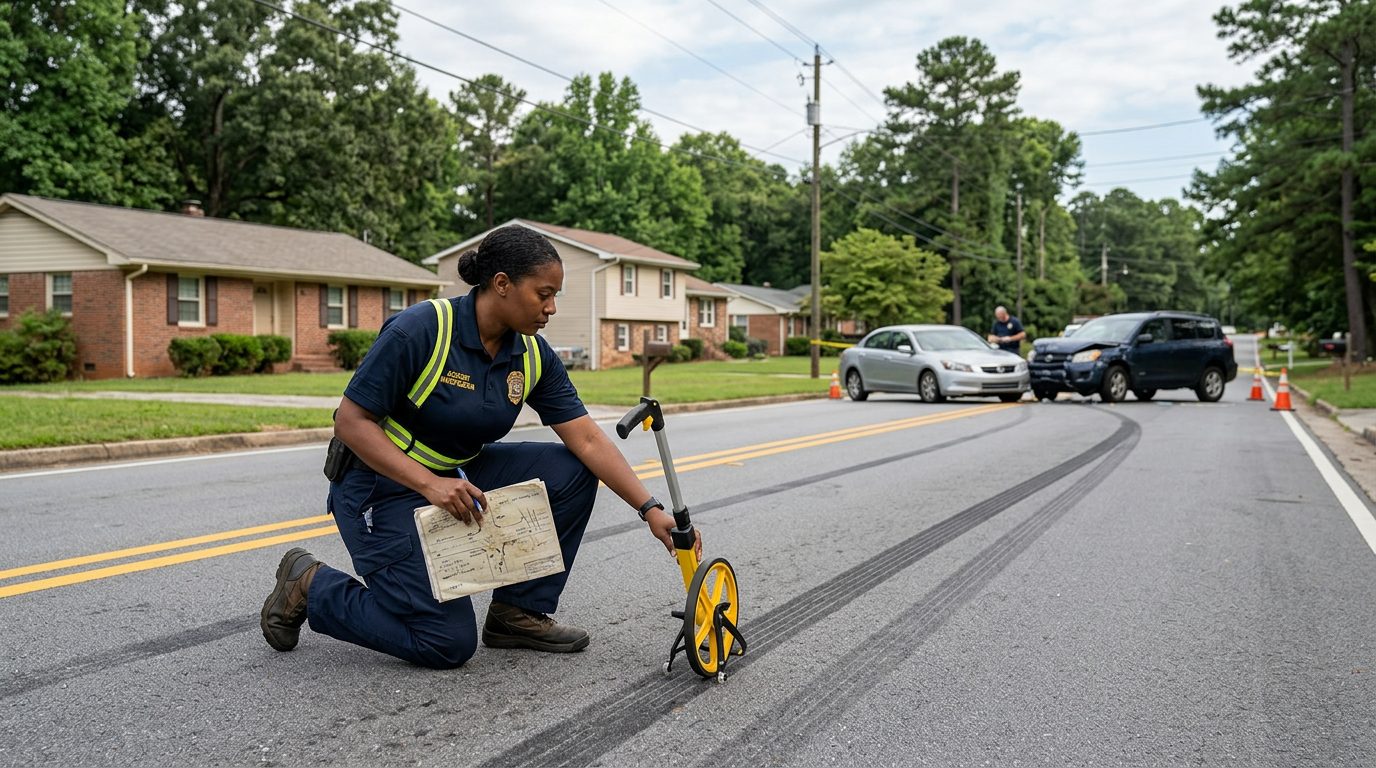
Physical evidence, such as where vehicles came to rest and how they were damaged, can show how the crash unfolded. Reading that evidence is a technical task, and it is one of the first things reviewed.
If you’re managing a loved one’s recovery
If you’re the one making the calls, you already know how much this job takes.
You may be a spouse, a mother or an adult daughter. You’re also working, driving and keeping the house running. You’re sitting in a hospital chair, with a police report nobody has picked up, an adjuster who keeps calling, and a date on the calendar you’re afraid to miss.
Your family has taken care of each other for years, and this is no different. Start a simple log. Record the crash date, the location, the names involved, and every call made to police, insurers and providers. Note the time and what was said.
Keep the log in one place. Add every letter and bill. A log like this lets a lawyer see the dates without guessing.
The firm has been in practice since 1999 and has offices in Jonesboro, Atlanta, Decatur, Macon and Augusta. If you’re keeping this log for someone you love, reach out for a free case evaluation. The firm offers a free, confidential first consultation with no obligation to continue, where the deadlines and next steps for this crash can be reviewed.

Frequently Asked Questions
How long do you have to report an accident in GA?
Under O.C.G.A. § 40-6-273, if a crash causes injury to or death of any person, or property damage to an apparent extent of $500.00 or more, a driver involved must immediately give notice by the quickest means of communication. If the crash happens within a municipality, notice goes to the local police department. If it happens outside a municipality, notice goes to the office of the county sheriff or to the nearest office of the state patrol. Report the crash to police right away, and talk to a lawyer well before that deadline.
How long do I have to file a lawsuit after a car crash in Georgia?
Most Georgia injury and wrongful death claims must be filed within two years, and most property damage claims have a four-year deadline. Call T. Madden & Associates, P.C. for a free, confidential first consultation with no obligation to continue.
Does the deadline change if a government vehicle or road was involved?
Yes. Claims against a city, county or the state usually require a formal written notice, called an ante litem notice, within a much shorter window, often six months for cities and 12 months for counties and the state.
What if the injured person was a minor, or the injury came from medical care?
Some deadlines can pause, such as when the injured person is a minor. Medical malpractice claims generally must be filed within two years, with an outside limit of five years from the act under O.C.G.A. § 9-3-71.