

E-Bike Crash Claims | Jonesboro, Atlanta, Decatur, Macon, Augusta
How Fast Was the E-Bike Going? Proving It After a Georgia Crash
Speed is often the question at the center of an e-bike crash. Here is how the evidence can answer it.
T. Madden & Associates, P.C.
1999
Serving Georgia clients since 1999
5
Offices in Jonesboro, Atlanta, Decatur, Macon and Augusta
24/7
Call us any time, day or night
By Terance Madden · Published November 24, 2026
If the driver says your e-bike was speeding, you don’t have to take their word for it. Speed can be worked out after a crash, and the records decide the answer.
Short answer: speed is proven by checking three sources against each other. Those are the crash scene, the e-bike’s own data, and the damage to the bike and the other vehicle. No single one settles it.
How Do You Prove How Fast an E-Bike Was Going?
You prove an e-bike’s speed by matching three kinds of evidence. Each one gets checked against the others.
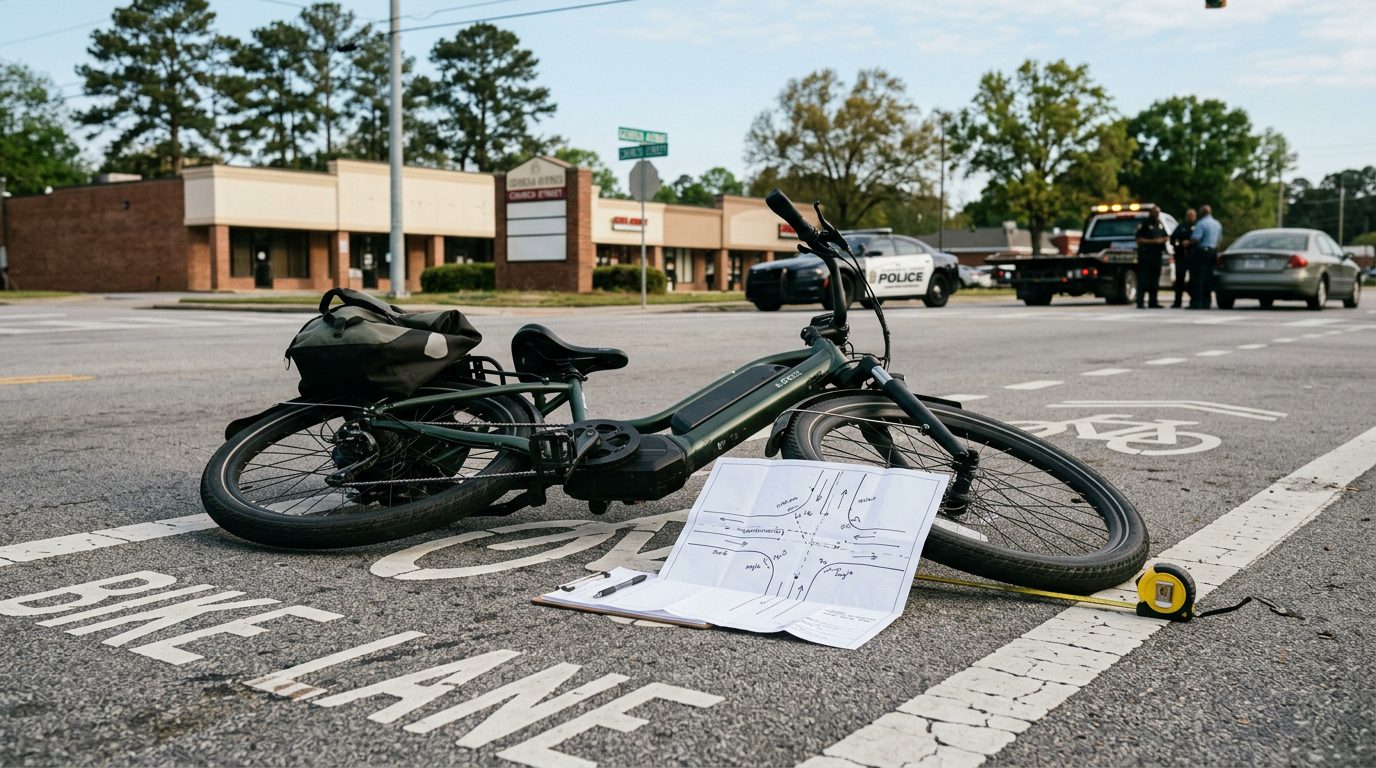
The scene comes first. Skid or drag marks, the final resting spot of the bike and rider, and the distance from impact to stop all tell a story about speed. Nearby video can show it too, but video is often overwritten quickly.
Next is the bike itself. Many e-bikes store controller data. Some pair with a phone app that logs speed, assist level and time. Whether a given bike keeps this data depends on its make and model, so it has to be checked, not assumed.
Last is the damage. Bent parts, crush depth and the spot where the bike and the other vehicle touched all show how hard the impact was.
If the app shows one speed and a skid mark suggests another, that conflict has to be explained. Records that line up are what make a speed claim hold up.
Not sure what your next step is?
Talk it through with our team — the first consultation is free, confidential, and carries no obligation.
What Is the E-Bike’s Speed Class and Why Does It Matter?
An e-bike’s speed class is the category that sets how its motor helps the rider and how fast that help goes. Many bikes are sold in classes tied to motor type and top assisted speed.
The class is confirmed from the label, the maker’s documents and the controller settings. It is not confirmed from a guess or from how the bike felt on the day of the crash.
Here is why it matters. The other driver may say the bike was running faster than the class it was sold in. That claim is a fact to test, not a conclusion to accept.
Settings can be changed after the bike leaves the store. The controller record shows what the bike was set to do at the time of the crash. Keep the original box, manual and paperwork, because they show how the bike was sold.
How Is Braking Distance Calculated?
Investigators work out braking distance from speed, road friction and the marks left at the scene. Stopping distance has two parts, reaction distance and braking distance.
Reaction distance is the ground covered from the moment a rider or driver sees a hazard until the brakes begin to work. Braking distance is the ground covered while the brakes slow the bike. Add them together and you get stopping distance.
Speed matters more than most people expect. Braking distance rises with the square of speed. On the same surface, doubling the speed roughly quadruples the braking distance. A small change in speed makes a large difference at the scene.
Friction is the grip between the tires and the pavement. Wet pavement, worn tires, worn brake pads and loose gravel all change that number. The calculation has to use the real surface, not a guess.
Working backward, the reconstruction team measures the marks and the stopping point. That gives an estimate of the speed when braking started. A driver who claims the rider was fast has to fit that claim to the same numbers.
What Does Delta-V Mean and What Does Damage Show?
Delta-V is the change in speed during the impact. It is the number engineers use to measure how hard a collision was.
Engineers estimate it from crush depth, bent parts, the height where the bike and vehicle made contact, and how the parts moved. The damage is a record of what happened in the moment of impact.
Big Insurance often argues “low impact” when the bike looks minor. The look of the damage is not the whole story. A rider can be seriously hurt in a crash where the bike looks only scratched.
Keep the tone factual. Physics answers the speed question. Medical records document the injuries. Each one needs its own proof, and neither one replaces the other.
Where Are the Data Records and How Should They Be Kept?
The main sources are the bike’s controller and app data, the phone’s location and motion history, nearby video, and any dashcam or vehicle data in the other vehicle.
Keep the bike, battery and phone exactly as they are. Don’t charge, reset, repair, reflash or delete anything without advice. If the battery is swollen, hot or smoking, move it outdoors away from anything that can burn and call 911.
Photograph the scene, the damage and each broken part where it lies. Write down the time, the place and the other vehicle’s make, model and color. Get witness names while memory is fresh.
Georgia law requires the driver of a vehicle in a crash that causes injury to give notice right away to the local police. Outside a city, notice goes to the sheriff or the state patrol, under O.C.G.A. § 40-6-273.
Records get overwritten or lost over time, so early preservation matters. A lawyer can send written requests to preserve data the other side holds.
If you’re the spouse, parent or adult child keeping your loved one’s recovery on track, start a folder today. Put in the photos, the police report number, the bills, the appointment dates and the witness names.
How Does Big Insurance Use a Speeding Claim?
Big Insurance uses a speeding claim to shift blame. Every share of blame it can assign to the rider lowers what it has to pay.
Georgia calls this comparative fault, or shared fault. Under O.C.G.A. § 51-12-33, the judge reduces an award by the injured person’s share of fault. A person who is 50 percent or more responsible may not receive any damages.
The same statute requires the jury to weigh the fault of all persons or entities who contributed to the injury, regardless of whether they were, or could have been, named as parties, and a nonparty’s fault is considered if the plaintiff settled with that nonparty or a defending party gives notice not later than 120 days prior to the date of trial that the nonparty was wholly or partially at fault. The question is never only the rider against the driver, but fault assigned to nonparties is used only in determining the percentage of fault of named parties.
Big Insurance relies on familiar tactics. It asks for an early recorded statement, meaning an interview taped by the insurer. It makes quick, low offers. It delays payment. It disputes whether the treatment was needed. It argues “low impact” to shrink the injury.
Three things are worth knowing. The insurer is not on the injured rider’s side. A first offer is rarely what a claim is worth. The firm knows how to pursue what is owed.
Georgia sets rules for written settlement offers in motor vehicle injury cases. Medical expenses are limited to the reasonable value of medically necessary care, under O.C.G.A. § 51-12-1.1.
The response is to pursue every coverage layer. That includes the at-fault party’s liability coverage, uninsured and underinsured motorist coverage (UM/UIM, protection from your own policy when the other driver has too little or none), umbrella coverage (an extra layer above a policy), excess coverage, and corporate coverage. The firm looks at the full lifetime cost of the injury and prepares the case as if it will go to trial.
Not sure what your next step is?
Talk it through with our team — the first consultation is free, confidential, and carries no obligation.
How Terance Madden’s Engineering Training Shapes the Speed Analysis
He starts a speed question by asking what the data shows and how the crash happened.
Controller logs and battery data carry timestamps. Reading them means checking each timestamp against the scene, the marks and the damage.
When the data and the physical evidence disagree, the case needs an answer. That answer decides which records to request first and which to preserve right away.
His engineering view also looks past the rider and the driver. Brakes, tires, cargo or maintenance records, and battery or component makers can all be possible liable parties. Each may carry its own insurance, which can mean additional coverage for the injured person.
The firm has been in practice since 1999. It has offices in Jonesboro (Clayton County), Atlanta, Decatur, Macon and Augusta.
Frequently Asked Questions About Proving E-Bike Speed in Georgia
How long do I have to file a claim in Georgia?
Georgia generally requires an injury-to-the-person lawsuit to be filed within two years after the right of action accrues, though injuries to reputation must be brought within one year after the right of action accrues and loss of consortium actions must be brought within four years after the right of action accrues, under O.C.G.A. § 9-3-33.
What if the driver says my e-bike was speeding?
Georgia reduces your damages by your share of fault. A share of 50 percent or more bars recovery, under O.C.G.A. § 51-12-33. Speed records are how that share gets tested.
Do I have to report the crash?
Georgia law requires a driver in a crash that causes injury to give notice right away, under O.C.G.A. § 40-6-273.
What should I do if I get hit by an e-bike?
Get medical care, photograph the scene and the damage, keep the bike and phone as they are, and write down witness names. Hold off on any recorded statement until someone has reviewed the file.
Can my own insurance help if the other driver has little coverage?
Georgia requires auto policies to include an endorsement that pays insured people harmed by an uninsured motorist, unless a named insured rejected that coverage in writing, under O.C.G.A. § 33-7-11. Whether it applies to an e-bike rider depends on the policy and the facts.
If the crash left you or someone you love hurt, and the driver now says your e-bike was speeding, the firm can review the bike, the data and the damage with you. The first consultation is free, confidential and carries no obligation to continue. Contact the firm to get started.