

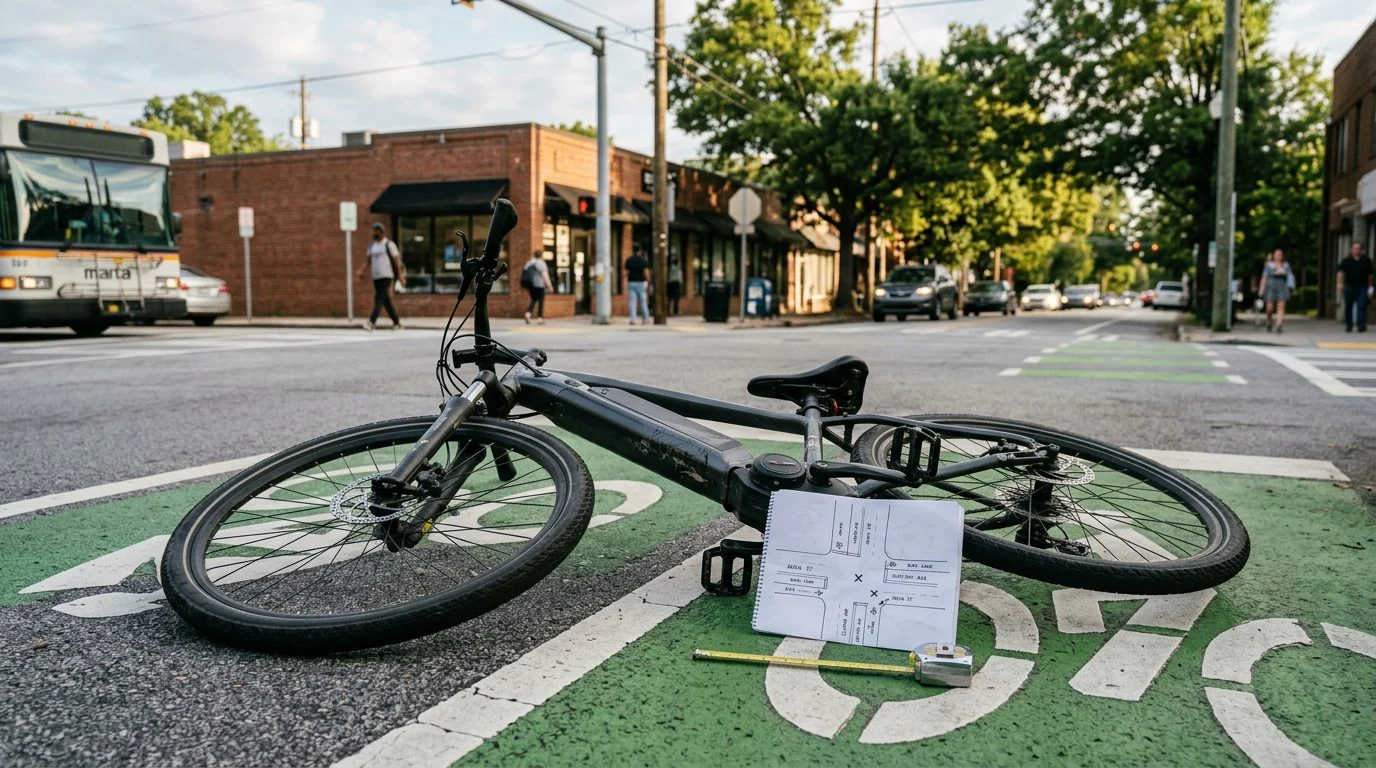
E-bike crash claims | Jonesboro, Atlanta, Decatur, Macon, Augusta
Hurt in an e-bike crash? Find out who has a claim against your settlement.
Medical bills and health plan reimbursement claims can follow you to a settlement. Here is how to see what is owed and what can be challenged.
Why people call the firm
1999
Year the firm began practicing law
24/7
Call us available any time
Free
First consultation, with no obligation to continue
By Terance Madden · Published November 22, 2026
If a lien notice showed up after an e-bike crash, you’re probably asking one thing: how long can it stay on the case? There’s no single answer for every lien in Georgia.
A lien’s life depends on its type. Each type runs on its own statute and its own clock.
The short answer: a Georgia lien’s life depends on its type
So identify the type first, then worry about the date.
A lien is a legal claim against property or money that secures a debt or a right to be paid. Think of it as a claim that sits on top of something until it’s paid, released or no longer enforceable.
This guide covers four types: judgment liens, hospital and medical provider liens, mechanic’s and materialman’s liens, and liens recorded against real estate. The answer depends on the facts and the paperwork. Read the notice first. It usually names the type, the filer and a date.
Keep one other clock in mind. Georgia’s general deadline for a personal injury lawsuit is two years, under O.C.G.A. § 9-3-33. That is a lawsuit deadline, not a lien deadline, but it shapes when the case and its liens get resolved.
If a lien notice arrived while a loved one is still recovering from an e-bike crash, you don't have to sort it out alone. Our team can talk it through with you. Talk it through with our team — the first consultation is free, confidential, and carries no obligation.
How long a judgment lien stays valid in Georgia
A judgment lien lasts as long as the court judgment behind it stays enforceable. The record dates control that.
Here’s how it can reach an e-bike case. Suppose a lawsuit ends in a money judgment against the driver or business that caused the crash. The injured person is usually the one holding the judgment, so the lien works in their favor.
Judgments can also surface years after the crash. Lawsuits take time, and appeals or collection efforts push dates out. That’s why the record date matters.
Keep certified copies of the judgment and every recording notice. Write down the date each one was entered. Check the county record before you rely on any date.
Hospital and medical provider liens after an e-bike crash
A hospital or medical provider lien is tied to your injury claim and any money paid from it. It is not a claim on your house.
Georgia’s rules for these liens come from their own statute, so confirm the current text before you act on any date. Most injury cases feel the pressure of medical bills first.
Under O.C.G.A. § 51-12-1.1, medical expenses are limited to the reasonable value of medically necessary care. The trier of fact (the judge or jury that decides the case) sets that amount.
Some providers treat you now and agree to wait for payment from a settlement. That promise is called a letter of protection, but the statute applies the same way to any other arrangement, regardless of how such arrangement is referred to, in which a provider treats you for a promise of payment from a settlement. The same statute makes the letter, the itemized charges and any referral relevant and open to review in the case.
Medicare adds a second layer. CMS explains that when a person with Medicare is hurt in a crash involving liability insurance, that insurance pays first and Medicare pays second. If insurance won’t pay promptly, Medicare may make a conditional payment, which must be repaid from a settlement. Federal law takes precedence over state laws and private contracts on that point.
Mechanic’s and materialman’s liens: filing and enforcement deadlines
Mechanic’s and materialman’s liens belong to people who supplied labor or materials to improve property and were not paid. Their filing and enforcement clocks run separately from injury and judgment deadlines.
These liens usually follow a repair, a remodel or a contractor dispute. A shop that fixed a family car does not typically place a lien on the house. A contractor who worked on the home might.
Don’t guess the dates. Put three dates on one page: the last day work was done, the day the lien was filed, and any day an enforcement suit was due.
A lien that was filed or enforced late may be open to challenge.
Can someone put a lien on your home without you knowing?
A lien can be recorded in county real estate records, and the owner may not see it right away. The county where the home sits is where to look.
Georgia law also protects some home equity. Under O.C.G.A. § 44-13-1, a debtor’s property is exempt from levy and sale in the amount of $5,000, or $21,500 for real or personal property that is the debtor’s primary residence.
That exemption limits what can be taken through levy and sale. It does not tell you whether a recorded lien is still valid. The statute also bars enforcement against exempt property, with narrow exceptions such as taxes and labor done on the property.
At the county clerk’s office, look for three things: the grantor and grantee names, the recording date and the lien type.
If you’re the one handling the household while a family member recovers, add this check to your early list. A home lien can appear at the same time a paycheck stops.
Liens on an e-bike injury settlement: what Big Insurance does and how to respond
Big Insurance is not on your side. A lien is one more reason to check every number before money moves.
Big Insurance often opens with a low first offer. A first offer is rarely what a claim is worth. Insurers commonly ask for a recorded statement early, may take time before they pay, may question whether treatment was needed, and may argue that a “low impact” crash caused little harm.
The response starts with every coverage layer. That means liability coverage, uninsured and underinsured motorist (UM/UIM) coverage, any umbrella or excess policy (extra coverage above the base limits), and corporate coverage where a business is responsible. The response also covers lifetime damages where injuries last. The firm prepares each claim as if it may go to trial.
Georgia also reduces an award by the injured person’s share of fault, under O.C.G.A. § 51-12-33; O.C.G.A. § 9-11-67.1 instead provides that a settlement offer for a motor vehicle injury claim is an offer to enter into a bilateral contract. Under O.C.G.A. § 51-12-33, a plaintiff who is 50 percent or more responsible recovers nothing.
Terance Madden trained as an electrical engineer and earned a B.S. in Electrical Engineering before law school. He reads a case the way an engineer reads a system: what the facts show, how the crash happened, and which records must be preserved. In an e-bike case, that means checking crash facts, medical records and billing against each other before any lien is paid.
Not sure what your next step is?
Talk it through with our team — the first consultation is free, confidential, and carries no obligation.
What to do when a lien shows up on your injury case
Don’t sign a payoff or release until someone has reviewed the lien’s type, dates and amount. That single step protects the money your loved one may need.
If you’re the spouse, mother or daughter handling the calls and the paperwork, start a simple log. Write down each lien’s type, filer, filing date and amount. Keep every notice and letter. Note any deadline printed on the document.
If Medicare sends a conditional payment letter, know that it isn’t the final amount. CMS states that the letter does not give a final amount, and Medicare might make more payments while the claim is pending. A formal recovery demand comes only after a settlement, judgment or other payment.
If a lien notice arrived in the middle of your loved one’s e-bike case, you don’t have to sort it out alone. Start with a free case evaluation with T. Madden & Associates, P.C.
The first consultation is free, confidential, and carries no obligation to continue. The firm handles these matters on a no-fee-unless-we-win basis, but you may still be responsible for court costs and case expenses.
Frequently Asked Questions
What is a lien in a personal injury case?
A lien is a legal claim on money from a settlement or judgment that pays a debt, such as unpaid medical bills or a health plan’s reimbursement claim.
Can a medical lien be challenged in Georgia?
Yes. Contact T. Madden & Associates, P.C. to review the lien’s filing dates and amounts.
Related practice areas
- E-Bike Accident Lawyer in Georgia
- My Auto Policy May Pay for an E-Bike Crash
- Why Big Insurance Calls an E-Bike Crash a Low-Speed Impact
- How to Get a Medical Lien Removed? Georgia E-Bike Crash