

E-bike crash insurance · Clayton County, Atlanta, Decatur, Macon and Augusta
Hurt on an e-bike? Your own car policy may still be part of the picture.
Insurance paperwork can look like a maze after a crash. Terance Madden and the firm can read it with you and explain what it may mean for your next step.
The firm at a glance
1999
Year the firm began practice
5
Georgia offices: Jonesboro, Atlanta, Decatur, Macon, Augusta
24/7
Call the firm any time
By Terance Madden · Published November 21, 2026
Someone you love got hit while riding an e-bike, and the bills are already stacking up. The first question is whether the car insurance in your house can help.
Short answer: a car policy may pay for an e-bike crash in Georgia. Whether it does comes down to which coverages the policy includes and how the crash happened. This page walks through what to check first.
Does Car Insurance Cover an E-Bike Crash in Georgia?
It may, and the policy’s own wording decides it. A car policy is a contract. Its definitions say what counts as a covered vehicle, who counts as a covered person, and what the policy pays for.
Riders often assume the bike is outside the car policy. Sometimes it is. Sometimes the wording covers a rider who was hit by a car, even when the bike itself is not insured. You find out by reading the paper, not by guessing.
This depends on the facts. The coverages on the policy, who was riding, and who caused the crash all matter.
If you’re reading this, someone you love is probably hurt. The bills are piling up, the phone keeps ringing, and nobody knows which policy to call first. That’s a hard place to be. Start with the paper, not the phone.
A rider hit by a car may have a claim against the driver, against coverage in the household, or against both. Knowing which doors are open is the first step.
Not sure what your next step is?
Talk it through with our team — the first consultation is free, confidential, and carries no obligation.
What to Pull From the Policy Before You Call Anyone
Start with the declarations page, because it lists what you actually bought. The declarations page is the summary at the front of the policy. It lists each vehicle, each driver, and each coverage limit. Check every line.
Ask for the full policy, not just the insurance card. The card lists only a few facts.
Three coverages matter most for a rider.
Medical payments coverage, often called MedPay, pays certain medical bills no matter who caused the crash. It applies only if the policy includes it and the wording reaches your injury.
Underinsured motorist coverage (UIM) pays when that driver’s insurance is not enough to cover your losses.
Then read the exclusions and definitions. Look for words about motorized vehicles, bicycles, or vehicles not used for transportation. Those words can decide whether an e-bike counts.
Last, list every household member. Some policies reach relatives who live in the same home.
When the Driver Who Hit You Has Little or No Coverage
If the at-fault driver has little or no insurance, your own UM or UIM coverage may be the next source of payment.
Under Georgia law, a car policy must include uninsured motorist coverage unless the insured rejects it in writing. O.C.G.A. § 33-7-11 requires automobile liability policies issued or delivered in Georgia, on vehicles principally garaged or principally used in Georgia, to include an endorsement or provisions undertaking to pay the insured damages for bodily injury, loss of consortium or death of an insured, or for injury to or destruction of property of an insured under the named insured’s policy sustained from the owner or operator of an uninsured motor vehicle.
Here is the basic idea. Under O.C.G.A. § 33-7-11(b)(1), a different rule applies if you rejected add-on coverage and selected the reduced option in writing. In that case, the law treats the vehicle as uninsured only for the amount of the difference between the available bodily injury and property damage liability coverages on the at-fault vehicle and the limits of your uninsured motorist coverage. Under the default add-on coverage, your UM coverage pays in addition to the at-fault driver’s liability coverage. Your combined recovery cannot be more than your total losses.
The firm pursues every layer. That includes the at-fault driver’s liability policy, your UM or UIM coverage, any umbrella or excess policy, and corporate coverage when a company or vehicle owner is involved.
Other parties may share fault too. A vehicle owner, a company, or a maker of a defective battery or part may be liable. Georgia reduces damages by your percentage of fault, and bars recovery at 50 percent or more (§ 51-12-33). Each at-fault party pays only its own share.
How Big Insurance Handles an E-Bike Injury Claim
Big Insurance is not on the injured person’s side, even when the adjuster sounds friendly.
Expect a low first offer. Expect a request for a recorded statement, often soon after the crash. Expect delays in paying bills, arguments that the treatment wasn’t needed, and the claim that the crash was “low impact,” so the injuries must be small. Expect the insurer to ask for records, then question each bill. These steps can stretch on for months while bills keep arriving.
An insurer’s first offer is rarely what a claim is worth. Treat it as a starting point, not a final answer.
The response is to count the full cost of the injury, not just the first few months of bills. Georgia law presumes general damages, such as pain and suffering, flow from a wrongful act, so they can be recovered without proof of an amount. Special damages, such as bills and lost wages, must be proved (§ 51-12-2). Medical expenses are limited to the reasonable value of medically necessary care (§ 51-12-1.1).
The firm prepares every case as if it will go to trial. For how the “low impact” argument works, read the low-speed impact argument in Georgia.
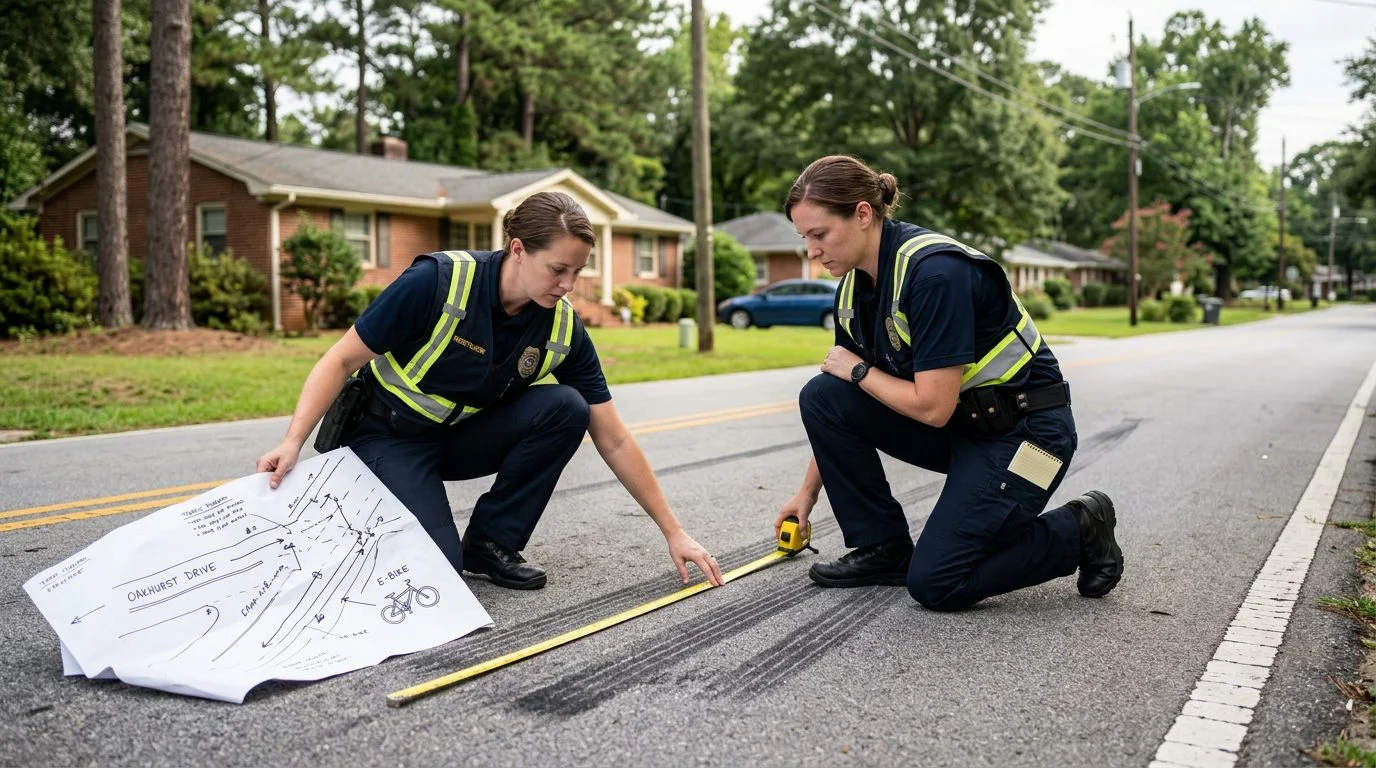
What the Crash Evidence Shows and Why It Matters
Crash evidence often decides whether a “low impact” argument holds up.
Before he became a lawyer, Terance Madden trained as an electrical engineer. Before law school, he trained as an electrical engineer. So he starts a case by asking what the evidence shows and how the crash happened. He also asks which records exist and must be kept.
Delta-V is the change in speed during impact. It helps show how hard the impact really was. A rider can be badly hurt in a crash that looks minor from the outside, so the numbers and the photos should be read together.
In a car crash, the other vehicle may record data about speed and braking. That data can be lost if no one asks for it early.
Keep what you can. That means the bike and its battery, the charger, the helmet, photos of both vehicles and the scene, and the crash report number. If a battery, brake, tire, or part failed, that may point to another liable party and more insurance.
Medical Bills, Liens, and Who Gets Paid First
Track MedPay, health insurance, and liens together, so nothing gets lost.
A lien is a legal claim to be repaid from a settlement. A health provider or insurer can hold one. A letter of protection, where a provider treats you and waits for payment from your case, is another way bills tie to a claim. Georgia law makes letters of protection relevant evidence (§ 51-12-1.1).
Federal rules add another layer when Medicare is involved. When a person entitled to Medicare is hurt in a crash involving liability or no-fault insurance, that insurance pays first. Medicare pays second (CMS overview). Medicare may also make a conditional payment, which must be repaid from a settlement. Federal law takes precedence over state law and private contracts.
A Medicare beneficiary must also report the claim to Medicare (CMS reporting guidance).
For a closer look, read medical bills and liens after an e-bike crash. Settlement math has to account for these bills before the family sees any money.
Not sure what your next step is?
Talk it through with our team — the first consultation is free, confidential, and carries no obligation.
If You Are Managing a Loved One’s Recovery
If you’re handling the calls, appointments, and paperwork, you’re the person holding this together. A simple system helps.
If you’re the spouse, mother, or adult daughter in charge, start a folder. Put in it the declarations page, the crash report number, photos, the bike’s make and model, every receipt, and a running log.
Log every insurer call. Write down the date, the caller’s name, the company, and what was asked or said. Keep the phone numbers in one place too.
If an insurer asks for a recorded statement, the injured person does not have to answer alone. The firm can handle those contacts for you.

Talk to the Firm About Your E-Bike Crash
Start with a free talk about your policy and your claim. Here are three questions families ask first.
Does my car insurance cover me on an e-bike in Georgia?
It may. The declarations page, the coverage wording, and the crash facts decide it.
How long do I have to file?
Georgia generally gives two years to sue for injuries to the person, but actions for injuries to the person involving loss of consortium must be brought within four years, under O.C.G.A. § 9-3-33.
Can I still recover if I was partly at fault?
Yes, if your share of fault is under 50 percent. Georgia reduces your damages by your share of fault, and bars recovery at 50 percent or more (O.C.G.A. § 51-12-33; Quynn v. Hulsey (2020)).
The first consultation is free, confidential, and carries no obligation to continue. Terance Madden is the responsible lawyer for this page. If someone you love was hurt on an e-bike and the policy still isn’t clear, start a free case evaluation. The firm takes calls 24/7 and has offices in Jonesboro, Atlanta, Decatur, Macon and Augusta.