

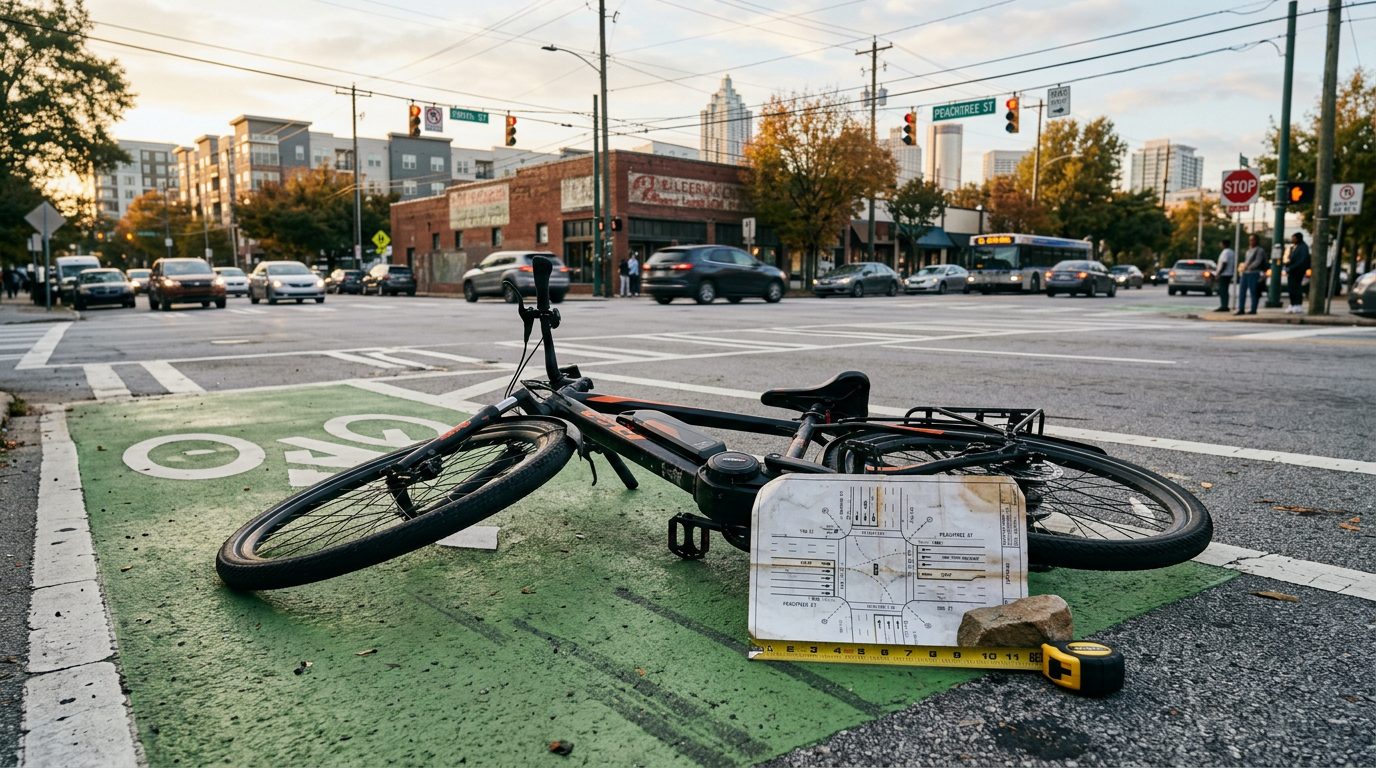
E-Bike Accident Lawyer | Georgia
Hurt on an E-Bike? Let's Find Out How Georgia Law Treats Your Ride
Motor-powered bikes sit in a gray area, and the answer can shape your claim. The firm's team will look at your bike and your crash with you.
Serving Georgia since 1999
1999
Year the firm began practice
5
Georgia offices
24/7
Phone line for case calls
By Terance Madden · Published November 11, 2026
Hit while riding an e-bike? Is an e-bike a vehicle in Georgia? Often, yes. A motor-powered e-bike can fit Georgia’s general definition of a vehicle, and that label shapes who owes what after a crash.
A motor-powered e-bike can fit Georgia’s definition of a vehicle
Georgia’s definitions section, O.C.G.A. § 40-1-100, defines a “vehicle,” for that part of the code, as any machine propelled or drawn by mechanical power and used on the highways to carry passengers or property, as determined by the commissioner. In plain words, that’s a machine that moves under its own power and carries people or cargo on the road. An e-bike with a working motor, ridden on a public road, may fit that wording, but the definition covers vehicles as determined by the commissioner and applies only within that part of the code.
The statute applies “as used in this part” of the code, so the wording of the specific rule in your case still matters. Georgia’s e-bike rules are also not fully settled. Public reports disagree on how a given e-bike should be classified. Often the classification question comes up early, in the first call with the insurance company. That gap is why the bike’s own setup and the facts of the crash carry so much weight.
Hurt on an e-bike in a crash someone else caused? You may have a claim, and the firm can review the bike's setup and your insurance coverage with you in a free, confidential consultation. Talk it through with our team — the first consultation is free, confidential, and carries no obligation.
Why a motorcycle is a different question
Georgia’s motorcycle helmet rule, O.C.G.A. § 40-6-315, says no person may operate or ride a motorcycle without approved protective headgear. That rule covers motorcycles. Whether an e-bike is a motorcycle under Georgia law is a separate question. Big Insurance sometimes blurs the two when it helps the claim, so keep them apart.
A rider who asks “what rules did I have to follow?” is asking the right question. The answer starts with the definitions and runs through the facts of the crash.
Motor power and assisted speed: how the label and the data are read
The motor’s rated power and the speed the controller allows show what the bike can do. Power is usually listed on a label, the frame, or the controller. Assisted speed is the fastest the motor pushes the bike, which can differ from how fast a rider pedals.
He can explain the difference in plain terms to a family that needs to understand it.
A modified motor, a removed speed limiter, or a swapped controller can change what the bike does. That change can matter to the claim, because the bike’s real capability is evidence of its speed at the moment of the crash. Most riders never look at these settings. A clear photo of the label and the controller often tells you more than memory of the ride.
Why the classification matters when a crash happens
The bike’s classification matters because it helps show which rules applied and who broke them. Georgia uses comparative fault (shared fault). Under O.C.G.A. § 51-12-33, the trier of fact (the jury or judge who decides the facts) sets the injured person’s percentage of fault. The judge then reduces the damages by that share.
The cutoff is 50 percent. Under the same statute, an injured person who is 50 percent or more responsible for the injury is not entitled to receive any damages under O.C.G.A. § 51-12-33 (Quynn v. Hulsey (2020))(g).
Fault also turns on ordinary negligence, which means failing to use the care a prudent person would use. O.C.G.A. § 51-1-2 defines ordinary diligence as the care exercised by ordinarily prudent persons under the same or similar circumstances.
A crash claim is a liability question, meaning who is legally responsible, not a question of blame. A driver who turns left in front of a rider made that choice, and the law measures it. Speed, lane position, signals, and whether the driver looked for the rider are the facts that often decide fault.
Evidence and other liable parties that can change the claim
Keep the bike, its label, and its data exactly as they are until they are documented. Preserve these items:
- Photos of the label, the battery, the motor, and the controller
- Controller settings and any app data from the ride
- Phone records showing the ride and the route
- The damaged bike, unrepaired and unsold
- Purchase papers and any repair receipts
Controller and app data can show speed and power near the time of the crash. Read it with care. A bike changed after the crash can look different than it did on the road.
A battery maker, a motor maker, a repair shop, or a seller can share fault. Under O.C.G.A. § 51-12-33, the trier of fact must consider the fault of all persons or entities who contributed to the injury, named in the suit or not.
If the driver was working, the employer may have its own exposure.
Big Insurance and the e-bike defense
Big Insurance is not on your side, and its first offer is rarely what your claim is worth. Expect three tactics.
The first is the low opening offer, often made before the full extent of the injury is known. The second is the “not a vehicle” argument, which claims the rider has no real claim. The third is an early recorded statement, a taped or written account of what happened, taken before you understand the bike’s setup or your medical picture. Some insurers also dispute treatment, saying the bills were too high or the injury had another cause.
Medical bills are part of the fight. If you treated under a letter of protection (a promise to pay from any settlement), Georgia law makes the letter, the itemized charges, any sale of the accounts receivable to a third party (with the third party’s name and the amount it paid), and the referral source relevant and discoverable. O.C.G.A. § 51-12-1.1 also limits special medical damages to the reasonable value of medically necessary care.
The response is to find every layer of coverage. That can include the at-fault driver’s liability policy, your own uninsured or underinsured motorist coverage, umbrella or excess coverage, and corporate or employer policies. Georgia auto policies must include uninsured motorist coverage under O.C.G.A. § 33-7-11, within the limits the policy sets.
General damages are those the law presumes from a wrongful act, and they need no proof of an amount. Special damages are those that actually flow from it, and you must prove them (O.C.G.A. § 51-12-2). A serious injury can carry future care costs, and the claim has to count them.
Not sure what your next step is?
Talk it through with our team — the first consultation is free, confidential, and carries no obligation.
Common questions about e-bikes on Georgia roads
Does an e-bike count as a vehicle in Georgia?
A motor-powered e-bike can fit Georgia’s general definition of a vehicle. The bike’s setup and the crash facts decide how that applies.
Can I recover damages if I was partly at fault?
Yes, if you were less than 50 percent at fault. Georgia reduces your damages by your share of fault under O.C.G.A. § 51-12-33.
How long do I have to file?
What should I do first after an e-bike crash?
Get medical care, keep the bike and its label, and photograph the scene. Georgia requires the driver in a crash involving injury or death, or property damage of $500 or more, to immediately give notice to the local police if the crash is within a municipality, or otherwise to the county sheriff or the nearest state patrol office, under O.C.G.A. § 40-6-273.
If you were hurt on an e-bike and fault is now in question, you don’t have to sort out the bike’s setup and the insurance alone. T. Madden & Associates, P.C. offers a free, confidential first consultation with no obligation to continue. The firm has practiced in Georgia since 1999, with offices in Jonesboro, Atlanta, Decatur, Macon and Augusta. Contact T. Madden & Associates to talk through your bike, your crash, and your coverage.
Related practice areas
- E-Bike Accident Lawyer in Clayton County
- Georgia E-Bike Accident Lawyer: Who Pays for Pothole Crashes