

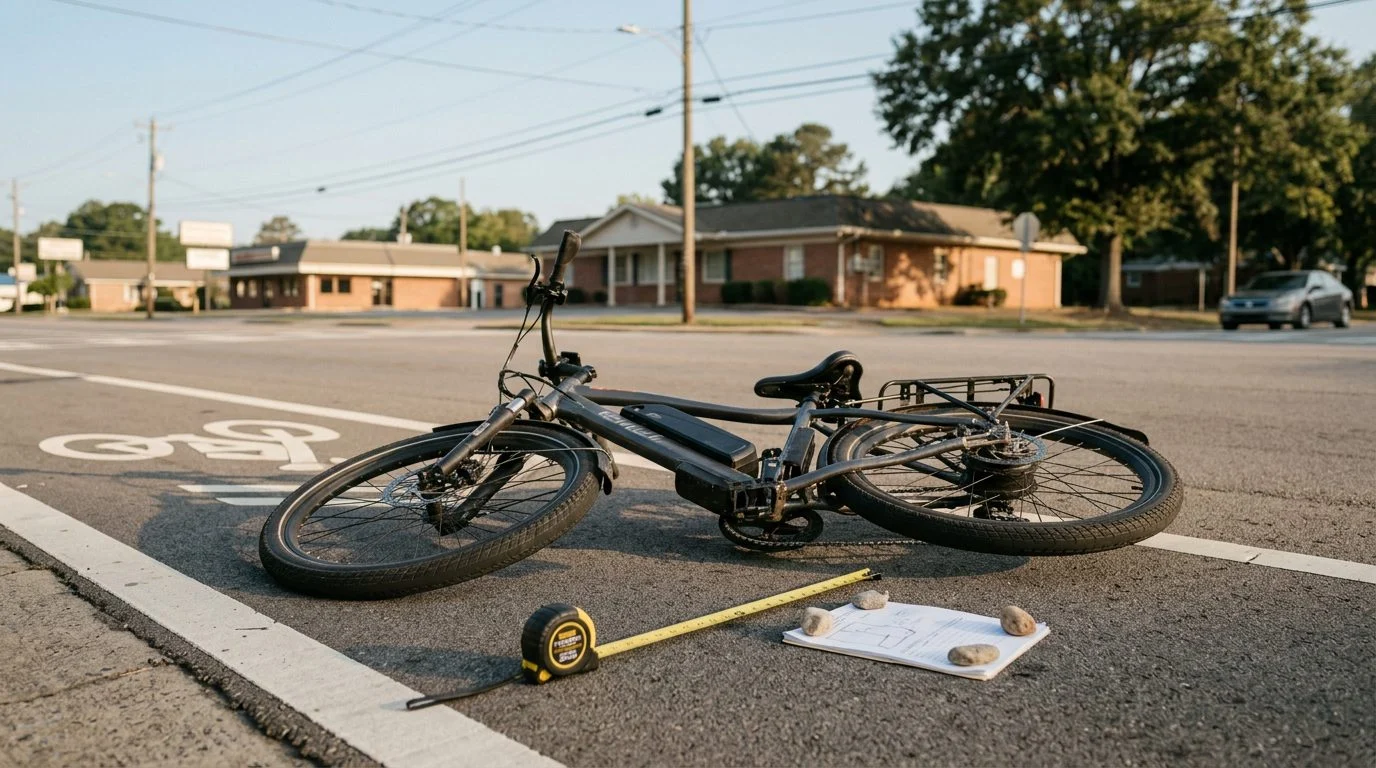
E-bike crashes involving rideshare drivers | Georgia
Hit by a rideshare driver on your e-bike? Start with the right steps.
The rideshare company's insurer may call you within hours. Knowing what to say, and what to leave unsaid, can shape your claim from day one.
Serving Georgia riders and families
1999
Year the firm began practice
5
Georgia offices, including Jonesboro and Atlanta
24/7
Call us anytime
By Terance Madden · Published November 25, 2026
A rideshare driver hit you on your e-bike. Now you’re dealing with injuries, repair bills and insurance calls. The first question is usually who pays.
Here is the short answer: in Georgia, the driver’s app status at the moment of the crash helps decide which insurance may pay. A rider may have a claim against more than one layer of coverage.
What Happens When a Rideshare Driver Hits Your E-Bike
A rider hit by a rideshare driver may have a claim, whether the bike was in a bike lane, a crosswalk or the road. A rideshare driver uses a phone app to pick up paying riders or deliveries. Many of these drivers use their own cars, so more than one policy can come into play.
This page is for the injured rider. It is also for the spouse, parent or adult daughter who is managing the recovery, tracking the bills and taking the insurance calls.
T. Madden & Associates, P.C. has been in practice since 1999. The firm has offices in Jonesboro, Atlanta, Decatur, Macon and Augusta.
Some injuries turn an e-bike case into a serious claim. Broken bones, head injuries and spinal injuries can need long treatment. They can also change how a person works, drives and cares for family. That is why the paperwork matters from day one.
If a rideshare driver hit your e-bike, you may have a claim, and you don't have to handle the insurance calls alone. Call the firm for a free consultation, any time, 24/7. Talk it through with our team — the first consultation is free, confidential, and carries no obligation.
Who Pays Depends on What the Driver Was Doing in the App
The driver’s app status at the moment of the crash decides which policies may apply. Georgia law uses the term “transportation network company” for these apps.
Under O.C.G.A. § 33-1-24, coverage periods start when a driver is logged on to the company’s digital network and available to accept a ride request, and run until the driver is logged off. Once a driver accepts a ride request, the period runs until the trip is complete or the ride ends, whichever is later. They run until the trip is complete or the ride ends, whichever is later. During that period, the company must carry at least $1 million per occurrence for death, personal injury and property damage.
The driver’s personal auto policy may not cover the crash. The same statute lets personal insurers exclude coverage while the driver is logged on or giving a ride. So that policy is one place to look, not the only place.
Georgia law also limits when a ride share network service can be held liable. The firm checks each condition early.
The firm pursues every coverage layer that may apply:
- The at-fault driver’s liability coverage.
- The company’s coverage for the app period, where the statute applies.
- Your own uninsured and underinsured motorist coverage (UM/UIM). This is coverage you carry that can pay when the at-fault driver has too little insurance or none. See O.C.G.A. § 33-7-11.
- Any umbrella or excess policy.
- Other liable parties. If a defective bike or battery played a part, its maker or seller may add another source of insurance.
The Evidence Disappears Fast, and an Engineer Reads It
The app trip log, the driver’s phone records and the vehicle’s own data are the first evidence to lock down. Digital records can be overwritten, lost or never saved. The request should go out early.
Under the same statute, when a driver’s personal insurer asks, the company must provide the crash time and the driver’s log-on and log-off times. That covers the 12 hours before and after the crash. The company has 15 days to respond.
Start your own file now:
- Photos of the bike, the scene and your injuries.
- The helmet and clothing you wore.
- The driver’s name, plate number and contact details.
- Names of anyone who saw the crash.
- Every bill, visit note and prescription receipt.
Before law school, Terance Madden trained as an electrical engineer. Before law school, Terance Madden trained as an electrical engineer, so he starts a case by asking what the evidence shows and how the crash happened. He reads a case by asking what the data shows: speed, timing, braking, and the path of the bike and the car. Vehicle data and video can show whether the driver had time to stop. That helps the firm show how the crash happened, not only who tells which story. Lost evidence can hurt the side that lost it, so the firm moves fast to preserve it.
What Big Insurance Does Early, and How the Firm Responds
Big Insurance is not on the rider’s side. A first offer is rarely what the claim is worth. Expect these tactics early:
- A quick, low offer made before the full injury is known.
- A request for a recorded statement before you understand your injuries.
- Delays in paying medical bills.
- Arguments that your treatment was not needed.
- A “low impact” argument that says a bike rider could not have been hurt badly.
The firm answers each tactic. It documents the injury over time and answers the “low impact” claim with the crash facts and the medical record. It pursues the full cost of the injury, including the future. It prepares the case as if it will go to trial.
Medical bills add another layer. Under O.C.G.A. § 51-12-1.1, medical expenses are limited to the reasonable value of medically necessary care. Medicare.gov explains that Medicare may then make a conditional payment, which it can later recover from a settlement.
Talk to a lawyer before you give any recorded statement or sign a release.
Georgia Claim Steps: What to Expect From Start to Finish
A rideshare e-bike claim usually moves through six steps. It can end in a lawsuit if the insurers will not pay a fair value.
- The first call. You describe the crash, your injuries and any contact from an insurer.
- The free consultation. The first consultation is free, confidential and carries no obligation to continue. The firm works on a no-fee-unless-we-win basis, but you may still be responsible for court costs and case expenses.
- Evidence and coverage review. The firm requests app, vehicle and video records and checks each coverage layer.
- Medical documentation. The firm gathers treatment records, bills and notes on how the injury affects daily life and work.
- Demand and negotiation. The firm presents the claim and negotiates with the insurers.
- Lawsuit, if needed. If the insurers will not pay a fair value, the firm can file suit and prepare the case for trial.
The timeline depends on your injuries, the records and the insurers’ responses. No single date fits every claim.
Deadlines matter. Under O.C.G.A. § 9-3-33, Georgia generally requires injury actions to be brought within two years after the right of action accrues.
Questions Riders and Families Ask About Rideshare E-Bike Claims
Do I have to talk to the driver’s insurance company?
No. You can refer the insurer to the firm. Talk to a lawyer before any recorded statement.
Can I still recover if I was partly at fault?
Georgia reduces your damages by your share of fault. Under O.C.G.A. § 51-12-33, you get nothing if you are 50 percent or more responsible.
How long do I have to file?
Georgia generally gives two years to file most injury claims (O.C.G.A. § 9-3-33; Kenneth B. Cameron v. Jmp Pizza, Inc (2026)). A spouse’s loss of consortium claim, meaning the loss of a partner’s companionship and support, has four years under the same statute.
Can Medicare be repaid from my settlement?
It can be. If Medicare paid bills while your claim was pending, it may need to be repaid from a settlement.
Who can handle this for me?
A spouse, parent or adult child can make the first call and join the consultation with you.
Not sure what your next step is?
Talk it through with our team — the first consultation is free, confidential, and carries no obligation.
Rideshare E-Bike Claims: Who May Be Responsible
T. Madden & Associates, P.C. handles e-bike crash claims in Georgia. The firm has been in practice since 1999. It also handles car, truck and motorcycle crashes, product liability and lithium battery fire cases.
The firm’s standards are simple. Keep communication clear, with no dead air. Treat you and your family with respect. Pursue every coverage layer. Prepare every case as if it will go to trial.
The Terance Madden Foundation also supports community work.