

E-bike crashes | Georgia
A Pothole Threw You Off Your E-Bike? Let's Look at the Facts.
Claims against a city or county follow their own steps, and the evidence you gather early can shape what comes next.
Why people call T. Madden & Associates, P.C.
Since 1999
Practicing law in Georgia
5 offices
Jonesboro, Atlanta, Decatur, Macon and Augusta
24/7
Call us any time
Free
First consultation, confidential, no obligation to continue
By Terance Madden · Published November 21, 2026
Your loved one is hurt. The bills are piling up. Someone in the family is asking whether the city or county should have fixed that hole before it threw a rider off the bike.
A city or county can sometimes be sued over a pothole that caused an e-bike crash in Georgia. The rules are strict, though, and the first deadline is short. Here is what to know first.
Short answer: sometimes, but the notice deadline comes first
A city or county can sometimes be held responsible for a pothole crash, but only if you follow the claim steps the law requires. Miss one step and the court may never weigh the facts.
Claims involving a city or county can raise questions that differ from a typical injury claim, so the facts of each case matter. The process has its own steps, and each step has a clock.
Whether your claim works depends on the facts. Who maintained the road, how long the hole was there, and how the crash happened all matter. No two roads or riders are the same, so each claim gets its own review.
If a pothole left you or someone you love hurt, the notice clock may already be running, and we can help you check it. Reach out for a free, confidential first consultation. Talk it through with our team — the first consultation is free, confidential, and carries no obligation.

Why cities and counties are handled differently
A claim against a city or county follows its own path under Georgia law. It is not the same as a claim against a driver or a store.
Georgia law treats a city as a municipal corporation (the legal term for an incorporated city). It sets a written claim process for injuries caused by a city in Georgia municipal claim statute, § 36-33-5. Counties have their own deadline under Georgia county claim statute, § 36-11-1.
Which government owns and maintains the road is one of the first facts to pin down. It decides where the claim must go and which steps apply. Get that wrong and the whole claim can stall.
The written notice deadline is the first date to calendar
For a city, the written claim must be presented within six months of the event that caused the injury. For a county, the claim must be presented within 12 months after it accrues or becomes payable, or it is barred; minors and other persons under disabilities get 12 months after the disability is removed. Both deadlines come from the Georgia municipal claim statute, § 36-33-5 and the Georgia county claim statute, § 36-11-1.
The city claim must be in writing and given to the governing authority, which means the city’s council or commission. It has to state the time, place and extent of the injury, and the negligence that caused it.
The claim also must state a specific dollar amount of monetary damages. That number is an offer of compromise. It does not bind you if the claim is litigated later. Many families don’t know to include it, so put real thought into that number.
Serve the claim on the mayor or the chairperson of the council or commission. You can use personal delivery, certified mail or statutory overnight delivery.
The governing authority must act on the claim within 30 days. O.C.G.A. § 36-33-5 reads: “(c) Upon the presentation of such claim, the governing authority shall consider and act upon the claim within 30 days from the presentation; and the action of the governing authority, unless it results in the settlement thereof, shall in no sense be a bar to an action therefor in the courts.” The lawsuit clock pauses while a demand for payment sits before the city without action. Separately, Georgia gives two years for actions for injuries to the person under Georgia injury deadline statute, § 9-3-33; injuries to reputation must be brought within one year, and actions involving loss of consortium within four years. Treat that as a different clock, not a replacement for the notice.
Send the claim by certified mail and keep the receipt. The family member managing the file should keep a copy and a dated log of every step.
Proving the city or county knew about the pothole
A pothole claim turns on notice.
Evidence that shows notice includes 311 or service request records, past repair tickets, inspection logs, road crew work orders, and reports from neighbors. Dated photos and video help too. So do weather records, which can show when the pavement started to break down.
Georgia measures care by ordinary diligence, the care an ordinarily prudent person takes under similar circumstances. The Georgia negligence definitions, § 51-1-2 sets that standard.
Before law school, Terance Madden trained as an electrical engineer. That training shapes how he reads this evidence. He asks what the measurements show: the depth, width and edge height of the hole, how long it likely existed, and what a reasonable repair would have looked like. He also asks which records exist and must be preserved, because a missing work order can change how a case is built.
How a pothole throws a rider off an e-bike
A deep pothole can stop a front wheel in a split second and pitch the rider forward over the handlebars. A rear wheel dropping in can twist the bike sideways. Either way, the rider’s body keeps moving after the bike stops.
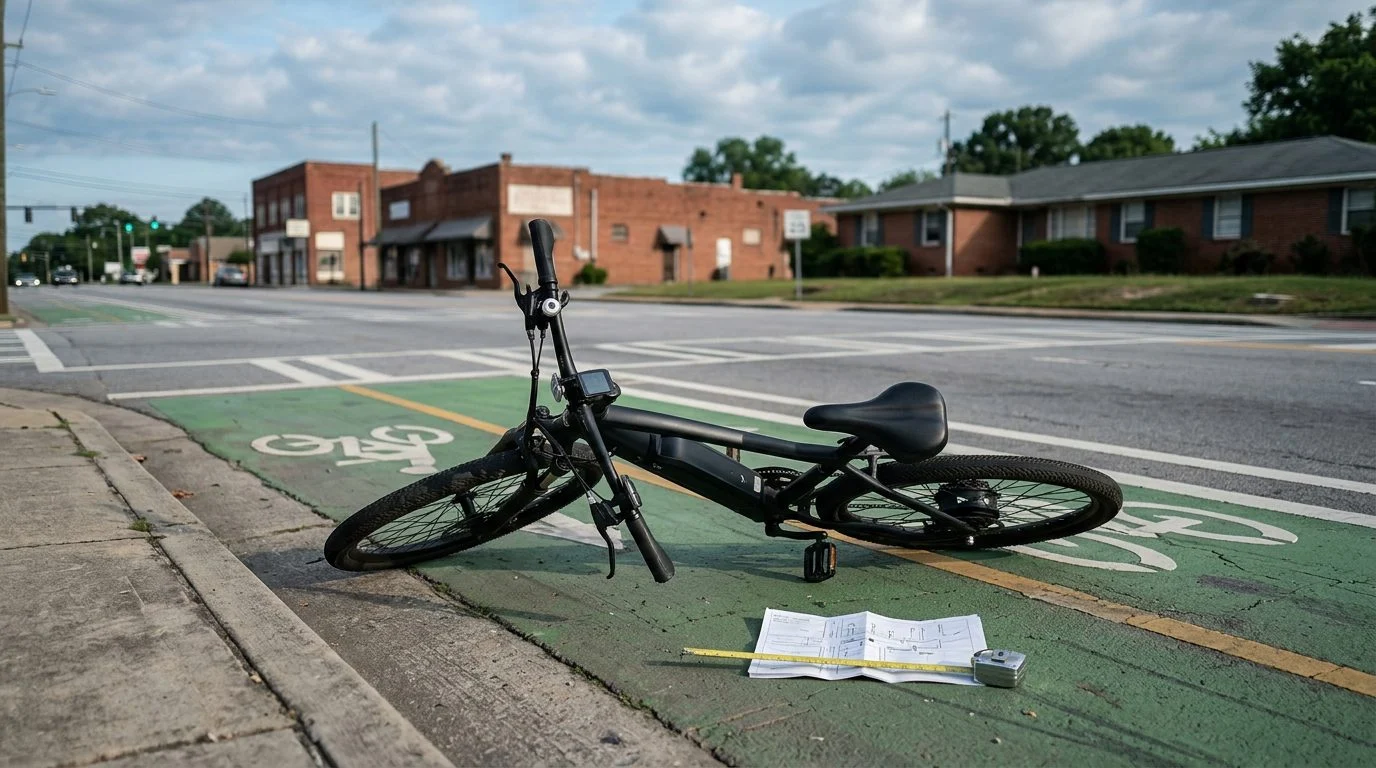
Speed, the bike’s weight, the battery’s mass, and the height of the hole’s edge all shape how the rider lands. Those details are why measurements matter. A hole that looks small in a photo can still be deep enough to trap a wheel.
Ride data can also help. Phone apps, GPS trails, and the bike’s own display or controller logs may show speed and stops, when they exist. Save them early, before they are lost or overwritten.
If a battery defect or a faulty part played a role, a separate product claim may apply against the maker. Our lithium battery fire lawyer page explains how battery defects are handled.
What Big Insurance will likely do with a pothole claim
Big Insurance is not on your side, and its first offer is rarely what the claim is worth.
Expect an early request for a recorded statement. Expect a low offer made before the medical picture is clear. Expect slow replies, requests for more paperwork, and arguments that the treatment was not needed. Expect the claim that the rider should have seen the hole. Each tactic is meant to make the claim smaller or slower.
The response is to pursue every layer of coverage that may apply. That includes the city or county’s liability coverage, the rider’s own auto policy, any uninsured or underinsured motorist coverage (UM/UIM), medical payments coverage, umbrella or excess policies, and any contractor who patched the road. https://www.legis.ga.gov/api/document/docs/default-source/joint-features-document-library/t51-(v39)-2017-pdf.pdf
Georgia also splits fault. Under Georgia apportionment statute, § 51-12-33 (Quynn v. Hulsey (2020)), the jury assigns a percentage of fault to each party. A plaintiff who is 50 percent or more responsible for the injury is not entitled to any damages. That is why the facts about the rider’s own riding matter from day one.
The firm has represented injured people and families since 1999. Every claim is prepared as if it may go to trial.
Not sure what your next step is?
Talk it through with our team — the first consultation is free, confidential, and carries no obligation.
Pain and suffering and the other damages
Pain and suffering is the non-money harm an injury causes. That includes pain, lost sleep, limits on daily life, and fear.
Georgia law separates two kinds of damages. Under the Georgia damages statute, § 51-12-2, general damages are presumed to flow from a wrongful act and can be recovered without proof of any amount. Special damages actually flow from the act and must be proved.
Medical expenses have their own rule. Under the Georgia medical expense statute, § 51-12-1.1, special damages for medical care are limited to the reasonable value of medically necessary care, treatment or services.
Other damages can include lost wages and future care. For serious injuries, a claim looks at the lifetime cost, not only the first bills. The value depends on the facts of each claim. Medical records and a clear timeline do much of the early work. For more on this topic, read e-bike pain and suffering guide.
If you are managing a loved one’s recovery
Start a simple file. Keep the crash date and place, photos, the notice deadline, every bill, and a log of every call and letter from an insurer. Write down who called, when, and what they asked. That log is worth more than memory.
Do not give a recorded statement to an insurer until you’ve talked with a lawyer about it. A short call can shape the whole claim.
If your loved one has Medicare, the rules change. CMS Medicare secondary payer rules explain that liability insurance pays first for crash-related care. Medicare may make a conditional payment that must be repaid from a settlement. Keep every explanation of benefits and ask for an itemized bill.
Where a pothole claim starts
Right now, you’re asking two questions. Can the city or county be held responsible? Is the notice clock still running? You may be researching this for someone else, in a recovery you did not choose.
If the hole was on a city or county road, don’t wait. Our team can review the road, the records and the deadline with you. T. Madden & Associates, P.C. has been in practice since 1999, and Terance Madden is the responsible lawyer for this page. The firm serves clients from its offices in Jonesboro, Atlanta, Decatur, Macon and Augusta.
The first consultation is free, confidential, and comes with no obligation to continue. The firm works on a no-fee-unless-we-win basis, but you may still be responsible for court costs and case expenses. Contact the firm to start.

Frequently Asked Questions
Can you sue a city for a pothole that caused an e-bike crash in Georgia?
Every claim against a city or county turns on its own facts, and the details of what happened matter.
How soon must you notify the city after a pothole crash?
Georgia law generally requires written notice of your claim to the city within six months after the injury (O.C.G.A. § 36-33-5). Missing that deadline can end a claim before it starts, so act quickly.
How long do you have to file a lawsuit?
For most personal injury claims in Georgia, the general deadline is two years from the date of injury (O.C.G.A. § 9-3-33). Claims against a city can involve shorter steps, so contact T. Madden & Associates, P.C. early.
Can the city blame you for the crash?
Georgia uses modified comparative fault (O.C.G.A. § 51-12-33), which reduces your recovery by your share of fault and bars recovery if you are 50 percent or more at fault. Expect the city to argue you should have seen the hole, so photos of the road, your speed, and the lighting at the time all matter.