

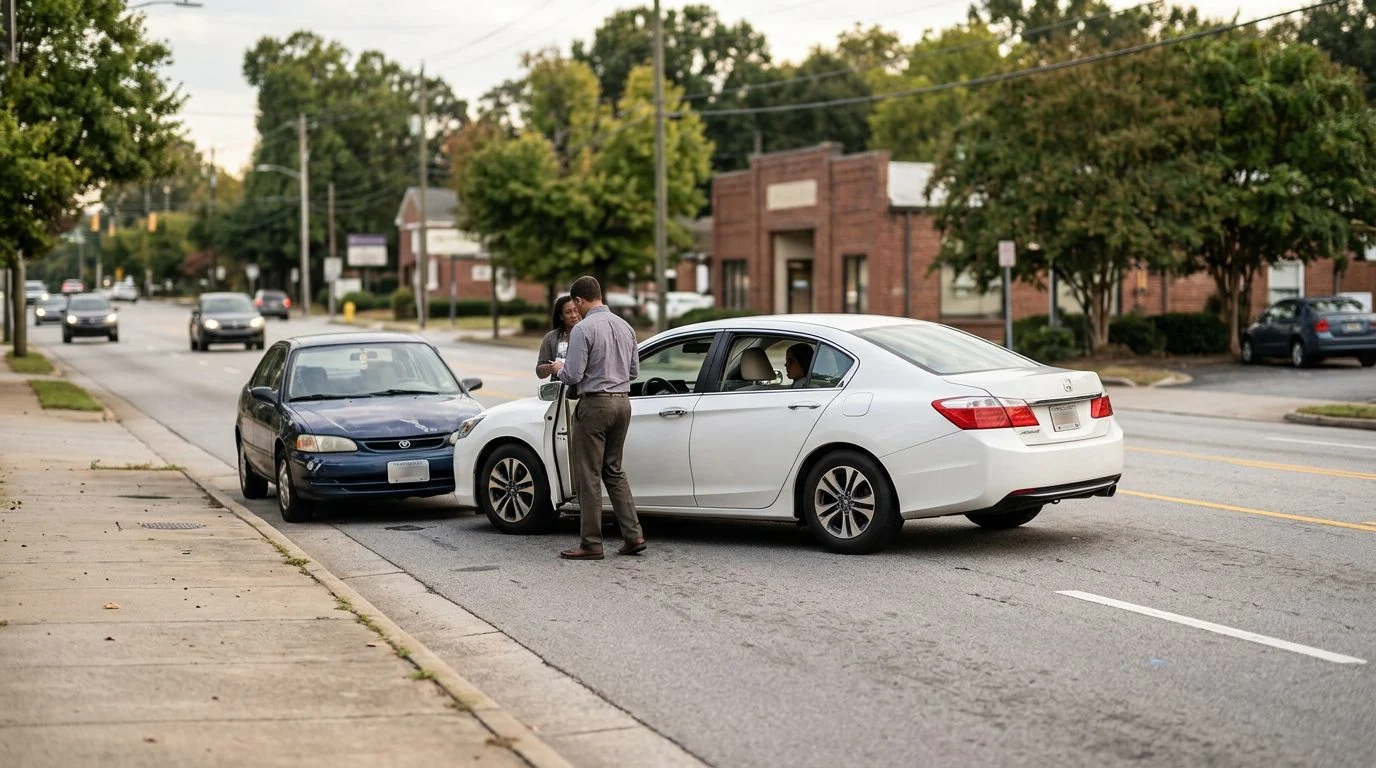
Rideshare Crashes in Georgia
Hurt in an Uber Crash? Find Out Who May Be Responsible
Rideshare claims can involve the driver, the company and other drivers. Learn which questions matter first and how the evidence is pieced together.
T. Madden & Associates, P.C.
1999
Year the firm began practicing law
Georgia
Offices in Jonesboro, Atlanta, Decatur, Macon and Augusta
Free
First consultation, confidential and without obligation
By Terance Madden · Published November 21, 2026
Your loved one was hurt, and now someone in your family is juggling the bills, the insurance calls and the Uber app. You want one straight answer: who is responsible?
The short answer: the Uber driver, the rideshare company, another driver, or a third party such as a repair shop or a parts maker can each be responsible. What decides it is what caused the crash and what the driver was doing on the app when it happened.
Who can be responsible after an Uber crash?
Legal responsibility for harm someone caused is called liability. Several parties can share it, and more than one can be at fault in the same crash.
The driver is the first place to look. A driver who runs a light, speeds, or looks at a phone has failed to use ordinary care. Georgia treats that failure as ordinary negligence, meaning the absence of the care a prudent person would use in the same situation.
Other parties come next. So can a shop that got a brake repair wrong, or a company that made a defective tire. Each one may carry its own insurance. The facts of the crash decide who is in the picture, and the records prove it.
Think of it as a checklist, not a guess. Ask who was driving, who owned the car, who was logged on to the app, and what failed. Those four answers point you toward the right claim. Write them down while the details are fresh.
If your loved one was hurt in an Uber crash, you don't have to sort out who is responsible alone. We can walk through what the records show. Talk it through with our team — the first consultation is free, confidential, and carries no obligation.
Is Uber liable for its drivers?
The company can be held responsible in some cases, but Georgia law sets specific limits on when that happens.
Start with the question of employment. In Quynn v. Hulsey, 310 Ga. 473 (2020), the court explained that “claims for negligent hiring, training, supervision, and retention are based on the alleged negligent acts of the employer.” Whether a driver was working for the company at the moment of the crash turns on the facts and the app records.
O.C.G.A. § 51-2-2 makes every person liable for torts committed by his wife, his child, or his servant by his command or in the prosecution and within the scope of his business. The separate rideshare statute, O.C.G.A. § 40-1-193, sets rules for network companies, including driver registration, driver lists, background checks, a zero-tolerance policy, insurance and digital identification.
The company may also face its own claim. Under O.C.G.A. § 34-7-20, an employer must use ordinary care in choosing employees and must not keep them after learning of their incompetency. In Quynn v. Hulsey, 310 Ga. 473 (2020), the court tied these claims to the employer’s own alleged negligent acts. Ask early whether the company picked, trained or kept the driver.
Which insurance applies when an Uber driver causes a crash?
The driver’s app status at the time of the crash helps decide which insurance policies come into play.
Georgia requires a rideshare company to keep insurance in effect for each contracted driver, covering personal injury and property damage liability in the amounts the law requires. Under O.C.G.A. § 40-1-193, that coverage is a legal duty of the company, not a courtesy.
The driver’s own auto policy can also apply, and it may not cover the driver while logged on to the network. Under O.C.G.A. § 33-1-24, Georgia insurers may exclude coverage under the owner’s policy for losses that happen while a driver is logged on. If the driver’s required coverage has lapsed, the network’s coverage becomes primary from the first dollar of a claim.
Every layer matters. Look for the driver’s liability coverage, the rideshare company’s coverage for the trip period, and uninsured and underinsured motorist coverage (UM/UIM). UM/UIM pays when the other driver has too little insurance or none at all. Georgia’s uninsured motorist statute, O.C.G.A. § 33-7-11, sets out the endorsement that motor vehicle liability policies must carry, with limits the insured may choose. Check for any umbrella or excess policy (extra coverage above the primary limits) and any corporate coverage that applies; the required uninsured motorist coverage excludes umbrella or excess liability policies unless affirmatively provided for in such policies or in a policy endorsement. The firm pursues every layer that applies, because an injured passenger, pedestrian or other driver may be able to reach more than one policy.
When another driver or a third party is at fault
Sometimes the at-fault party is another motorist, a vendor or a manufacturer, not the app driver.
Some crashes involve a second driver who ran a red light, changed lanes without looking, or was impaired. Hit by an impaired driver? You may have a claim against that driver.
Brakes, tires, cargo, maintenance and defective parts can make a repair shop or a maker a liable party. That can add another source of insurance.
Technical records often decide these questions. App trip logs, GPS and timestamp data, phone records, vehicle event data and repair records can show speed, timing and whether the driver was logged on. Each record answers a different question, so each one has to be preserved early.
Before law school, Terance Madden trained as an electrical engineer, so he starts a case by asking what the evidence shows and how the crash happened. He starts with what the data shows and how the crash happened. Then he asks which records exist and which ones must be preserved before they are lost. That’s how he reads a timestamp or a vehicle log in a case like this.
What if more than one party is at fault?
Georgia cuts your recovery by your own share of fault, and it bars recovery if you are 50 percent or more at fault (O.C.G.A. § 51-12-33; Quynn v. Hulsey (2020)).
That idea is called comparative fault (a rule that splits blame among everyone involved) (O.C.G.A. § 51-12-33; Quynn v. Hulsey (2020)). Under O.C.G.A. § 51-12-33, the judge reduces an award in proportion to the injured person’s fault.
Each liable party owes only its own share. Under the same statute, each person’s apportioned damages are that person’s own liability, not joint liability, and are not subject to contribution. A defendant can also name a nonparty as at fault by giving notice no later than 120 days before trial.
How a jury would split fault depends on the facts, and nobody can promise a split. That’s why every party and every policy should be identified early.
How Big Insurance handles Uber crash claims
Big Insurance is not on the injured person’s side, and its first offer is rarely what a claim is worth. The firm starts by looking for the tactics that can delay or lower a claim.
Expect an early, low offer made before the family knows the full extent of the injuries. Expect a request for a recorded statement, sometimes before anyone understands the injuries. Expect delays while the app status and trip records are disputed. Expect challenges to the treatment, and “low impact” arguments that treat a hard crash as a minor one.
A “low impact” argument often leans on speed alone. Crash physics looks at the change in speed during impact, which engineers call delta-V, and at how the body was loaded. Terance Madden’s engineering training helps him check those numbers.
The response is to pursue every coverage layer, value the full lifetime cost of the injury, including future care and lost earning power, and prepare the case as if it will go to trial. Think before you give a recorded statement.
Not sure what your next step is?
Talk it through with our team — the first consultation is free, confidential, and carries no obligation.
Time limits, evidence and what happens next
Georgia generally gives you two years to file a lawsuit for injuries to the person, under O.C.G.A. § 9-3-33; injuries to the reputation must be brought within one year, and actions for injuries to the person involving loss of consortium within four years. The statute opens with “except as otherwise provided,” so other rules can change the timing in some cases.
Start a folder now. Save photos, the app receipt and trip details, witness names, medical records and bills, repair records, and the names of any other driver or vendor involved. Keep a simple log of every call and letter, with dates and names.
Evidence fades. Crash data gets overwritten, video gets deleted and cars get repaired. Acting early keeps your options open.
A settlement timeline depends on the injuries, the coverage and whether the claim must go to court. No one can promise a date.
The first consultation is free, confidential, and carries no obligation to continue. The firm works on a no-fee-unless-we-win basis, but you may still be responsible for court costs and case expenses.
If your loved one was hurt in a rideshare crash
If you’re the one making the calls, you’re carrying a lot. Start with the decisions in front of you: whether to speak with an insurer, whether to keep the app and trip records, and whether to talk with a lawyer before giving any recorded statement.
A spouse, parent or adult child often ends up handling appointments, bills and insurance calls while the injured person heals. That’s a heavy load, and these decisions are easy to rush.
Under CMS Medicare secondary payer guidance, liability insurance pays first for crash-related care when the injured person has Medicare.
Attorney Terance Madden has been in practice since 1999, and T. Madden & Associates, P.C. has offices in Jonesboro, Atlanta, Decatur, Macon and Augusta. The firm’s focus here is the legal help it provides.
If you’re holding the records and wondering what comes next, request a case evaluation with the firm.
Frequently Asked Questions
Who is responsible when an Uber driver causes a crash?
The driver who caused the crash can be held liable, and so can others whose negligence contributed to it. Georgia looks at fault, so the question is who acted carelessly, and the answer depends on the facts of each crash.
Does Uber’s insurance pay for a crash involving an Uber driver?
Rideshare companies carry commercial insurance, but how much applies depends on the driver’s app status. Coverage can differ when the driver was logged off, waiting for a ride request, on the way to a pickup, or carrying a passenger.
Can I bring a claim against the driver, the rideshare company, or both?
In many cases, injured people can pursue more than one party, including the driver and the company. The firm can review the app records, the driver’s status at the time, and the available insurance to decide who to pursue.
What if another driver caused the crash with an Uber?
You may still have a claim against the at-fault driver, and that driver’s insurance may apply. Hurt in an Uber crash that was someone else’s fault? The firm offers a free, confidential first consultation with no obligation to continue.