

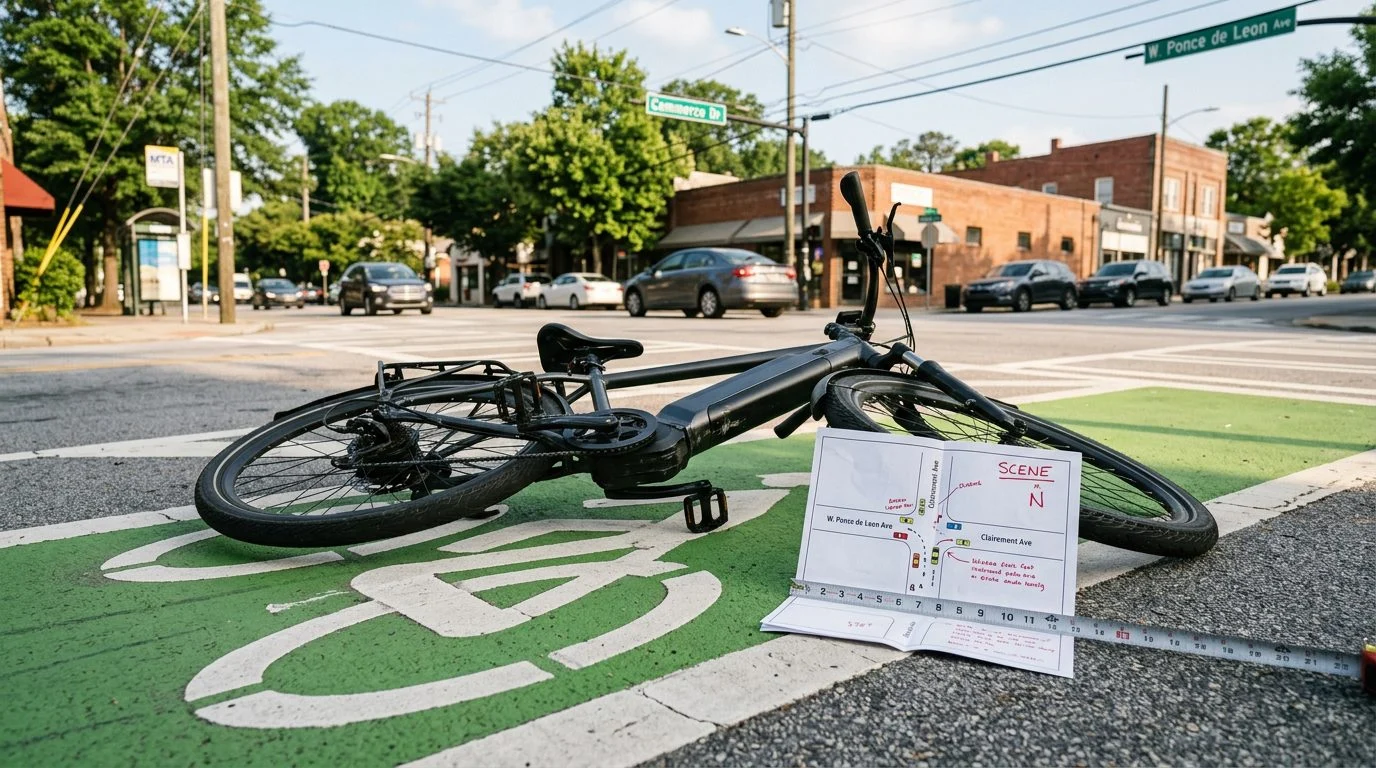
E-bike crash lawyer · Georgia
A Slow E-Bike Crash Can Still Cause Serious Injuries
The first offer often arrives before the full picture of your injuries is clear. Here is how to protect your claim from the start.
T. Madden & Associates, P.C.
1999
Year the firm began practicing law
5
Georgia offices: Jonesboro, Atlanta, Decatur, Macon and Augusta
By Terance Madden · Published November 21, 2026
The insurance company says your e-bike crash was minor because it happened at low speed. That is the first thing to question.
A crash at low speed can still break bones, injure the head and leave soft-tissue damage that hurts for months. The “minor” label is a negotiating position, not a medical finding. Georgia’s damage rules look at the injury you actually have, not the speed on the dashboard.
A Slow Crash Can Still Break Bones. Here Is Why Insurers Say Otherwise
A low-speed crash can cause real injury, and Big Insurance often says otherwise before the medical records are in. The standard move is what the industry calls the “low impact” argument. The adjuster points to a small dent, a bent wheel or no visible damage, then says the rider could not have been hurt badly.
Timing is the point. A claim looks smaller on paper before anyone has read the scans, the surgeon’s notes or the therapy plan. A bike can look fine while the rider’s wrist, ribs or skull take the real hit.
Only medical records can say what the injury is, and those records take weeks or months to build. For the full picture on e-bike crash claims, from fault to filing, read our complete guide to e-bike crash claims.
Hurt in a slow crash that someone else caused, with the insurer calling it minor? Our team can talk through your options in a free, confidential consultation. Talk it through with our team — the first consultation is free, confidential, and carries no obligation.
The Tactics Big Insurance Uses on a “Minor” E-Bike Claim
Big Insurance uses a set of tactics to shrink a slow-crash claim. Its first offer is rarely what the claim is worth. An insurance company is not on the injured rider’s side. Its job is to pay as little as it can.
Watch for these moves:
- A quick low offer. It often arrives before the medical picture is clear.
- An early recorded statement. A recorded statement is an interview the insurer tapes. Loose words about how you felt or what you were doing can be used later to argue fault or shrink your injury.
- Delays. Slow decisions and slow payments pressure a family that is already paying bills.
- Disputes over treatment. The insurer argues the care was not needed, or lasted too long.
The response starts with restraint. Don’t give a recorded statement, and don’t sign a release, until a lawyer has reviewed it. A release closes the claim for good. The firm pursues every coverage layer that may apply and builds the full cost of the injury, including future care, into the claim.
What Delta-V Means in Plain Words
Delta-V is the sudden change in speed the body feels during an impact. It often matters more than how fast the bike looked. A bike and rider can stop or change speed hard even when the bike seems to be moving slowly.
So a low crash speed does not always mean low force on the body. A rider thrown forward, or onto the pavement, can take a hard hit in a split second.
Terance Madden trained as an electrical engineer and holds a B.S. in Electrical Engineering before he went to law school. He approaches a crash the way he would approach a failed system. What did the evidence show, how did the event unfold, and which records exist and must be kept? That habit helps him read the physics of a fall. It keeps the focus on the body and the medical records, where the real injury shows up.
What the Evidence Shows in a Slow E-Bike Crash
The evidence that matters in a slow crash shows how the bike hit, how the rider landed and what the force did to the body. Start collecting it early, because some of it disappears fast.
Key pieces include:
- Photos of the scene, the bike, and the rider’s helmet and clothing.
- Damage to the frame, wheel, handlebars, pedals and battery housing.
- Names and statements of witnesses.
- The police report.
- Video from nearby businesses or traffic cameras, which is often recorded over quickly.
Each item tells part of the story. A cracked helmet points to a head strike. Scrapes on the road show where the rider landed. An engineer reads these marks as data: which part took the load, which way the bike moved and where the body went next. The firm starts a case by asking what the evidence shows and how the crash happened, then builds the case around that answer.
Other parties may be liable too. A battery, charger, brake or wheel part can fail. Where the facts point to a defect, the maker or seller may be another source of insurance. For battery problems, see our guide on proving a burned e-bike battery defect.
Which Insurance Layers May Pay, and How Georgia’s Fault Rule Works
Several insurance layers may pay a slow-crash claim. Which one applies depends on the facts.
- The at-fault driver’s liability coverage. This is the other driver’s policy, if a driver caused the crash.
- UIM pays when that driver’s limits are too low. Georgia’s O.C.G.A. § 33-7-11 requires auto policies to include this protection, at the insured’s option, within set limits.
- An umbrella policy. This is extra liability coverage that sits above a home or auto policy’s limits.
- An excess policy. This coverage sits above a primary policy and pays once that policy’s limit runs out.
- Corporate or employer coverage. This may apply where a business or employer shares responsibility.
Georgia uses a comparative fault rule (shared fault). Under O.C.G.A. § 51-12-33, the judge reduces damages by the injured person’s percentage of fault. If that share is 50 percent or more, the injured person cannot receive any damages.
Expect Big Insurance to argue the rider shared the blame. The record of who had the right of way matters here.
Steps to Take Now, and the Person Managing the Recovery
The first steps are medical care, a paper trail and keeping the bike as it is. Take them in this order.
- Get medical care right away, and follow every referral.
- Keep every bill, receipt and pharmacy slip.
- Photograph the bike, the scene and your injuries as they change.
- Leave the bike and battery as they are. Don’t repair, sell or throw them away yet.
- Hold off on recorded statements until you have talked to a lawyer.
If you are the spouse, mother or adult daughter managing a loved one’s recovery, you are often the one on the phone with the insurer. Start a simple log. Write down appointments, symptoms, pain levels, missed work, chores that can’t get done, and every insurer call, with the date and what was said. The log shows how the crash changed daily life. That is what the “minor” label leaves out.
Who pays medical bills is a separate question. Medicare may later recover payments the primary payer should have made, per Medicare.gov. Our guide on who pays hospital bills after an e-bike crash walks through it.
Not sure what your next step is?
Talk it through with our team — the first consultation is free, confidential, and carries no obligation.
What Drives the Value of a Slow-Crash Claim
No honest number can be named until the treatment and the evidence are in. A first offer is not that number.
Value depends on the injury, how long treatment runs, lost income, future care, the coverage layers that apply and the fault picture. Under O.C.G.A. § 51-12-1.1, medical damages are limited to the reasonable value of medically necessary care. The trier of fact, the jury or judge deciding the case, sets that amount. Future economic losses may be reduced to present value under O.C.G.A. § 51-12-13, using a 5 percent rate or another rate the trier of fact deems appropriate.
The firm prepares each claim as if it may go to trial. It builds the record from day one.
The initial consultation is free, confidential and comes with no obligation to continue. The firm works on a no-fee-unless-we-win basis, but you may still be responsible for court costs and case expenses.
T. Madden & Associates, P.C. has practiced since 1999, with offices in Jonesboro, Atlanta, Decatur, Macon and Augusta. Terance Madden is the responsible lawyer for this page. The Terance Madden Foundation supports community work.
Can I still recover if I was partly at fault?
Yes, unless your share of fault is 50 percent or more. Georgia reduces your damages by your percentage of fault under O.C.G.A. § 51-12-33.
How long do I have to file?
Georgia generally requires an injury lawsuit within two years after the right of action accrues, under O.C.G.A. § 9-3-33.
Should I talk to the insurer before a lawyer?
Hold off on recorded statements and signed releases until a lawyer has reviewed them. Hurt in a slow crash that someone else caused? Start a free case evaluation and let the firm review what the insurer has sent you.