

Truck Accident Lawyer · Jonesboro, Clayton County
Hurt in a Truck Crash in Jonesboro? Start With These 72 Hours
Practical steps to protect your health and your claim, from T. Madden & Associates, P.C., a Georgia personal injury firm practicing since 1999.
T. Madden & Associates, P.C.
1999
Year the firm began practice
5
Offices, including Jonesboro
24/7
Phone line available
By Terance Madden · Published October 27, 2026
What to do after a truck crash in Jonesboro comes down to three things: get safe, get medical care, and protect the proof. Those steps matter most in the first 72 hours, when details are fresh and records are easier to reach. This checklist walks through that window in order. It is general information, not legal advice. It is written for injured drivers, passengers, and family members acting for someone who was hurt.
Why the First 72 Hours Matter After a Truck Crash
The first 72 hours matter because some proof about a truck crash can change or disappear quickly. A commercial truck is run by a carrier. The carrier keeps driver logs, maintenance files and dispatch records. Federal rules set time limits for some of this, including federal post-accident testing rules that require employers to test drivers for alcohol and drugs after certain crashes. Those rules also say when testing must end, which is one reason early steps count.
Truck crashes bring more paperwork than most car crashes. You may deal with the driver, the trucking company, and more than one insurance company. Each one may ask you for a statement. Each one has its own interests.
This page follows the order most people need: safety first, then police, information, evidence, medical care, and insurance. If you want the wider picture of how these cases work, read our truck accident lawyer guide for Georgia. This checklist does not replace advice about your own case.
If a truck crash has left you hurt and unsure what comes next, reach out for a free consultation, so you don't have to face it alone. Talk it through with our team — the first consultation is free, confidential, and carries no obligation.

Get to Safety and Check for Injuries
Get out of traffic first, then check for injuries. If your vehicle can move safely, pull it onto the shoulder and turn on your hazard lights. If it cannot move, stay in a safe spot away from the lanes.
Next, check yourself and everyone in your vehicle. Say clearly where it hurts. Pain, dizziness, numbness, headache and trouble breathing all matter. Tell the paramedics and the doctor about each one. Do not say you are fine just because you feel shaken.
Call 911 if anyone is hurt. Ask for an ambulance even when the injury seems small. A medical record made on the day of the crash helps connect your injuries to the wreck.
Some injuries do not show clear signs right away. Get checked the same day when you can. Keep every follow-up visit, even if you start to feel better.
Call the Police and Ask for a Report
Call 911 and ask for police to come to the scene. The officer writes a crash report that records the parties, the vehicles, the location and any citations. That report is one of the first documents an insurer or a lawyer will ask for.
Before the officer leaves, get the officer’s name, badge or unit number, and the report or incident number. Ask where the report will be filed. If the other driver left the scene, tell the officer right away.
Once the report is available, request a copy and keep a record of your request. Our guide on how to look up an accident report in Georgia walks through the request steps.
Collect Information from the Truck Driver and Company
Write down the truck driver’s full name, phone number and driver’s license number. Ask for the insurance company and policy number too. If the driver allows it, photograph the insurance card.
Look closely at the truck. Note the company name on the cab or doors, the USDOT number, the trailer number, and the license plate. These details help you match the truck to its company later.
The driver also keeps a record of duty status. Federal logging rules require the driver’s log to show the city, town or village, and State, for each change in duty status. The rules also require the carrier’s name to appear on the record. You do not need to read the log at the scene. You only need to know it exists, so the company can be asked for it.
Write your own notes about the time, date, weather, road conditions and direction of travel. Keep the notes factual. Avoid guessing about speed or distance, and avoid writing who was at fault.
Gather Evidence at the Scene
Take photos before anything is moved, if it is safe. Shoot the truck’s position, the damage to both vehicles, skid marks, lane lines, traffic signals and the road surface. Take wide shots and close-up shots from several sides.
Photograph your injuries too. Take pictures of cuts, bruises, bandages and any braces you need. Images taken on the day of the crash show what you looked like at the start.
Ask witnesses for their names and phone numbers. Other drivers, passengers and people working nearby may have seen the lights or the lane change. A witness who gives a name now is easier to reach later.
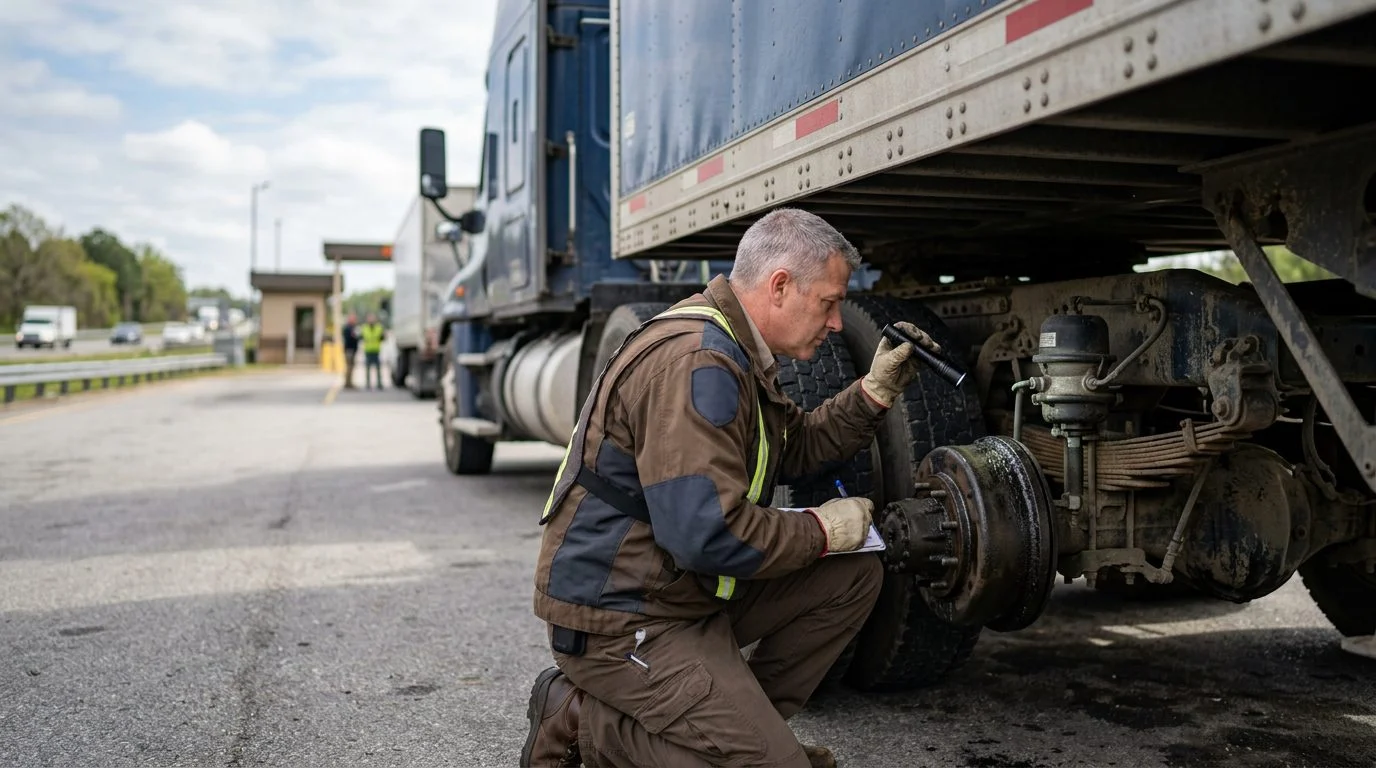
Keep the evidence after you leave the scene. Save your phone photos, the police report and every letter from an insurer. Records from the carrier matter too. Under federal maintenance rules, a motor carrier must keep inspection, repair and maintenance records for each truck for one year where the truck is housed. It must keep them for six months after the truck leaves its control.
Avoid Admitting Fault and Be Careful With Insurance Calls
Do not admit fault at the scene, even as a reflex. Saying “I’m sorry” can later be heard as a statement of blame, even when you only meant you felt bad. Stick to facts: where you were, what you saw and where you hurt.
Report the crash to your own insurer. Give the date, the place and the people involved. Keep the call short and factual.
Think before you give a recorded statement to the truck company’s insurer. Ask what the statement is for. Do not sign a release or settlement paper until you understand what it gives up. A release can limit what you can claim later.
Georgia’s motor carrier provisions also limit when an insurer can be added to a lawsuit arising under those provisions. Under Georgia’s motor carrier insurance rule, an insurance carrier may be joined only in specific situations. An insurance claim is therefore a separate step from a lawsuit.
Not sure what your next step is?
Talk it through with our team — the first consultation is free, confidential, and carries no obligation.
Get Medical Care and Keep Records
See a medical provider as soon as you can, and describe every symptom, even the small ones. Medical records create a dated link between the crash and your injuries. Write down what you told the provider.
Keep copies of discharge papers, imaging results, prescriptions, bills and follow-up notes. Keep a simple daily log of pain, sleep, missed work, rides you needed and tasks you could not do. A log written close to the events is easier to rely on than memory later.
Special damages are actual losses, such as medical bills and lost wages. They must be proved, and your bills and records are how that proof is built.
Why Truck Crashes Can Involve More Than One Responsible Party
A truck crash can involve more than one responsible party. Depending on the facts, the trucking company, a maintenance provider, a cargo loader or another driver may share blame. Georgia law makes an employer answerable for certain work-related conduct. That is one reason the trucking company can be part of a claim.
Fault is also divided. Under Georgia’s apportionment rule, the trier of fact considers the fault of all persons who contributed to the alleged injury or damages, whether or not they were named in the suit, but a nonparty’s fault is considered only if the plaintiff settled with that nonparty or if a defending party gives notice not later than 120 days before trial that the nonparty was wholly or partially at fault. Damages are then divided among those found liable. Each person owes only their own share, not a joint amount.
Georgia also has a 50 percent bar. A plaintiff who is 50 percent or more responsible for the injury or damages claimed recovers nothing (O.C.G.A. § 51-12-33(g)). Under O.C.G.A. § 51-12-33, when a plaintiff is to some degree responsible for the injury or damages claimed, the judge reduces the damages otherwise awarded in proportion to the plaintiff’s percentage of fault, and a plaintiff who is 50 percent or more responsible is not entitled to receive any damages.
Maintenance is a common issue. Our guide on suing a truck maintenance company after a crash in Georgia explains how those records can matter. For how fault gets weighed, see what counts as an at-fault accident. How long a claim takes to settle depends on the facts.

Talk With a Jonesboro Truck Accident Lawyer About Your Next Steps
A free consultation with T. Madden & Associates, P.C. can help when injuries, bills and insurance calls all arrive at once. If you are reading this after a crash, you may be hurt, missing work and fielding calls from insurers. You do not need every answer before you talk with us.
T. Madden & Associates, P.C. is a Georgia personal injury firm led by attorney Terance Madden. The firm has practiced since 1999 and has offices in Jonesboro (Clayton County), Atlanta, Decatur, Macon and Augusta. The firm represents people hurt in car and truck wrecks, along with motorcycle and e-bike crashes, slip and falls, and other injury cases.
The firm offers a free first consultation, which is confidential and carries no obligation to continue. The firm handles cases on a no-fee-unless-we-win basis, but the client may still be responsible for court costs and case expenses.
When you are ready to talk about your situation, contact T. Madden & Associates through the firm’s contact page.
Frequently Asked Questions
What is the first thing to do after a truck crash in Jonesboro?
Get out of traffic, check for injuries, and call 911. Those steps come before anything else.
Does Georgia reduce damages for the injured person’s fault?
Yes. Under Georgia’s fault rule, the judge reduces a plaintiff’s damages in proportion to the plaintiff’s percentage of fault, and a plaintiff who is 50 percent or more responsible for the injury or damages claimed is not entitled to receive any damages.
Under O.C.G.A. § 40-1-112, for a claim arising under Georgia’s motor carrier provisions, it is permissible to join the motor carrier and its insurance carrier in the same action only when one or more motor carriers related to the cause of action are insolvent or bankrupt, or when personal service cannot after reasonable diligence be effected against the driver or the motor carrier.
Should I give a recorded statement?
Ask what it is for first. Do not sign a release you do not understand.
Responsible lawyer:
Terance Madden, T. Madden & Associates, P.C. Contact: tmaddenlaw.com/contact. This page is general information, not legal advice, and it does not create an attorney-client relationship.
Your First 72 Hours at a Glance
Get to safety and call 911
Move out of traffic if you can, check yourself and others for injuries, and call 911. Medical needs and safety come first.
Get medical care and keep every record
See a doctor even if you feel only sore. Save discharge papers, bills, prescriptions, and appointment notes in one place.
Document the scene while it is fresh
Photograph vehicles, road conditions, skid marks, and visible injuries. Write down the truck's company name, unit number, and driver details if you can.
Talk to a lawyer before speaking with insurers
Insurance adjusters may call quickly. Speak with our team before giving any recorded statement or signing anything.
How We Help Clients After a Truck Crash
A free first consultation
Our first consultation is free, confidential, and comes with no obligation to continue.
Organized evidence
We help gather crash reports, medical records, photos, and witness information for your case.
Fees only if there is a recovery
You pay no attorney fees unless there is a recovery. You may still be responsible for court costs and case expenses, which we will explain before you decide.
Attention to your recovery
We focus on your injuries, your medical care, and the impact on your family while your case moves forward.
Avoid These Mistakes
Do not post about the crash on social media, do not admit fault at the scene, and do not sign medical or insurance releases you have not reviewed. These moves can affect your claim.