

Jonesboro, Atlanta, Decatur, Macon and Augusta
Hurt in a Semi Truck Crash? Talk to a Georgia Truck Lawyer Today
Jackknife crashes happen in seconds, but the claim can take months of careful work. The firm can take that load off your shoulders while you focus on getting better.
Why Georgians hurt in truck crashes call the firm
1999
Year the firm began practice
5
Georgia offices, including Jonesboro and Atlanta
24/7
Call us any time, day or night
By Terance Madden · Published November 6, 2026
Many people reading about a jackknife or rollover are recovering from one, or helping a family member who is. This page explains how these semi truck crashes happen, who may be responsible, what evidence shows fault, and how a claim moves forward in Georgia. The short answer: a jackknife or rollover can support an injury claim when another party’s negligence (carelessness that causes harm) contributed to the crash. T. Madden & Associates, P.C. is a Georgia personal injury law firm, in practice since 1999. This page explains how a jackknife semi truck accident lawyer approaches these cases.
What a jackknife or rollover semi truck crash is
A jackknife is a crash where the trailer swings out of line with the cab. A rollover is a crash where the truck tips onto its side or roof.
A jackknife often starts with sudden or hard braking, or a loss of traction on wet or icy pavement. The trailer can swing across lanes, hit other vehicles, or block traffic. Rollovers often happen on curves and ramps, or when a load shifts and pulls the truck off balance.
In Georgia, these crashes happen on interstates, state routes, in wet or icy weather, and in work zones where lanes narrow. The people hurt include truck drivers, passengers, people in cars, motorcyclists, and pedestrians.
If a jackknife or rollover left you or someone you love hurt, our team can talk with you about what happened and what it may mean for a claim. Talk it through with our team — the first consultation is free, confidential, and carries no obligation.
Is a jackknife crash an accident, and who can be held responsible?
Yes, a jackknife is a type of crash. Whether someone is legally responsible depends on how the crash happened and what caused it.
Possible parties include:
- The truck driver, if careless driving caused the crash.
- The trucking company that operated the truck, which can be named along with the driver.
- The owner-operator, if the driver leased the truck.
- Anyone whose work on the truck, its cargo, or its equipment contributed to the crash.
Georgia law requires the jury or judge to consider the fault of everyone who contributed to the injury. That includes people who were never named in the lawsuit. O.C.G.A. § 51-12-33 Each defendant pays only its own share of fault. The statute says those damages are not joint liability and are not subject to contribution.
Georgia also reduces your recovery by your own share of fault. If you are 50 percent or more responsible, you cannot recover any damages. O.C.G.A. § 51-12-33
What causes jackknife and rollover crashes?
Most of these crashes trace back to speed, braking, loading, equipment, or driver fatigue. Each of those leaves records that can be checked later.
- Speed for conditions. Federal rules bar a carrier from scheduling a run that would require driving faster than the posted limits. 49 CFR 392.6
- Sudden braking or following too closely. These moves can start a jackknife.
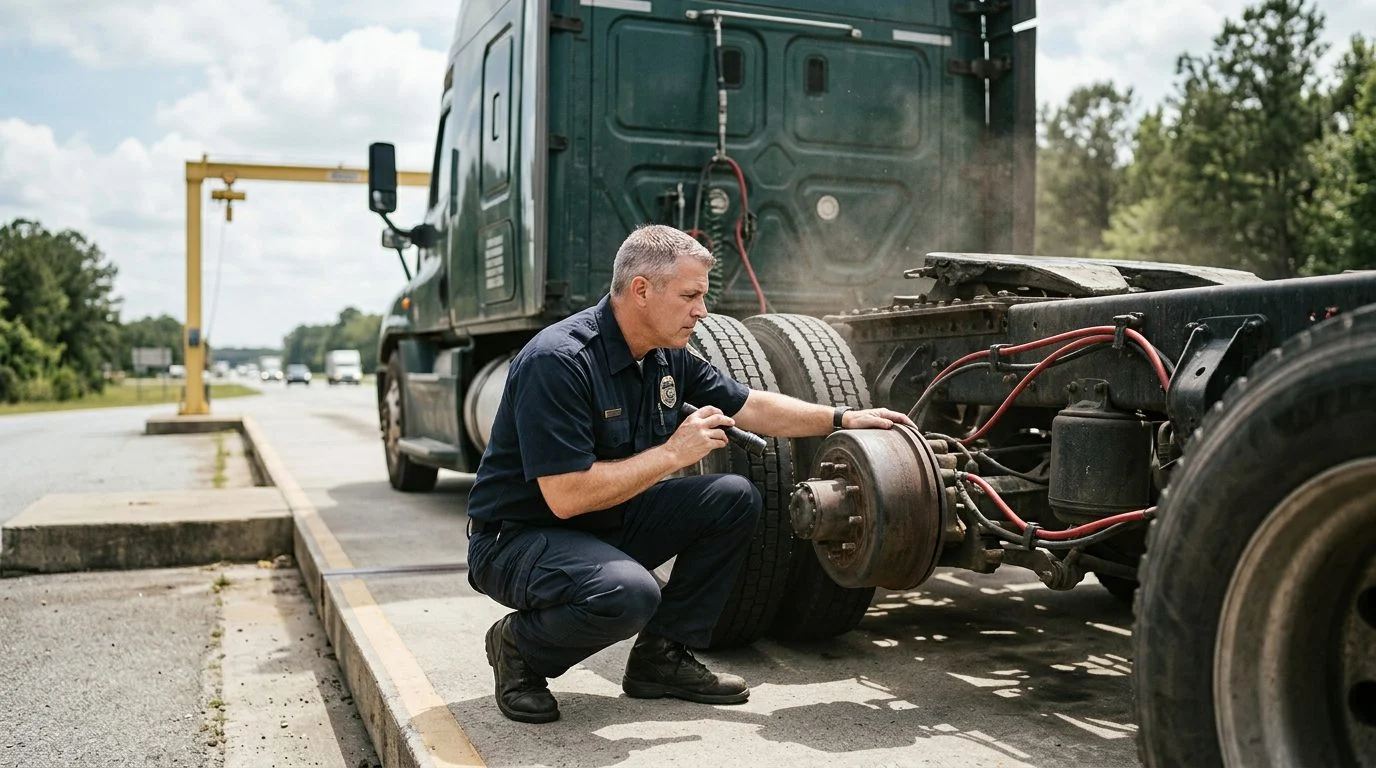
- Brake or tire defects. Poor maintenance can leave a truck unable to stop or steer in a controlled way.
- Unsecured cargo. Federal rules require cargo to be contained, immobilized, or secured so it does not shift and affect the truck’s stability. 49 CFR 393.100
- 49 CFR 395.3
- Distraction, impairment, or weak training. These can lead a driver to brake or steer in ways that start a crash.
What evidence shows what went wrong?
The truck’s records, the crash scene, and the police report are the core evidence. Early requests matter, because records can be lost or overwritten if no one asks to keep them.
- Electronic logging device data. Federal rules bar false duty-status reports and tampering with the device. 49 CFR 395.8
- Scene evidence. Dashcam video, photos, skid marks, and where the trailer and cargo came to rest.
- Company files. Driver qualification and training records, maintenance and inspection records, and drug and alcohol testing records.
- Police and medical records. The crash report and witness statements show what happened. Medical records link injuries to the crash.
The Georgia Department of Public Safety says the Georgia State Patrol investigates fatal and major-injury crashes. Families can ask about the status of an investigation. Georgia Department of Public Safety The Georgia Department of Transportation’s crash reporting system covers crashes on public roads and how police crash reports are obtained.
What compensation may include?
A claim may cover medical bills, lost income, and other losses, along with pain and suffering. The value depends on the injuries, the insurance involved, and how strong the fault evidence is.
- Medical costs. Past and future bills, rehabilitation, and medical equipment.
- Lost income. Wages you missed, and any loss of future earning ability.
- Pain and suffering. Physical pain, emotional distress, and loss of enjoyment of life.
- Property damage. Your vehicle and personal items damaged in the crash.
- Catastrophic injuries. A spinal cord injury, traumatic brain injury, or amputation can need long-term care planning.
Medical expenses are limited to the reasonable value of medically necessary care. O.C.G.A. § 51-12-1.1 If you have health insurance, the court looks at both the amount billed and the amount the insurance contract requires for payment.
When a death results from criminal or other negligence, the personal representative may recover funeral, medical, and other necessary expenses. O.C.G.A. § 51-4-5
What are the Georgia deadlines, and how does the claim move forward?
Georgia generally requires an injury lawsuit to be brought within two years after the right of action accrues, except for injuries to the reputation, which must be brought within one year, and actions involving loss of consortium, which must be brought within four years. O.C.G.A. § 9-3-33 O.C.G.A. § 9-3-33
- Two years in general. The statute has exceptions, so early review of the timing is wise.
- Nonparty fault notice. A defendant can name a nonparty as at fault by giving notice at least 120 days before trial. O.C.G.A. § 51-12-33
- Typical sequence. An insurance claim and demand, then negotiation, then a lawsuit if needed. Next come discovery (exchanging evidence), possible mediation, and trial.
- Timing varies. Each stage can take a different amount of time, and the total length changes from case to case.
Not sure what your next step is?
Talk it through with our team — the first consultation is free, confidential, and carries no obligation.
How does T. Madden & Associates, P.C. handle jackknife semi truck accident claims?
Attorney Terance Madden is the responsible lawyer for these matters. Our team of support staff keeps each case organized and in contact with the client.
The firm has been in practice since 1999. It has offices in Jonesboro (Clayton County), Atlanta, Decatur, Macon, and Augusta.
- Free first consultation. It is confidential and carries no obligation to continue.
- Review of the facts. We look at how the crash happened, your injuries, and the insurance information.
- Preservation and investigation. We send written requests to keep evidence, and we look into the truck, the driver, and the carrier.
- Demand and suit. We present a demand to the insurers and file suit if a fair resolution is not reached.
The firm works on a no-fee-unless-we-win basis, but you may still be responsible for court costs and case expenses.
Calls can be made at any time, 24 hours a day, 7 days a week.
Questions people ask before calling a lawyer
Here are short answers to common questions about these crashes.
Is a jackknife considered an accident?
A jackknife is a type of crash. Whether someone is responsible depends on how it happened.
Can you sue a semi-truck driver for hitting you?
Yes, the driver can be named. The trucking company may be named too.
Can I file a claim against the trucking company, or only the driver?
Both can be named when their fault contributed to the crash.
How long do I have to file?
Georgia generally allows two years for an injury lawsuit, but the statute has exceptions. O.C.G.A. § 9-3-33
Can I recover compensation if I was partly at fault?
Yes, unless you are 50 percent or more responsible (O.C.G.A. § 51-12-33; Quynn v. Hulsey (2020)). Otherwise, your damages are reduced by your share of fault.
If a jackknife or rollover left you or someone you love hurt, you don’t have to sort out the crash alone. You can start a free case evaluation with T. Madden & Associates, P.C. at any hour.
This page is general information, not legal advice. The responsible attorney is Terance Madden, T. Madden & Associates, P.C., with offices in Jonesboro (Clayton County), Atlanta, Decatur, Macon, and Augusta.