

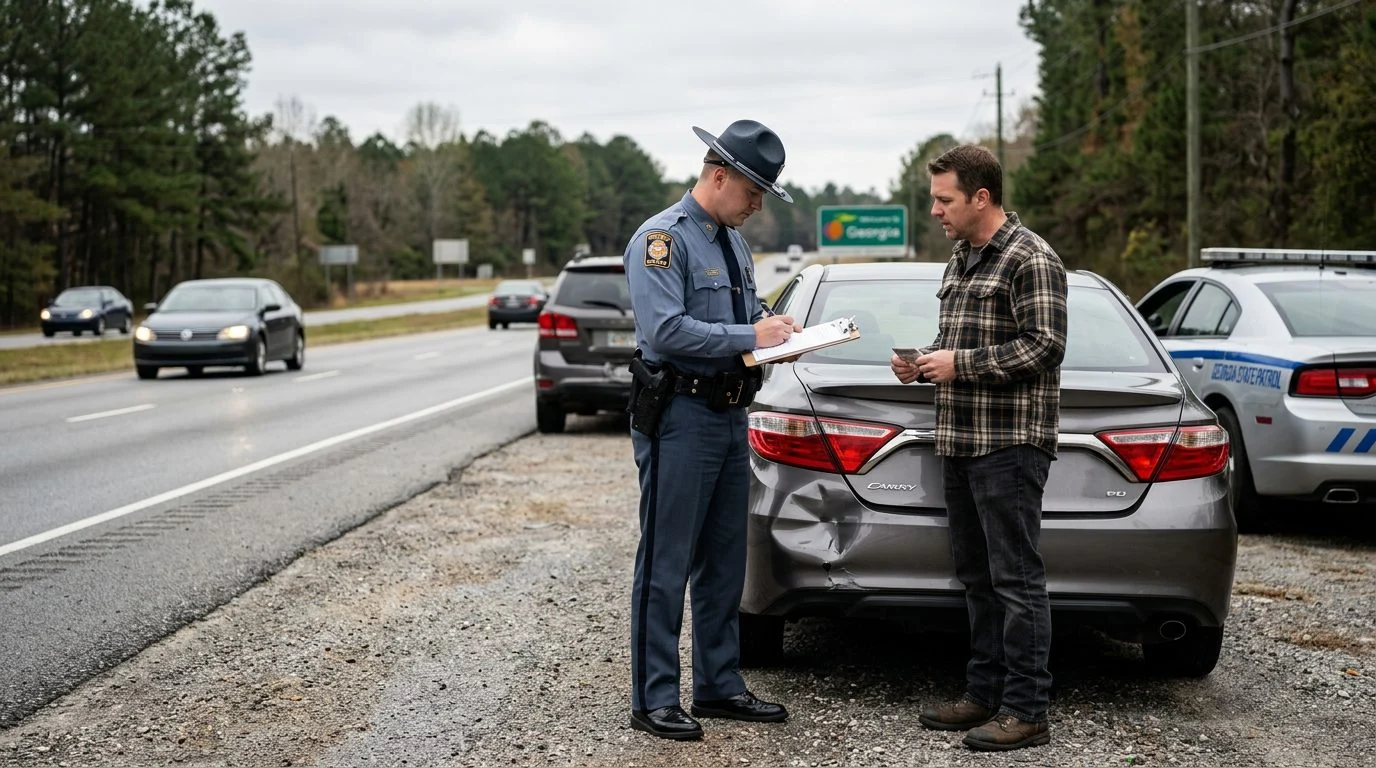
Georgia Accident Guidance | Jonesboro, Atlanta, Decatur, Macon & Augusta
Should You File a Police Report After an Accident in Georgia?
A clear guide from T. Madden & Associates, P.C., a Georgia personal injury firm in practice since 1999. Start with a free, confidential first consultation with no obligation to continue.
Why Georgians Call Our Office
1999
Serving Georgia injury clients since
5
Offices: Jonesboro, Atlanta, Decatur, Macon and Augusta
24/7
Call us any time
By Terance Madden · Published October 19, 2026
Should I file a police report after an accident? In Georgia, the answer depends on the crash, but filing is the safer choice. Each crash has its own facts, and the steps that matter after one can depend on those facts. A police report also gives you an official record of what happened. This guide explains what Georgia law asks of drivers, what a report records, and why it matters even more when a commercial truck is involved.
Reporting a Crash in Georgia
Duties after a crash depend on the circumstances of that crash.
Hit-and-run cases carry serious consequences. A police report also names everyone involved, which helps if the other driver takes off.
Some people don’t notice an injury until later. A report made at the scene puts the crash on record while the details are fresh.
If you were hurt in a crash and you're unsure what to do about the police report, you don't have to work through it alone. Our team is glad to talk through your situation with you. Talk it through with our team — the first consultation is free, confidential, and carries no obligation.
How Much Damage Do You Have to Report?
When you’re unsure about damage or injury, call police instead of guessing. Damage is hard to judge at the roadside, and trucks make it harder. A trailer, frame, or cargo problem may not show until later.
Damage that looks small can hide bigger problems underneath. A dented bumper may point to a bent frame or a strained suspension. You can’t see those problems from the curb.
If anyone says they’re hurt, call 911 and ask for an officer. A fender bender that seems minor can still lead to an injury claim. Your safest move is to let the officer document what they see.
What to Do First at the Scene of a Car Accident
First, check everyone for injuries. Call 911 if anyone is hurt or if the road is unsafe. Then move vehicles out of traffic when it’s safe to do so.
Next, gather the basics before details fade:
- Exchange names, insurance details, driver’s license numbers, and license plates with the other driver.
- Take photos of the vehicles, the road, any skid marks, and the surrounding area.
- Write down the time, the location, the weather, and the names of any witnesses.
- Be careful what you say about fault. Stick to facts you saw and heard.
Keep your notes and photos somewhere safe. You may need them when you talk with the officer, your insurer, or anyone else asking about the crash.
What a Police Report Records
A police report records what the officer sees and hears at the scene. It usually covers several key parts of the crash.
- An account of how the crash happened, as the officer records it.
- The drivers, passengers, and vehicle owners involved.
- Each vehicle’s make, model, plate, and visible damage.
- The location and time of the crash.
- Witness names and contact details, when witnesses are present.
Getting a copy takes a request. Read your copy closely when it arrives. Note anything that looks wrong so you can raise it.
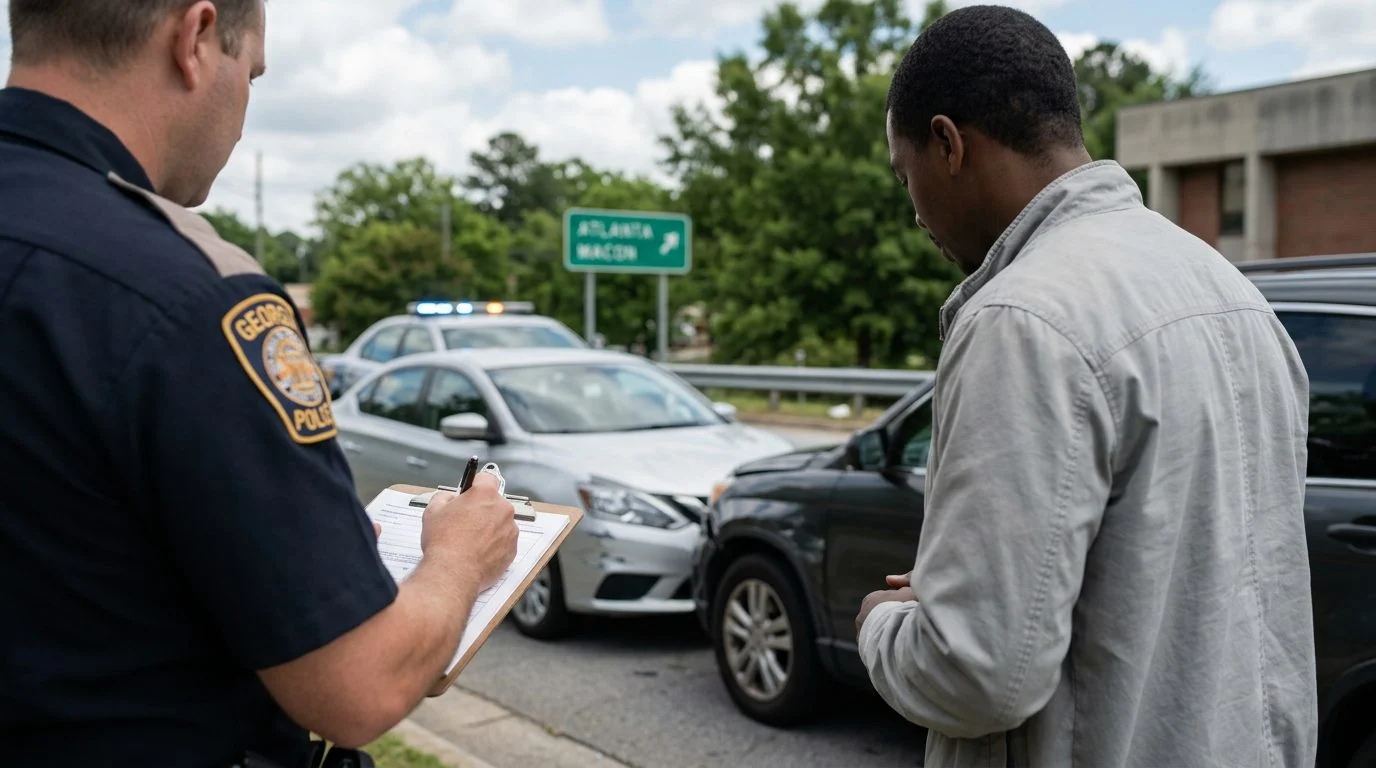
Does a Police Report Affect Insurance Claims?
A police report can support your insurance claim. It is a written record of what the officer documented, not a final ruling on fault.
Your own words also count. Under O.C.G.A. § 51-12-33, damages are reduced by the injured person’s percentage of fault (O.C.G.A. § 51-12-33; Quynn v. Hulsey, 310 Ga. 473 (2020)). A person who is 50 percent or more responsible for the injury may not receive any damages (O.C.G.A. § 51-12-33; Quynn v. Hulsey, 310 Ga. 473 (2020)). A casual guess about speed made at the scene can be quoted later.
Georgia generally gives two years to file a personal injury lawsuit, under O.C.G.A. § 9-3-33. Report the crash to your own insurer promptly, and include the report number once you have it.
Police Reports in a Truck Accident Case
In a truck crash, the police report is only a starting point. The trucking company keeps its own records, and those records often matter a great deal.
Federal rules set minimum record-keeping duties for motor carriers:
- Drivers record their duty status, and carriers keep those records and supporting documents for at least six months.
- Drivers complete a driver vehicle inspection report at the end of each day’s work on each vehicle, but are not required to prepare one if no defect or deficiency is discovered by or reported to the driver.
- Carriers keep a driver qualification file for as long as the driver is employed, and for three years afterward.
Drug and alcohol testing also has timing rules. After certain commercial vehicle crashes, an employer must test surviving drivers for alcohol as soon as practicable. Controlled substance tests have a 32-hour limit. The same rule says nothing requires delaying necessary medical attention.
Georgia law also requires accidents involving commercial motor vehicles to be reported to the state transportation commissioner, under O.C.G.A. § 40-1-8.
Punitive damages are a separate issue. Under O.C.G.A. § 51-12-5.1, they may be awarded only if proven by clear and convincing evidence of conduct such as willful misconduct or wantonness. Under O.C.G.A. § 51-12-5.1(g), in a tort action not provided for by subsection (e) or (f) where the jury or judge decides punitive damages should be awarded, the amount is limited to a maximum of $250,000.00.
Not sure what your next step is?
Talk it through with our team — the first consultation is free, confidential, and carries no obligation.
Talk With Terance Madden About Your Crash
If you’re deciding what to do after a crash, a short conversation can help you sort out your next steps. You may be dealing with this for yourself or for a family member, and you didn’t choose any of it. The report, the insurance calls, and the questions about what comes next can pile up fast.
Terance Madden, the attorney responsible for T. Madden & Associates, P.C., has been in practice since 1999. The firm has offices in Jonesboro, Atlanta, Decatur, Macon, and Augusta. It handles car, truck, motorcycle, and e-bike crash cases, along with other personal injury matters.
The first consultation is free, confidential, and carries no obligation to continue. The firm works on a no-fee-unless-we-win basis, but clients may still be responsible for court costs and case expenses.
Should I file a police report after an accident?
After a crash, notes about what happened and any police involvement can be useful information to share with a lawyer. Filing a report is the safer choice in most cases.
Does a police report affect insurance?
A police report gives insurers a written record of the scene. It does not decide fault on its own.
How do I get a copy of a Georgia crash report?
If the Georgia State Patrol investigated the crash, you can request the report through the Georgia Department of Public Safety; for crashes investigated by local police or sheriff’s offices, request the report from that agency. The request process is set out in the agency’s open records guidance.
How long do I have to sue after a crash?
Georgia generally allows two years to file a personal injury lawsuit (O.C.G.A. § 9-3-33). Ask about your deadline early.
If a crash has left you with questions about the report, your insurer, or your next steps, our team is ready to listen. You can start with a free case evaluation.
Disclaimer: This page is general information, not legal advice. Terance Madden is the responsible attorney for T. Madden & Associates, P.C. Contact the firm through its contact page.
How a Police Report Can Help
A written record of the scene
A report captures the date, time, location and conditions at the time of the crash, details that are easy to forget later.
Names and contact information
It can list the drivers, passengers and witnesses involved, which helps when insurers and attorneys need to follow up.
A starting point for insurers
Insurers review police reports as part of their file. A report does not decide fault on its own, but it adds an official account of what was documented.
Support for your lawyer's review
Sharing the report with a lawyer lets them compare it with your own notes, photos and medical records.
Key Reminder: Protect Your Health First
Get medical attention for any injury, even one that seems minor, and avoid debating fault at the scene. Tell the officer what you observed, keep your notes, and then talk with a lawyer about your options.
Steps to Take After a Crash
Check for injuries
Call 911 if anyone needs help, and see a doctor promptly, even if you feel fine at first.
Gather information
Write down the other driver's name, insurance details, license plate and the names of any witnesses.
Document the scene
Take photos of vehicles, road conditions, traffic signs and visible injuries while the scene is still intact.
Ask for the report
Ask the responding agency how to obtain a copy of any crash report, then share it with our team when you reach out.