

What Counts as an At-Fault Accident in Georgia?
By Terance Madden · Published October 27, 2026
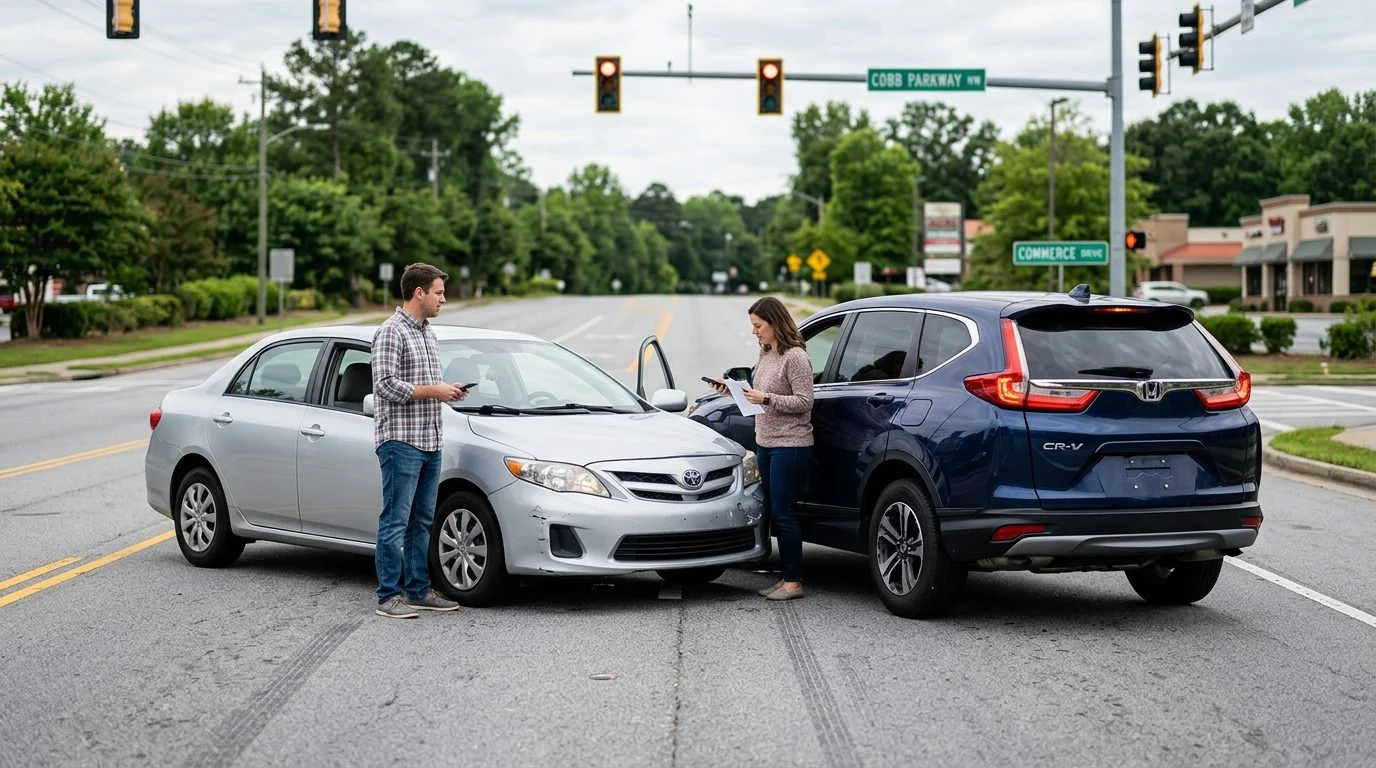
What counts as an at-fault accident? Questions about who caused a crash often come up after a collision. That driver failed to use the care a reasonable person would use in the same situation. Fault is not decided by who apologizes or who a witness blames. It turns on what each driver did and what the evidence shows. This page explains how fault works in Georgia and how it can affect an injury claim and insurance. T. Madden & Associates, P.C. has practiced in Georgia since 1999.
What “At Fault” Means in a Georgia Crash
Fault means legal responsibility for causing a crash. It is not the same as blame at the scene. The core idea is negligence. Under O.C.G.A. § 51-1-2, ordinary diligence is the care ordinarily prudent people use in similar circumstances. Failing to use that care is ordinary negligence.
Negligence claims often turn on the specific facts of what happened. A driver owes others on the road a duty of reasonable care. The driver breaks that duty. Mechanical problems, such as brake trouble, are sometimes examined after a crash. Someone is then hurt or loses property. Claims are usually built on facts rather than assumptions.
Georgia also allows recovery when someone breaks a legal duty. Under O.C.G.A. § 51-1-6, an injured party may recover for breach of such a duty if damage follows. Many crashes involve more than two people. The real question is who caused the collision and how much each person contributed. If a commercial truck was involved, see our Georgia truck accident guide.

Common Driving Conduct That Is Usually Treated as Fault
Most at-fault crashes involve a driver who broke a rule of the road or failed to watch for others. These patterns come up often:
- Speeding or driving too fast for conditions, such as rain, fog, or heavy traffic.
- Running a red light or stop sign, or failing to yield at intersections, merges, and left turns.
- Following too closely, rear-ending another vehicle, or changing lanes unsafely.
- Distracted, impaired, or drowsy driving.
Pedestrian crashes follow similar rules. Under O.C.G.A. § 40-6-93, every driver must exercise due care to avoid colliding with a pedestrian on a roadway. Drivers must also take proper precautions when they see a child or an obviously confused, incapacitated, or intoxicated person. Under O.C.G.A. § 40-6-92, a pedestrian crossing a roadway at any point other than within a marked crosswalk or an unmarked crosswalk at an intersection must yield the right of way to all vehicles upon the roadway, unless the pedestrian has already and under safe conditions entered the roadway. O.C.G.A. § 40-6-92 provides that a pedestrian crossing a roadway outside a marked crosswalk, or outside an unmarked crosswalk at an intersection, must yield the right of way to all vehicles upon the roadway, unless the pedestrian has already entered the roadway under safe conditions.
A traffic ticket is evidence of what an officer saw or believed. It is not the final word on fault. Fault is still weighed with other proof. The same ideas apply to motorcycle and e-bike crashes, where a rider’s or driver’s broken traffic rule is often central.
How Investigators and Insurers Determine Who Caused the Crash
Fault is decided by weighing several kinds of evidence together. No single item settles it.
The police report is usually the first document people see. It may include a diagram, the officer’s notes, and any citations. Read it closely. Compare its diagram and description with photos and your own memory. An officer’s view matters, but it is one view.
Witness accounts matter, and memories fade. Get a witness’s name and contact details at the scene. Write down what you remember as soon as you can.
Photos and video often carry real weight because they show positions and conditions. Dashcam footage, traffic cameras, and nearby business cameras may capture the crash. Recordings can be lost, so asking early helps.
Physical evidence adds detail. Skid marks, debris fields, vehicle damage, and final rest positions can show direction, speed, and sequence. Driver statements count too. An admission at the scene or in writing is weighed against everything else.
When Both Drivers Share the Blame: Georgia’s 50% Rule
In Georgia, a person who is 50 percent or more at fault cannot recover damages. A smaller share of fault lowers the award by that share. Under O.C.G.A. § 51-12-33, the trier of fact sets the injured person’s percentage of fault, and the judge reduces the award in proportion. Under subsection (g) of the same section, a plaintiff who is 50 percent or more responsible receives no damages.
Here is a hypothetical, not a prediction. Suppose total damages are $100,000, and the injured driver is found 20 percent at fault. The award drops by 20 percent, leaving $80,000. At 50 percent, nothing would be recoverable.
Fault can also be split among several people. Under subsection (b), each liable person’s share is that person’s own liability, not joint liability. Under subsection (c), the fault of everyone who contributed counts, even someone who was never sued. How the percentages fall depends on the facts of each crash.
What Fault Looks Like in a Truck Accident
In a truck crash, fault can involve the driver, the carrier, or both. Trucking cases often involve many records and documents.
Hours of service are central. Under 49 C.F.R. § 395.3(a), a driver may not drive without first taking 10 consecutive hours off duty. A driver may not drive after 14 consecutive hours following that break, and may drive 11 hours in that window. Under 49 C.F.R. § 395.3(b), weekly on-duty limits apply: 60 hours in any 7 consecutive days if the employing carrier does not operate commercial vehicles every day of the week, or 70 hours in any 8 consecutive days if it does. The Federal Motor Carrier Safety Administration sets out these rules, including required rest breaks.
Duty records matter too. Under 49 C.F.R. § 395.8, except for a private motor carrier of passengers (nonbusiness), a carrier must require each driver to record duty status for each 24-hour period. Under 49 C.F.R. § 392.3, no driver may operate a commercial vehicle while the driver’s ability or alertness is so impaired, or so likely to become impaired, through fatigue, illness, or any other cause, as to make it unsafe to do so; in a case of grave emergency where the hazard would be increased by compliance, the driver may continue to the nearest place at which that hazard is removed.
Vehicle maintenance is another line of proof. Under 49 C.F.R. § 396.3(a), carriers must systematically inspect, repair, and maintain their vehicles. Under § 396.3(c), those records must be kept for 1 year and for 6 months after the vehicle leaves the carrier’s control. Because these periods are limited, asking for records early helps preserve proof. A company can also answer for its driver’s conduct. Under O.C.G.A. § 51-2-2, a person is liable for torts committed by a servant within the scope of the business.
How Fault Affects Insurance Claims and Payouts
If you caused the crash, the injured person’s claim usually goes to your liability coverage. Liability coverage pays other people’s injury and property damage up to your policy limit.
Your own collision coverage may pay for your vehicle, subject to your deductible and policy terms. Your insurer and your policy set how a crash may affect your premiums and renewal.
Insurance coverage questions can be complicated after a crash.
Adjusters use fault percentages when they value a claim.
What to Say and What to Avoid After an Accident
Stick to facts you know. Give the location, the time, your direction of travel, and any injuries you can see. Keep it short and accurate.
Avoid guessing. Do not estimate speed or distance, or say who had the right of way if you did not see it. A guess can become a fact in someone’s notes. An apology can be heard as an admission, so show concern for others without saying the crash was your fault.
An insurer may ask for a recorded statement. The other party’s insurer represents its own insured, so its questions may aim to assign fault to you. Take time to think before you answer.
Keep records. Save photos, medical visits, lost-wage documentation, and all written communication with insurers.
Bringing Your Crash Questions to a Free Consultation
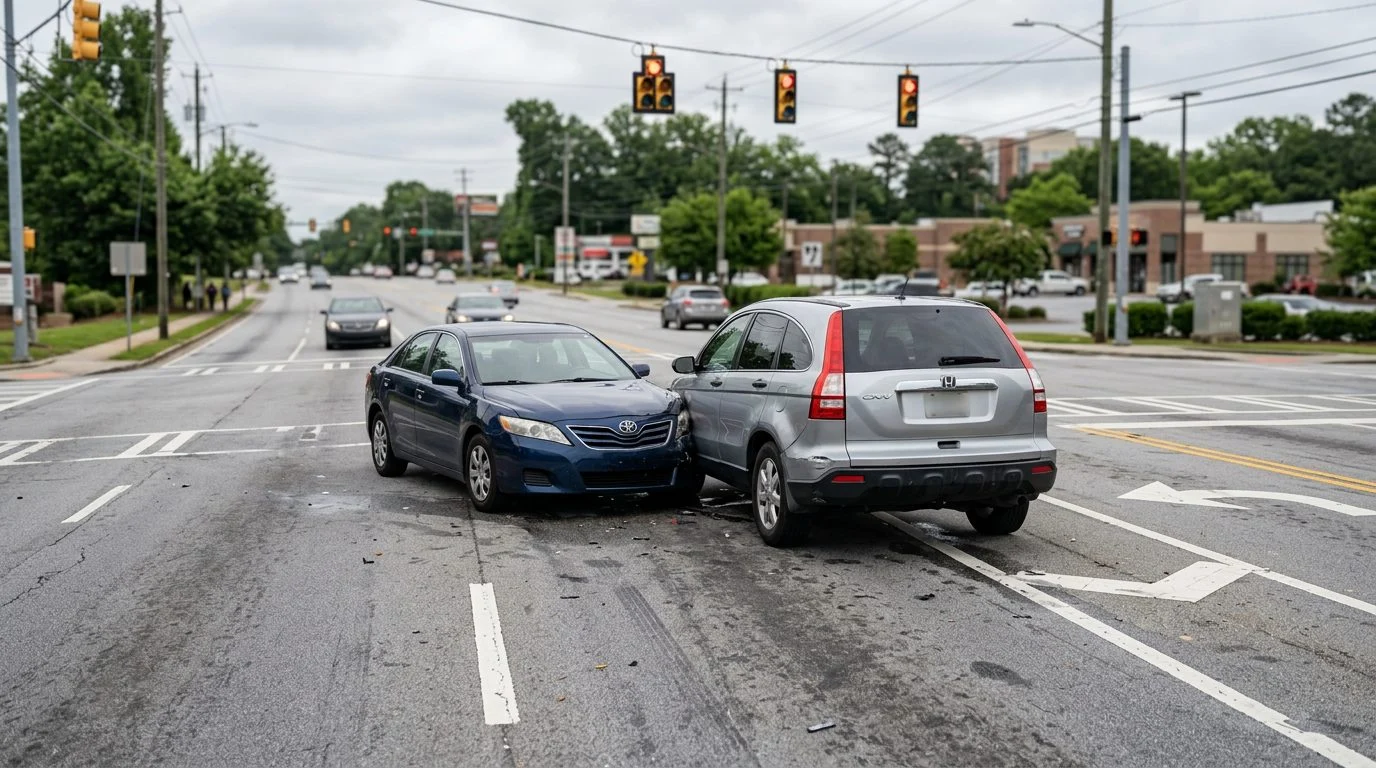
If you are trying to understand who is responsible for a crash, you do not have to sort it out alone. Maybe a crash just happened and you are hurt. Maybe a family member was hurt and you are reading for them. Maybe a police report lists fault in a way that feels wrong, or an insurer has asked for a recorded statement.
T. Madden & Associates, P.C. has practiced in Georgia since 1999. The firm represents people hurt in car, truck, motorcycle, and e-bike crashes, and in slip and fall, medical malpractice, nursing home abuse, negligent security, and wrongful death cases. It has offices in Jonesboro, Atlanta, Decatur, Macon, and Augusta.
The first consultation is free, confidential, and carries no obligation to continue. The firm works on a no-fee-unless-we-win basis, but you may still be responsible for court costs and case expenses.
Start a free case evaluation or schedule a free consultation there. The firm can also be called 24/7.
Frequently Asked Questions
What counts as an at-fault accident?
It is a crash in which one driver is legally responsible for causing it by failing to use reasonable care.
Does a police report decide who is at fault?
No single document decides fault. A police report is important evidence, but it is weighed with other proof.
Will insurance pay if it’s my fault?
If you caused the crash, the other person’s claim generally goes to your liability coverage, up to your policy limit.
How long do I have to file an injury lawsuit in Georgia?
Georgia generally allows two years for a personal injury lawsuit, under O.C.G.A. § 9-3-33.
Can I recover anything if I was partly at fault?
Yes, unless your share is 50 percent or more (O.C.G.A. § 51-12-33; Quynn v. Hulsey (2020)).
Disclaimer:
This page is general information, not legal advice. Terance Madden is the responsible lawyer for this page at T. Madden & Associates, P.C. Contact the firm through its contact page.
Ready to take the next step?
Related practice areas
- Georgia Accident Report Lookup: Step-by-Step Guide