

Truck Accidents · Georgia
Hit by a Company Truck? Know Your First Steps in Georgia
T. Madden & Associates, P.C. has represented injured people in Georgia since 1999. Learn what to do after a company truck hits your car, and talk with our team for a free, confidential consultation.
Why Georgia Drivers Call Us
1999
Year the firm began practice
5
Georgia offices
24/7
Phone line available
By Terance Madden · Published October 25, 2026
If a company truck hits your car in Georgia, your first steps are medical care, a police report, and written details about the truck. Georgia law can make both the driver and the trucking company answer for the harm. Most injury claims must be brought within two years, so timing matters. This guide walks through what to do next.
What Happens When a Company Truck Hits Your Car
A crash with a company or work truck usually involves more parties than a typical car wreck. You may deal with the truck driver, the company that employs or contracts that driver, and each side’s insurer. Commercial trucks are larger, carry heavier loads, and are often insured under commercial policies. That can make the claim look different from a car-to-car crash.
Expect the case to move in stages. First come the scene and the records. Next come medical care and insurance claims. A lawsuit may follow if the claim cannot be resolved.
Trucks also leave more paperwork behind than cars do. That includes driver logs, maintenance files, and training records. Those records are kept for set periods, so the early days matter.
If a company truck hit you or someone you love, you don't have to sort out the claim alone. T. Madden & Associates offers a free, confidential first consultation with no obligation to continue. Talk it through with our team — the first consultation is free, confidential, and carries no obligation.

Steps to Take at the Scene and in the First Days
Get medical help, call 911, and collect facts about the truck while you are still at the scene. Small details written down early can be hard to rebuild later.
- Call 911 and ask for a police report. Note the officer’s name and the report number.
- Write down the truck’s details: the company name, any DOT or company number on the door or cab, the driver’s name, license number, and the plate.
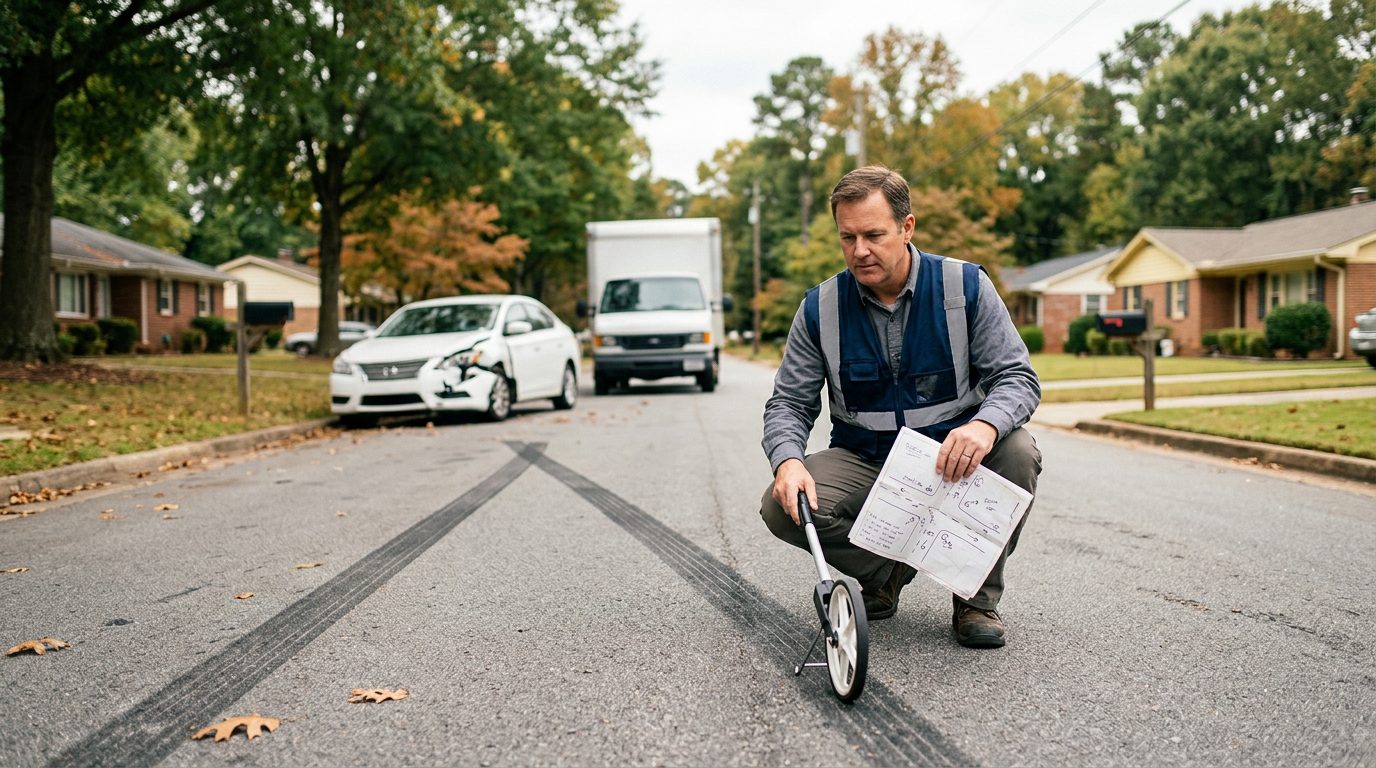
- Take photos of both vehicles, the damage, the road, skid marks, traffic signals, and any visible injuries.
- Get witness names and phone numbers. Ask nearby businesses whether they have cameras that may have recorded the crash.
- See a doctor the same day or as soon as symptoms appear, even if the injuries seem minor. Keep every discharge paper.
Federal rules can add testing after some serious crashes. Under 49 C.F.R. § 382.303, as soon as practicable following an occurrence involving a commercial motor vehicle operating on a public road in commerce, the employer must test for alcohol and for controlled substances each surviving driver who was performing safety-sensitive functions with respect to the vehicle if the accident involved the loss of human life. Under 49 C.F.R. § 382.303, as soon as practicable after an occurrence involving a commercial motor vehicle operating on a public road in commerce, each employer must test for alcohol each of its surviving drivers who receives a citation within 8 hours of the occurrence under State or local law for a moving traffic violation arising from the accident, if the accident involved bodily injury to any person who, as a result of the injury, immediately receives medical treatment away from the scene of the accident, or one or more motor vehicles incurring disabling damage as a result of the accident, requiring the motor vehicle to be transported away from the scene by a tow truck or other motor vehicle. The same employer must test each such surviving driver for controlled substances if the driver receives a citation within thirty-two hours of the occurrence under the same conditions. The same rule says a driver must stay readily available for testing. It also says it does not require delaying necessary medical attention.
Who Can Be Held Responsible for a Company Truck Crash
Crashes involving commercial trucks can result from many kinds of driving conduct, such as speeding, following too closely, distracted driving, or failing to yield. Georgia also holds employers responsible for certain work-related harm. Under O.C.G.A. § 51-2-2, a person is liable for torts committed by a servant in the prosecution and within the scope of the person’s business. That is why the trucking company is often part of the claim.
Other drivers can also share fault. A court or jury considers the fault of everyone who contributed to the injury, even people who were not named in the suit.
Georgia uses modified comparative fault (O.C.G.A. § 51-12-33; Quynn v. Hulsey (2020)). Damages are reduced in proportion to the injured person’s share of fault. If the injured person is 50 percent or more responsible, no damages are recoverable. Each liable person pays only its own share and is not jointly liable with others.
Can You Sue a Trucking Company If Its Truck Hits You?
Generally, yes. An injured person can bring a claim against a trucking company when its driver was working for the company at the time of the crash. The driver and the employer may both be named.
Discovery is where the company’s records come in. Federal rules require motor carriers, except private motor carriers of passengers (nonbusiness), to require each driver to record duty status for every 24-hour period, according to 49 C.F.R. § 395.8. Carriers must also keep each driver’s qualification file while the driver is employed and for three years thereafter, except as provided in paragraph (d), under 49 C.F.R. § 391.51. Vehicle inspection and repair records must be kept for one year and for 6 months after the motor vehicle leaves the carrier’s control, under 49 C.F.R. § 396.3. An early written request helps keep this evidence in place.
The general time limit for injury claims is two years after the right of action accrues. That rule comes from O.C.G.A. § 9-3-33. The statute has exceptions, so don’t rely on the general rule alone.
What to Say and Not Say to the Insurance Company
Give the insurer basic facts and avoid guessing about fault, speed, or how badly you were hurt. Calls may come soon after the crash, often from the trucking company’s insurer. Treat each call as a recorded conversation, even when it isn’t.
Share your name, the date, the location, and that you were injured. Avoid phrases like “I think I was going fast” or “I’m fine” when you are still being checked. Those guesses can be used later.
Do not sign a medical release, a recorded statement, or a settlement paper until you understand what it covers. A signed release can end the claim. Keep a log of every call with the date, time, and the representative’s name. Never skip a doctor’s visit because of a phone call.
Documenting Medical Bills, Lost Income, and Future Losses
Medical records, bills, and proof of lost pay form the core of the damages claim. Georgia separates general damages, which the law presumes from a wrongful act, from special damages, which must be proved. See O.C.G.A. § 51-12-2.
Special damages for medical and healthcare expenses in a Georgia injury case are governed by O.C.G.A. § 51-12-1.1. Some clinics treat patients under a letter of protection, which means they wait for payment from a future settlement or judgment. If that happens, the letter, the itemized charges, and any referral details can be requested in the case.
Keep a simple written list of economic losses. Include past medical bills, lost wages, vehicle repairs, and rental costs. Add future care your doctor recommends. Also keep a short daily note on pain, missed work, and limits on daily tasks.
Not sure what your next step is?
Talk it through with our team — the first consultation is free, confidential, and carries no obligation.
Settling or Suing: How the Two Paths Differ
Most claims start as a settlement demand to the insurer. A lawsuit is filed when that demand cannot be resolved. Each path has its own timeline and its own risks.
A settlement ends the claim once the release is signed. Read the release terms closely before signing. A lawsuit moves into discovery, where records such as driver logs and maintenance files are exchanged.
Several factors often shape the value of a claim. These include how serious the injuries are, how long treatment lasts, medical costs, lost income, how clear fault is, and the insurance available. The right path depends on the facts of each case. No outcome can be predicted from general information.
Frequently Asked Questions
What to do when a company truck hits your car?
Get medical care, call 911 for a police report, and photograph the scene and the truck’s company details.
Can I sue the trucking company?
Generally yes, when the driver was working for the company at the time of the crash.

Talk With T. Madden & Associates About Your Company Truck Crash
You may be the injured person, or a family member handling things for someone else. Either way, the damaged car, the doctor visits, and the insurer’s calls can pile up quickly. If you want to talk through the crash and the records you already have, contact T. Madden & Associates, P.C. The first consultation is free, confidential, and comes with no obligation to continue. The firm works on a no-fee-unless-we-win basis, but the client may still be responsible for court costs and case expenses.
Terance Madden is the responsible lawyer for this page. T. Madden & Associates, P.C. has practiced since 1999 and has offices in Jonesboro (Clayton County), Atlanta, Decatur, Macon, and Augusta. Contact the firm at tmaddenlaw.com/contact. This page is general information, not legal advice.
Steps to Take After a Company Truck Crash
1. Get Medical Care
Some injuries, such as whiplash and internal injuries, may not show symptoms right away. Get checked by a doctor even if you feel fine at the scene.
2. Call 911 and Get a Police Report
A police report documents the crash, the parties, and the officer's observations. Ask for the report number before you leave the scene.
3. Document the Scene
Photograph your car, the truck, the damage, the road conditions, and any injuries. Write down the time, weather, and what happened while it is fresh.
4. Record the Company Details
Note the company name, the DOT number on the truck, the driver's name and license number, and the insurance information. Get witness names and contact details.
Be Careful With the Company's Insurer
An insurance adjuster for the trucking company may call you soon after the crash. Before giving a recorded statement or signing any paperwork, consider speaking with a lawyer about what you say.
How We Can Help
Free, Confidential First Consultation
Our first consultation is free, confidential, and comes with no obligation to continue. You can explain what happened and ask questions.
Attorneys Who Focus on Injury Cases
Our lawyers focus on people hurt in car and truck wrecks, motorcycle and e-bike crashes, and other injury cases throughout Georgia.
Fees Only if There Is a Recovery
Our fees are contingent, so there are no fees unless there is a recovery. You may still be responsible for court costs and case expenses, which we will explain before you decide.
Reach Us Day or Night
Call our office at any hour to start a free case evaluation with our team.
Talk With T. Madden & Associates, P.C. About Your Truck Crash
Related practice areas
- Truck Accident Lawyer in Georgia: Who Pays, Your Deadline, and What to Do Now
- What Not to Tell a Claims Adjuster After a Georgia Crash