

E-bike injuries on the job · Georgia
Hurt on an E-Bike While Working? Know Your Options Early.
T. Madden & Associates, P.C.
Since 1999
Representing injured Georgians
5 offices
Jonesboro, Atlanta, Decatur, Macon and Augusta
By Terance Madden · Published November 20, 2026
You were hurt on an e-bike while doing your job, and now you’re juggling a comp claim and a pile of questions. A separate third-party claim against whoever else caused the crash may reach what comp leaves out.
This page explains how the two claims fit together, which deadlines matter, and what evidence decides who is at fault.
Two Claims, Two Targets: Workers’ Comp and Your Third-Party Claim
Workers’ compensation (comp) is the job injury system.
A third-party claim is a lawsuit against someone other than your employer. That could be a driver, a battery maker or a repair shop. It can reach damages that comp doesn’t cover.
Georgia law generally keeps you from suing your employer over the same injury. The statute says no employee loses the right to sue a third party, with limited exceptions. O.C.G.A. § 34-9-11
Many injured workers think comp is the only route. It’s often just the first one. Run both claims together from the first call, because your comp file and your lawsuit affect each other.
Hurt on a work e-bike in Georgia? Someone else may have caused the crash, and you may have a claim beyond comp, so our team can review it with you in a free consultation. Talk it through with our team — the first consultation is free, confidential, and carries no obligation.
Who Else May Be Liable for an E-Bike Crash at Work
Anyone whose carelessness helped cause the crash may be liable, not just the driver you can see.
- The driver who cut across the bike lane or opened a door into your path.
- A battery or charger maker, if a defect started the fire or the failure.
- A controller or software maker, if a fault caused sudden power or braking loss.
- A repair shop or parts vendor that worked on the bike.
- A property owner with a dangerous path, crossing or hazard.
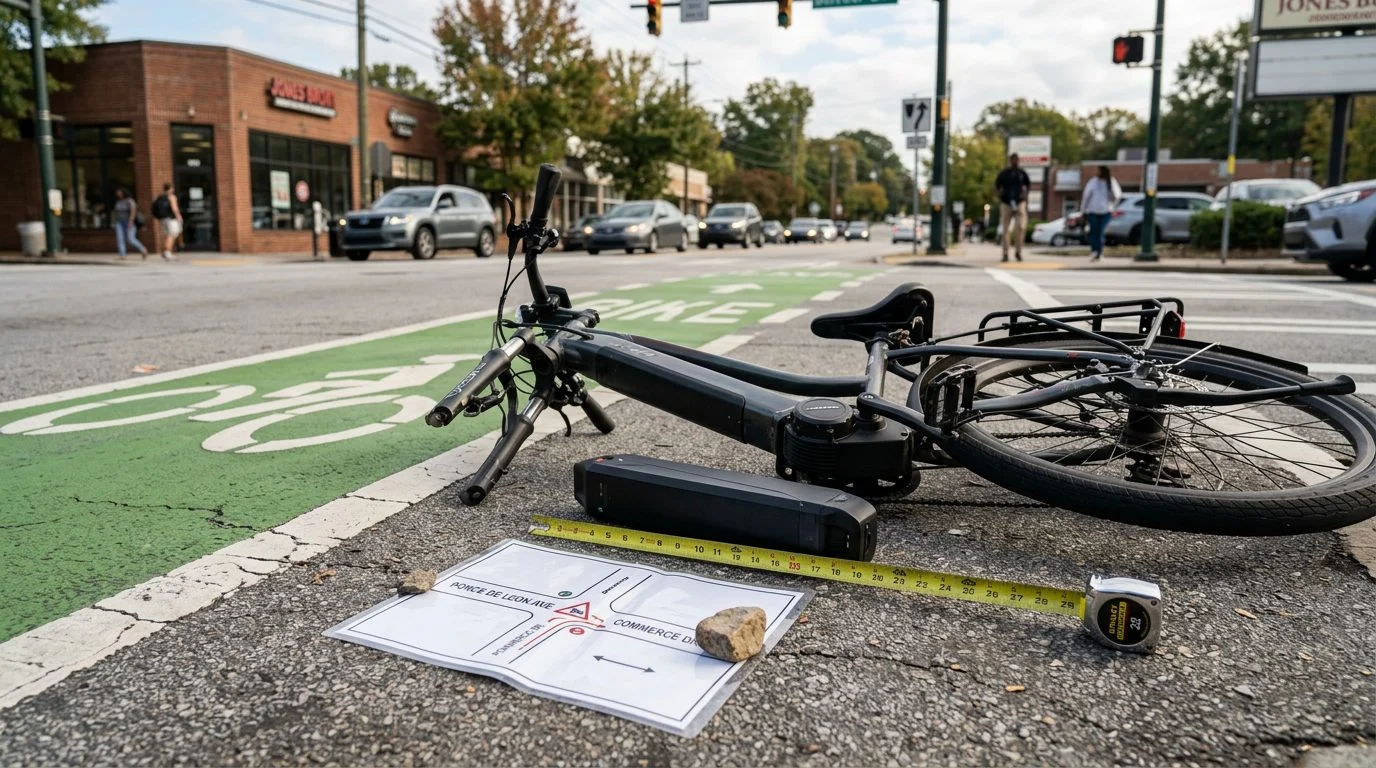
Shared paths, like the Atlanta BeltLine, mix riders, walkers and drivers at crossings. Who is at fault turns on who acted carelessly at that exact spot.
Georgia treats a seller differently from a manufacturer. A seller that is not the maker is not liable as one under strict liability (a claim based on a product defect, not on carelessness). O.C.G.A. § 51-1-11.1 That’s why tracing the battery back to its maker matters.
How the Workers’ Comp Lien Affects Your Recovery
Big Insurance does not work for you. Expect a quick, low first offer and a recorded statement taken before the full picture is known. Expect slow approval of treatment, disputes over whether your care was needed, and the claim that a “low impact” crash caused little harm. A first offer is rarely what a claim is worth.
The response starts with coverage. The firm maps every layer: the at-fault driver’s liability policy, your own uninsured or underinsured motorist coverage where it applies, umbrella and excess policies, and corporate policies.
Then the firm values the full lifetime cost of the injury, not just today’s bills. A claim is only as strong as the case behind it, so a case should be prepared as if it may go to trial.
If you’re on Medicare, add one more layer. Medicare can make a conditional payment (a payment for services another payer may be responsible for), and it must be repaid from a settlement. Federal law takes precedence over state laws and private contracts. Medicare Secondary Payer rules
What the Evidence Shows: Battery and Controller Data
The strongest evidence is often the bike itself, its battery and the data it recorded. Ask that all of it be kept, not repaired or thrown out.
- The battery make, model and serial number, plus the charger.
- Controller and app logs showing speed, power and braking.
- Photos of the scene and the damaged battery.
- Dispatch and route records, if you were on a delivery.
- Names of anyone who saw the crash.
These records can show whether a battery or controller failed, and when. A failure can point the case toward a product maker or seller, which may bring another insurance policy into the claim.
Before law school, Terance Madden trained as an electrical engineer. He starts a case by asking what the data shows, how the crash or fire began, and which records must be preserved. Battery cells, charging circuits and certification marks can show where a failure started and whether the part met a recognized standard.
Send a preservation request early. It’s a letter asking the other side to keep the evidence, and the firm can send one for you.
What to Expect, Step by Step
Most cases move through the same stages. The pace of each stage depends on the facts.
- Free consultation. The initial consultation is free, confidential and comes with no obligation to continue. Bring the date, your job details, the comp claim number and any photos. T. Madden & Associates, P.C. has practiced since 1999, with offices in Jonesboro, Atlanta, Decatur, Macon and Augusta, Georgia.
- Evidence preservation. The bike, battery, charger, app data, dispatch records and witness names get secured early.
- Find every liable party. Identify each insurance layer, and track comp benefits and the lien.
- Document your damages. Gather treatment records, proof of lost wages, future care needs, and how the injury changes daily life for you and your family.
- Negotiate, and prepare for trial. Negotiate with Big Insurance while the case is built for a courtroom from day one.
- Resolve the claim. Many injury claims involve a workers’ compensation lien (a claim for benefits already paid that is asserted against your recovery) or a Medicare repayment, and questions about either are worth raising early with your lawyer.
Deadlines You Need to Know
Georgia generally gives you two years to file a personal injury lawsuit, counted from when your right to sue accrues. In most crash cases, that is the date of the crash. O.C.G.A. § 9-3-33
A spouse’s loss of consortium claim (a claim for the loss of companionship and support) has a four-year limit under the same statute.
Comp has its own reporting rules. Tell your employer about the injury right away, and keep copies of everything you file.
Missing either deadline can end a claim, so check the clock early.
If you’re the spouse, parent or adult child handling the paperwork, start one folder now. Keep the crash date, employer notices, comp letters and every bill. That folder makes the case easier to build.
Not sure what your next step is?
Talk it through with our team — the first consultation is free, confidential, and carries no obligation.
Frequently Asked Questions
Is a separate third-party claim possible against someone other than your employer?
What if I was partly at fault?
Georgia reduces your damages by your share of fault, and you recover nothing if you are 50 percent or more responsible. O.C.G.A. § 51-12-33 Read more about partly at fault e-bike rules.
The facts of your case decide which one applies.
If someone else may have caused the crash that hurt you at work, your options may reach past comp. Send your details through the free case evaluation and let the firm review both claims with you.