

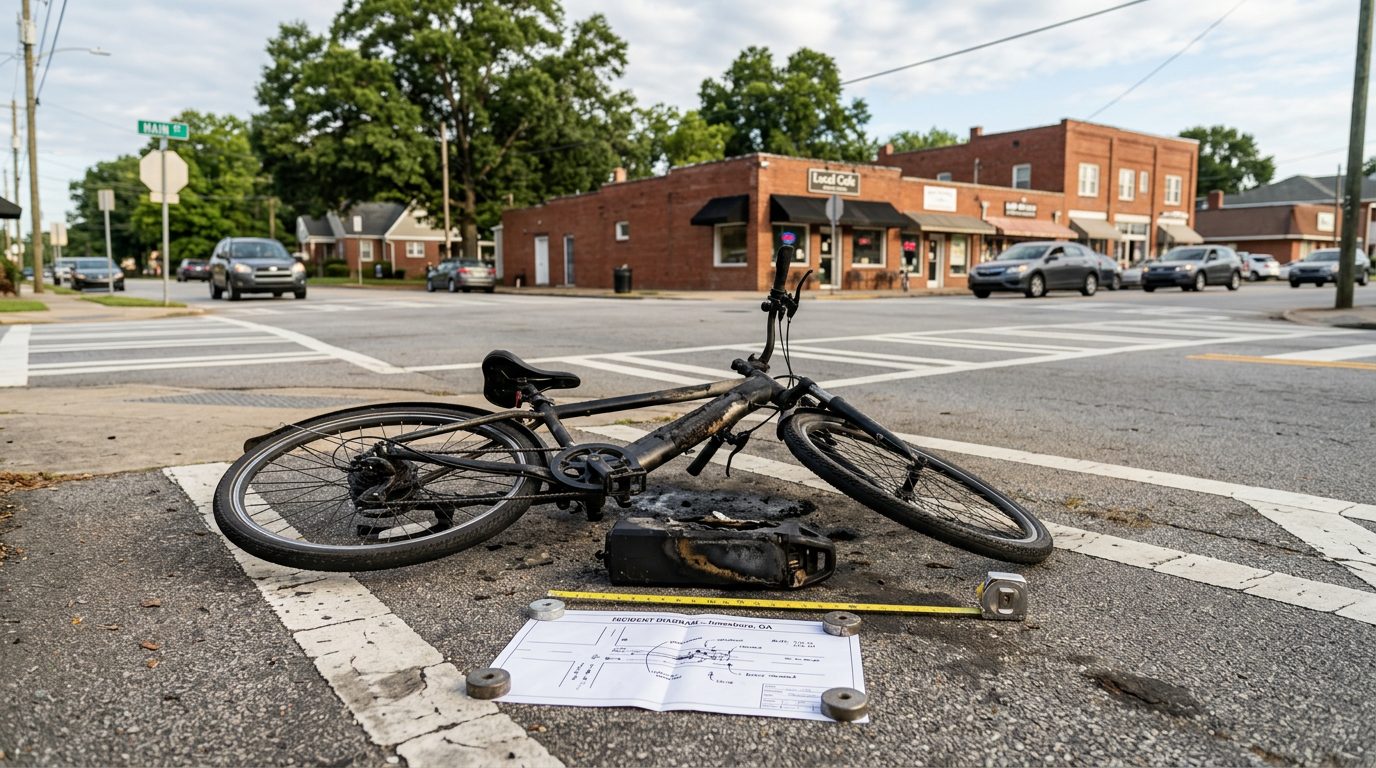
Lithium battery fire lawyer | Georgia
An e-bike battery fire hit your home. Know what to ask before you settle.
Your homeowners policy is one piece of the picture. A defective battery or product may open a separate path to recovery, and the first steps you take matter.
T. Madden & Associates, P.C.
1999
Year the firm began practicing law
5
Georgia offices: Jonesboro, Atlanta, Decatur, Macon and Augusta
24/7
Call us any time
By Terance Madden · Published November 23, 2026
A fire in your home is frightening. A fire that started with an e-bike battery raises hard questions fast. Does home insurance cover e-bike fires in Georgia? Often, yes, for the house and the belongings inside. But the e-bike part turns on the policy wording, and that wording is easy to misread.
If you’re the one keeping track of the claim for your family, this page gives you the steps, the policy terms, and the questions to ask.
Short answer: home insurance may cover an e-bike fire, but the policy language decides it
A homeowners policy is an insurance contract that protects your home and the things in it. An exclusion is a part of the policy that says what it will not pay for. Those two terms decide most e-bike fire claims.
Pull your policy and the declarations page today. The declarations page, often called the dec page, lists your limits, your deductible, and the coverage you bought. Read the exclusions next to it. The answer sits in those pages.
If a fire that started with an e-bike battery has your family dealing with insurance letters and a damaged home, you don't have to sort it out alone. The firm offers a free, confidential consultation. Talk it through with our team — the first consultation is free, confidential, and carries no obligation.
What a standard homeowners policy typically covers after a fire
A typical policy pays for three main things after a covered fire.
- Dwelling coverage pays to repair or rebuild the house itself.
- Personal property coverage pays for belongings, like furniture, clothes, and electronics.
- Loss of use coverage pays extra living costs, like a hotel or meals, while the home is repaired.
Each one has a limit. A limit is the most the insurer will pay in that category. If the dwelling limit is too low to rebuild, the gap can fall on your family. Check both limits now.
The cause of the fire also matters. The insurer will look at how the fire started. When an e-bike battery is the suspected source, the e-bike and its battery move to the center of the claim. A fire claim also has several parts: the structure, the contents, and the cost of living somewhere else. Each part needs its own paperwork.
Where e-bikes create coverage questions
The biggest question is whether your policy treats the e-bike as personal property or as a motorized vehicle. Many standard policies exclude motorized vehicles, so don’t assume the bike is covered. PeopleForBikes notes that homeowners and renters policies may treat e-bikes in ways owners don’t expect. Ask the insurer, in writing, how it classifies your e-bike.
Many people assume a bike is covered because it sits in the garage. Coverage turns on how the policy classifies the bike and which exclusions apply, not on where the bike was kept.
Business use is another trap. If the bike was used for delivery work or paid riding, the insurer may raise a business use exclusion.
Battery questions come next. Was it the original battery? Was it modified? Was it an off-brand replacement? Was it charging unattended? Each answer can change how the claim is read.
How much is bicycle insurance? Separate coverage exists, either as an add-on or a standalone policy. You can also ask your insurer about an endorsement, which is added coverage to an existing policy, for an e-bike you already own.
How Big Insurance tends to handle an e-bike fire claim
Big Insurance is not on your side by default. A first offer is rarely what the claim is worth.
Expect a quick, low first offer. Expect a request for a recorded statement early, before the cause is known. Expect arguments over how the fire started, long waits for answers, and attempts to use an exclusion to cut part of the loss. Read our guide to recorded statements in Georgia before you talk to anyone from the insurer.
The response is to work every coverage layer that may apply. That means dwelling and personal property coverage, loss of use, and any umbrella policy you carry, which adds liability limits above your other policies. Look at any other liability coverage that may apply too. Each layer can answer a different part of the loss.
Don’t sign a release or accept a final number without advice. A release closes the claim for good.
Who else may be responsible, and what the battery evidence shows
Other parties can be responsible too. That includes the battery or bike maker, a seller, and a repair shop that changed the battery. Product liability means a claim that a product was defective in its design, its making, or its warnings.
Georgia law lets an injured person sue a manufacturer without a direct contract with it. This rule covers a product sold as new. The product must have been not merchantable and reasonably suited to its intended use when the manufacturer sold it, and that condition must have caused the injury, under O.C.G.A. § 51-1-11. Under that statute, a strict-liability claim generally cannot start more than ten years after the product’s first sale.
A store that only sells the bike may be a product seller, not a manufacturer. Under O.C.G.A. § 51-1-11.1, a product seller is not liable as a manufacturer in a strict-liability claim. That status matters for who gets named.
Battery evidence tells the story. Investigators look at where the fire started, the damage pattern, the make and model, the charger used, and any recall or service history.
Before law school, Terance Madden trained as an electrical engineer, with a B.S. in Electrical Engineering. He reads battery cells, charging circuits, and certification marks the way an engineer does. He asks where the fire began, what the damage shows, and which records and parts must be kept before they are lost.
Georgia splits fault by percentage among everyone who contributed, under O.C.G.A. § 51-12-33. Each person’s share is its own liability. A plaintiff who is 50 percent or more responsible may receive no damages. For a rental, a landlord who has fully parted with possession and the right of possession is generally not responsible to third persons for damages resulting from the tenant’s negligence or illegal use of the premises. The landlord is still responsible for defective construction or for failing to keep the premises in repair, under O.C.G.A. § 44-7-14.
For the product side of these cases, see our lithium battery fire lawyer page.
Steps to take now, and how to keep the record clear
Start a written record now, and keep it in one place. If you’re the spouse, parent, or adult daughter keeping the paperwork, you’re holding the file for the whole family. Make one folder. Log every call.
Write down what you remember about the fire while it’s fresh. Note the time, what you saw and smelled, and who was home.
- Photograph the damage, the scene, and the e-bike only when it’s safe. Don’t handle a damaged lithium-ion battery without care.
- Get the fire department report in writing.
- Keep receipts for hotels, meals, and replacement items.
- Keep a log of each call with the insurer, with dates and names.
- Notify your homeowners insurer promptly, and ask for every coverage decision in writing.
- Don’t give a recorded statement or sign a release before you get advice.
Time limits matter too. Under O.C.G.A. § 9-3-31, an action for injuries to personal property (called personalty in the statute) must be brought within four years after the right of action accrues. Under O.C.G.A. § 9-3-33, an action for injuries to the person must generally be brought within two years after the right of action accrues, except that injuries to reputation must be brought within one year and actions for injuries to the person involving loss of consortium must be brought within four years.
Not sure what your next step is?
Talk it through with our team — the first consultation is free, confidential, and carries no obligation.
If your family’s home was hurt in an e-bike battery fire
A house fire that started with an e-bike battery leaves a family sorting insurance letters, repairs, and a hard choice about what to do next. If that’s where you are, you don’t have to sort it out alone.
T. Madden & Associates, P.C. represents people hurt, and families who lost someone, in fires and explosions caused by defective lithium-ion batteries and other defective products. The firm has practiced since 1999 and has offices in Jonesboro (Clayton County), Atlanta, Decatur, Macon, and Augusta. Terance Madden is the responsible lawyer for this page.
Our team can review the insurance letters and the battery evidence with you. We’ll explain each option in plain words.
The first consultation is free, confidential, and carries no obligation to continue. The firm works on a no-fee-unless-we-win basis, but you may still be responsible for court costs and case expenses. Start your free case evaluation when you’re ready.
Frequently Asked Questions
Does a standard homeowners policy cover damage from an e-bike battery fire?
Often, yes. Standard homeowners policies usually cover fire damage to your home and belongings, but coverage depends on your policy’s exact terms and exclusions, so read your policy or ask your insurer what it covers.
Will my home insurance pay to replace the e-bike itself?
Not always. Many policies limit or exclude motorized vehicles, and some e-bikes can fall into that category, so check whether your policy covers the bike or offers an endorsement for it.
What if someone was hurt in an e-bike battery fire at my home?
Your homeowners liability coverage may apply to a claim against you for injuries, depending on the policy and the facts. Anyone hurt in the fire should talk with a lawyer about their own rights.
Can I bring a claim against the battery maker if a defective lithium-ion battery started the fire?
Possibly. Georgia product liability law can allow an injured person or family to pursue claims against manufacturers, sellers, and others when a defective product causes harm. T. Madden & Associates, P.C. offers a free, confidential first consultation with no obligation to continue.