

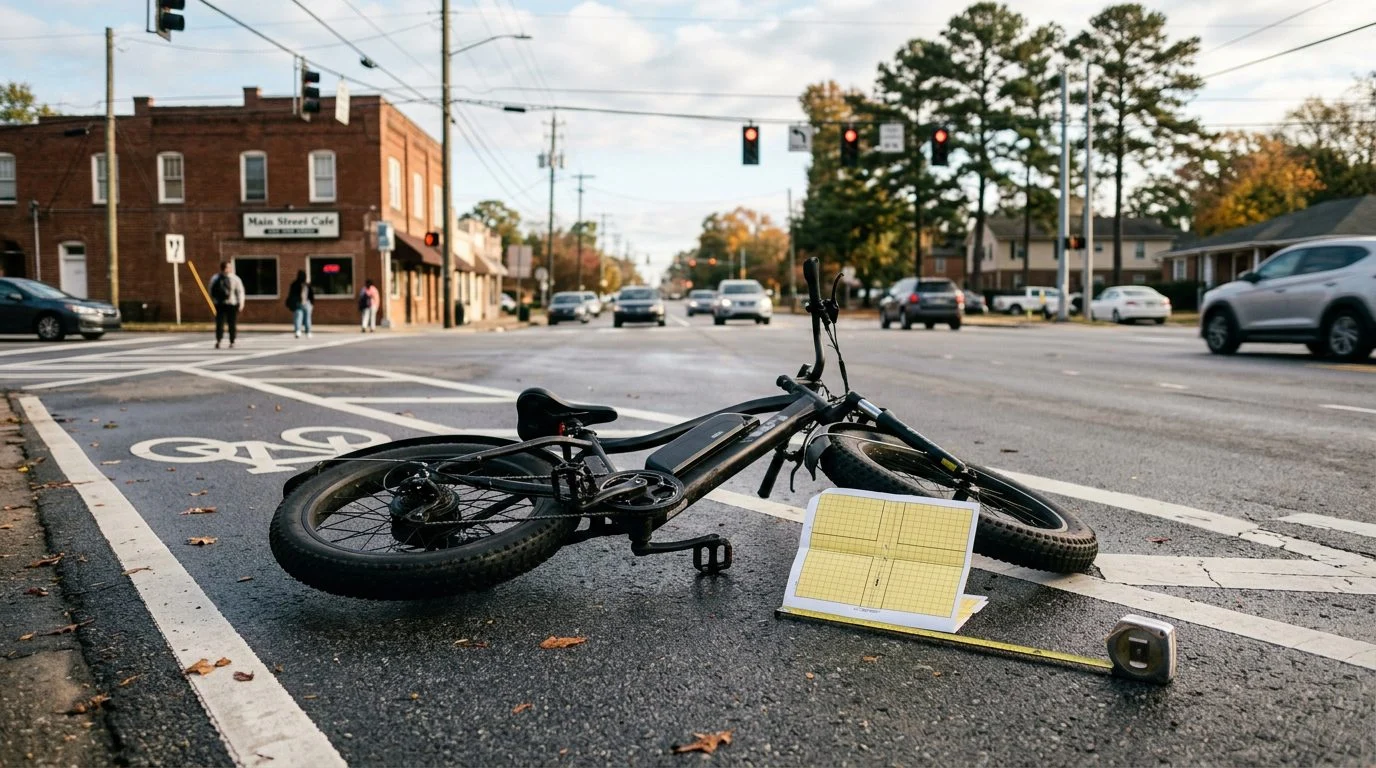
E-Bike Accidents | Jonesboro, Atlanta, Decatur, Macon and Augusta
Hurt on an E-Bike in Georgia? Start Your Free Case Evaluation
Tell us what happened. We will look at the evidence, explain your options in plain language, and answer your questions before you decide anything.
T. Madden & Associates, P.C.
1999
Representing Georgia injury clients since
24/7
Call us any time
Free
First consultation, confidential, with no obligation to continue
By Terance Madden · Published November 26, 2026
Hurt in an e-bike crash and not sure what comes next? A free e-bike accident case evaluation is a confidential review of whether someone else’s fault caused your crash and your injuries. It is a first look at your case, and it carries no obligation to keep going.
This page covers what the review includes, how the steps run, and the Georgia rules that shape a claim. If you are managing a loved one’s recovery, it is written for you too.
What a Free E-Bike Case Evaluation Is and Who It Helps
It is a free, confidential review of whether another party’s carelessness or a defective product caused your crash and harm. Negligence means carelessness that falls below the standard of reasonable care.
The question behind every claim is simple. Did someone’s negligence, or a defect, cause what happened to you? The review answers that question with the facts you have, and it says plainly what those facts do not yet show.
It fits riders who:
- Were hit by a car, truck or other vehicle.
- Were hurt by a hazard, such as a broken curb, a pothole or a rough road edge.
- Were burned or hurt when a battery overheated, caught fire or failed.
Families fit too. If a rider died, the family may have a wrongful death claim under Georgia law, and the review covers who can bring it.
If you are the spouse, parent or adult child handling the bills, the calls and the paperwork, the review is built for you too. You don’t have to be the one who was hurt to ask the questions. Terance Madden and the team will work with you on what comes next.
Hurt in an e-bike crash someone else caused? Call for your free case evaluation, and we'll look at what the evidence shows about your claim. Talk it through with our team — the first consultation is free, confidential, and carries no obligation.
What the Evaluation Covers
The review covers the crash facts, your medical records and the evidence that shows what failed.
- How and where the crash happened, plus any police report.
- Medical records and bills, and the treatment still ahead.
- The e-bike itself: battery, charger, brakes, frame, and photos of any heat marks or damage.
- Witness names, nearby video and phone records from the time of the crash.
- Every insurance policy that may apply, including your own.
- A plain answer on whether the claim appears to have value and who may share responsibility.
Terance Madden holds a B.S. in Electrical Engineering, and he trained as an engineer before law school. He starts an e-bike case by asking what the evidence shows and how the failure happened. In a battery fire, that means looking at the cells, the charging circuit and the certification marks on the battery pack, and tracing where the fire began. Those records and parts need to be preserved early, before they are lost or changed.
How the Process Works, Step by Step
You make one call, share what you know, and the firm reviews the facts before you decide anything.
- Reach the firm by phone or the contact form. The phone line is open 24/7.
- Share a short intake about the crash, your injuries and any insurance you know about.
- Send what you have: photos, medical records, bills and the bike and battery details. The team will tell you what to gather first.
- The firm reviews liability, damages and coverage, then explains what the facts show.
- You talk through your options and what a claim would involve, with no pressure to decide that day.
The evaluation itself is usually one conversation and a document review. The full claim timeline depends on how long your medical care lasts and how the insurers respond. It can run longer than the first call.
Who Else May Be Liable Besides the Rider
More than one party can share responsibility for an e-bike crash or fire.
- A driver who turned into your path, opened a door, or ran a light or stop sign.
- A property owner or occupier. Under O.C.G.A. § 51-3-1, an owner or occupier of land can be liable to invited visitors for failing to use ordinary care in keeping the premises and approaches safe.
- A battery or e-bike maker when a defect caused overheating or failure. Under O.C.G.A. § 51-1-11.1, a seller that did not make the product is not treated as its manufacturer for strict liability (liability for a defect without proof of carelessness).
- Off-brand chargers and parts, which can be the weak link in a battery fire.
- Repair shops and maintenance vendors whose work failed.
- An employer, if a company vehicle or worker caused the crash. The Georgia Supreme Court has said claims for negligent hiring, training, supervision and retention are based on the alleged negligent acts of the employer, in Quynn v. Hulsey.
A failed part or a heat mark can show whose design, part or repair work broke. That evidence can bring another party, and another source of coverage, into the claim.
Georgia Rules That Shape Your E-Bike Claim
Georgia sets firm filing deadlines, so the clock matters from the start.
- Deadline. Under O.C.G.A. § 9-3-33, most personal injury lawsuits must be filed within two years. Some claims run on other clocks, such as four years for a loss of consortium claim, which covers a spouse’s loss of companionship.
- City claims. Any claim against a city for injuries requires a written claim to the city’s governing authority within six months of the event, stating the time, place, and extent of the injury, with the extent including the specific amount of monetary damages sought, and the negligence that caused it (O.C.G.A. § 36-33-5).
- Shared fault. Under O.C.G.A. § 51-12-33, your damages drop by your share of fault. At 50 percent or more, you recover nothing. Each at-fault party pays only its own share, not a joint amount.
The crash facts decide how fault is split, so the review starts there.
How Big Insurance Responds and How the Claim Is Pursued
Big Insurance is not on your side, and a first offer is rarely what a claim is worth.
Expect these tactics:
- A low first offer, made before the full medical picture is known.
- A recorded statement requested early, while you are still in treatment.
- Delays in paying or deciding.
- Disputes over whether your treatment was needed or came from the crash.
- A “low impact” argument that a slow crash or a short fall could not cause real harm.
The response is to pursue every coverage layer: the at-fault party’s liability policy, your own uninsured and underinsured motorist coverage, any umbrella or excess policy, and corporate coverage when a business is responsible. Georgia sets up uninsured motorist coverage in auto policies under O.C.G.A. § 33-7-11.
The claim also counts lifetime costs: future medical care, lost earning ability and pain that continues. The firm builds those claims on records and documented evidence. If Medicare paid some of your bills, Medicare secondary payer rules say Medicare may need to be repaid from a settlement.
Crash physics and the physical evidence on the bike can answer a “low impact” argument with proof, not guesses. The firm prepares every claim as if it will go to trial.
Not sure what your next step is?
Talk it through with our team — the first consultation is free, confidential, and carries no obligation.
Fees, Costs and Your Questions
The first consultation is free, confidential, and comes with no obligation to continue. The firm works on a no-fee-unless-we-win basis, but you may still owe court costs and case expenses.
The firm has been in practice since 1999, with offices in Jonesboro, Atlanta, Decatur, Macon and Augusta. Terance Madden is the responsible lawyer for this page.
Is a free e-bike case evaluation a commitment?
No. You decide after the review whether to go forward.
Can I still recover if I was partly at fault?
Possibly. It depends on the facts, and Georgia cuts your damages by your share of fault.
Should I give a recorded statement to the insurer?
Big Insurance may ask for one early, before you know the full extent of your injuries. Your answer can shape the claim, so think it through first.
Who can start a claim for a rider who cannot handle it?
For example, a spouse, parent or adult child can make the call and take part in the review. The firm will explain who may bring a claim under Georgia law.
Hurt in an e-bike crash someone else caused? Start your free case evaluation today, and we’ll show you what the evidence says about your next step.