

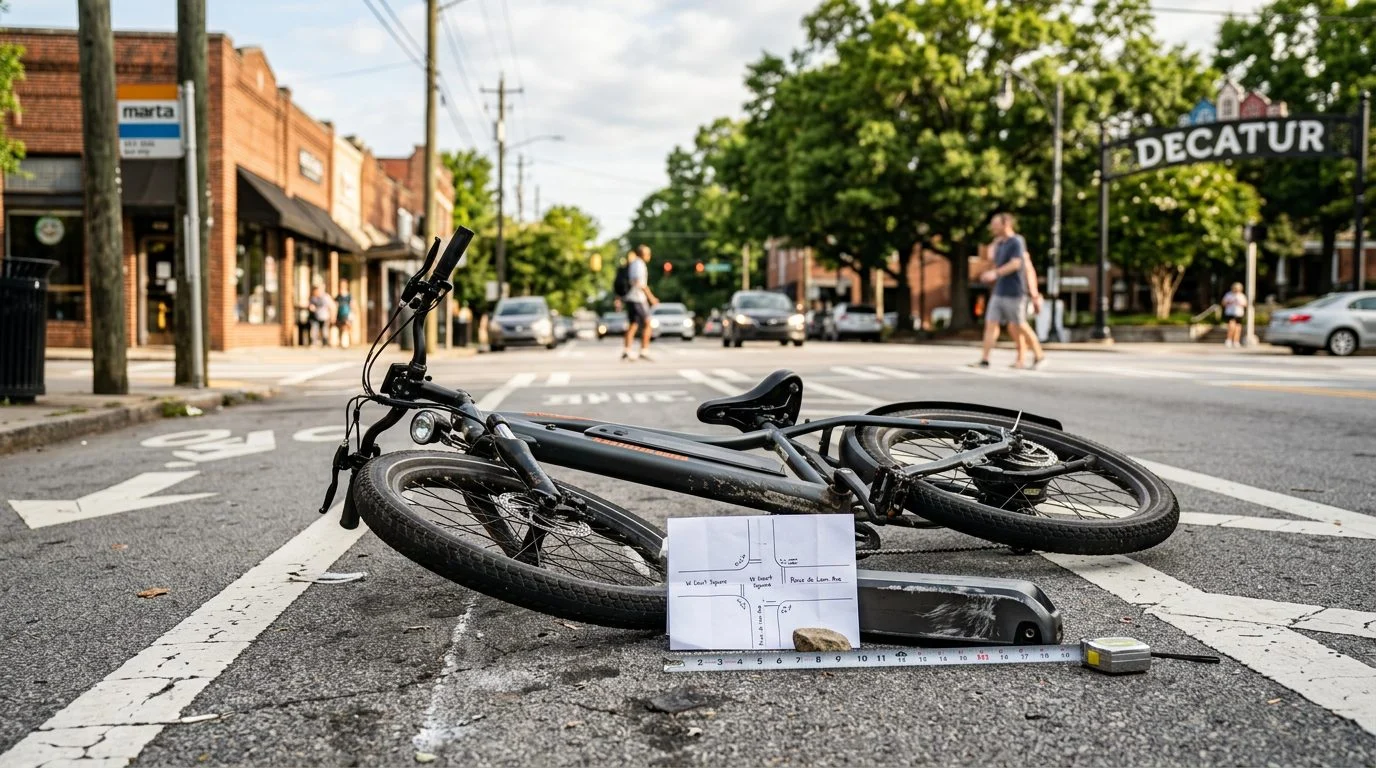
E-Bike Crashes | Georgia
Asked for a Recorded Statement After Your E-Bike Crash?
The adjuster sounds friendly and in no hurry. Before you speak, learn what your words could cost you.
T. Madden & Associates, P.C.
Since 1999
Representing injured Georgians
5 offices
Jonesboro, Atlanta, Decatur, Macon and Augusta
24/7
Phone line for calls about a crash
By Terance Madden · Published November 23, 2026
Your phone rings. A friendly voice says they only need a quick recorded statement about your e-bike crash, and it will take a few minutes. Here’s the short answer: most injured riders should talk with a lawyer before they say anything on tape to the other side’s insurer.
That one call can shape the whole claim, and it often comes before anyone knows how badly you’re hurt. If you’re the spouse, parent or adult daughter fielding these calls for someone you love, this page is written for you.
What a Recorded Statement Is and Why an Adjuster Asks for One
A recorded statement is a taped question-and-answer session between an injured person and an insurance adjuster. An adjuster is the person an insurer assigns to investigate and value a claim.
The adjuster works for the insurer, not for you, even when the call sounds warm and easy.
The recording becomes part of the claim file. It can be replayed, quoted and compared with your medical records and with anything you say later, including sworn testimony taken before trial, called a deposition.
Often, a spouse, mother or adult daughter takes these calls, keeps the notes and handles the paperwork. You don’t have to answer every question on the spot. You can say you want to talk with a lawyer first, and that is a sound move.
If you're dealing with a crash that wasn't your doing and calls you don't know how to answer, our team can talk with you before you speak with any adjuster. Talk it through with our team — the first consultation is free, confidential, and carries no obligation.
Should You Give One? Most Riders Should Talk With a Lawyer First
For most injured e-bike riders, the answer is to speak with a lawyer before giving any recorded statement to the other side’s insurer.
Early calls come fast, usually before the injuries are fully known. Pain medicine, shock and a rattled memory make the first days a poor time to describe speed, distance or who had the right of way.
Your own policy may also ask for cooperation after a crash. Ask the firm to review that request before you call your own insurer.
Timing matters on the lawsuit side, too. Georgia generally gives two years to file a personal injury lawsuit, under O.C.G.A. § 9-3-33. Don’t let the calls push that date out of your mind.
The Tactics Big Insurance Uses on These Calls
Big Insurance often uses a friendly call to collect words it can use later to pay less. Watch for these moves:
- A relaxed tone and a “quick” recording that runs much longer.
- Questions about how the crash happened, asked before you know your injuries.
- A low first offer. An insurer’s first offer is rarely what a claim is worth.
- A “low impact” argument: the crash looked minor, so the injury must be minor.
- Delays, and disputes over whether your treatment was needed or caused by the crash.
The response is to pursue every layer of coverage. That includes the at-fault driver’s liability coverage, your own uninsured and underinsured motorist coverage (UM and UIM), umbrella and excess coverage, and corporate coverage when a business or employer was involved. The firm values the claim with lifetime damages in mind and prepares the case as if it will go to trial while it negotiates.
How Your Words Can Be Used Against You
Your recorded words can be used to argue you were at fault or that you weren’t hurt much. Short phrases do the most damage.
- “I’m fine.” Shock can make you say this, and it can be replayed as proof you weren’t hurt.
- “I think I was going pretty fast.” A guess about speed becomes a fact on paper.
- “I didn’t see him.” This can be used to shift fault onto you.
- “I was checking my phone.” Even a brief look down can be used against you.
Prior injuries are another trap. An old back or neck problem, or an earlier doctor visit, can be used to shrink the injury claim. Say what you know, and say plainly when you don’t know.
The low-impact argument ties to a Georgia rule. If an injury is small or the mitigating circumstances are strong, O.C.G.A. § 51-12-4 says only nominal damages, a small token amount, are given. Document the injury from day one.
The Evidence Behind the Crash and Why an Engineer’s Eye Matters
The crash data often tells a clearer story than a quick phone answer. Controller app data can show speed, braking and power assist when the bike or its app logs them.
Battery and charger records, the bike’s condition, photos, video and witness names fill in the picture. Some of this can be lost, so ask for it early.
A battery or charging problem can change how a crash happened. A defective part can cause a fall or a fire. Investigators trace where a fire started, and that same question, where the failure began, drives an engineer’s review of a bike.
Crash physics matters too. A low-speed crash can still cause real harm, because a rider’s body keeps moving after the bike stops.
Terance Madden, the firm’s responsible lawyer, trained as an electrical engineer before law school. Before law school he trained as an electrical engineer. So he starts a case by asking what the evidence shows, how the crash happened and which records must be preserved.
Who Else May Owe Money After an E-Bike Crash in Georgia
More than one party or policy may owe you money after an e-bike crash. Start with the at-fault driver’s liability coverage, then check your own.
- Your own UM and UIM. Georgia auto policies must include uninsured motorist coverage, within limits you can choose, under O.C.G.A. § 33-7-11. Under O.C.G.A. § 33-7-11, a motor vehicle can be considered uninsured in several situations, including when the insurance company writing the insurance has legally denied coverage under its policy, or when that insurer is insolvent and unable to make either full or partial payment with respect to the legal liability of its insured. Before a vehicle is treated as uninsured because of an insurer’s insolvency, you must give your own uninsured motorist insurer notice within a reasonable time of any legal proceeding you know of against the insolvent insurer. You must also give that notice before you enter into any negotiation or arrangement with the insolvent insurer, and before your insurer is prejudiced by anything you do or fail to do about the insolvency. If the insolvent insurer makes a partial payment, the vehicle is only considered uninsured for the difference between that partial payment and your uninsured motorist coverage limits.
- Umbrella and excess coverage. These extra layers may apply when the damages are large.
- Corporate and employer coverage. A business can answer for a worker’s wrongs done within the scope of the job, under O.C.G.A. § 51-2-2. The Georgia Supreme Court has also said claims for negligent hiring, training, supervision and retention rest on the employer’s own negligence, in Quynn v. Hulsey.
- Makers, sellers and property owners. A part maker, seller, repair shop or landlord can be liable when a defect or unsafe condition played a role.
O.C.G.A. § 51-12-2 separates general damages, which the law presumes and which need no proof of an amount, from special damages, which must be proved to be recovered.
Not sure what your next step is?
Talk it through with our team — the first consultation is free, confidential, and carries no obligation.
What to Expect When the Firm Handles the Contact
When the firm takes your case, it handles the adjuster calls so you are not pressed for a recorded statement. The firm has offices in Jonesboro, Atlanta, Decatur, Macon and Augusta. Here’s the usual path.
- You call the firm. The firm reviews the crash facts, the insurer contacts and the medical picture.
- The firm handles the insurer. Questions go through the firm, and any request for a statement is reviewed first.
- The firm gathers the evidence. That means controller data, photos, witness details, medical records and every coverage layer.
- The firm values the claim and prepares for trial. It values the claim with lifetime damages in mind and builds the case as if it will be tried.
If Medicare paid for your care, a conditional payment may need repaying. CMS explains that Medicare may make one when a liability insurer won’t pay promptly, and it must be repaid from a settlement. See the CMS Medicare Secondary Payer overview.
The initial consultation is free, confidential and comes with no obligation to continue.
If you’re dealing with a crash you didn’t ask for and a phone that keeps ringing, you don’t have to decide what to say to the adjuster alone. Start a free case evaluation before you speak with anyone from Big Insurance.
Common Questions About Recorded Statements After an E-Bike Crash
Do I have to give a recorded statement to the other side’s insurance company?
Most riders should talk with a lawyer first. Don’t answer on the spot.
What if the adjuster says it’s only a formality?
A recording made as a formality can still be used to dispute fault, speed or injuries.
Can I give a statement to my own insurer?
Your own policy may ask for cooperation after a crash. Talk with the firm before you make that call.
Will my statement be used in court?
A recorded statement becomes part of the claim file and may be used later, including in a deposition.
What if I was partly at fault?
Georgia reduces your damages by your share of fault, and if you are 50 percent or more responsible, you recover nothing, under O.C.G.A. § 51-12-33. The firm can review your facts on that question.