

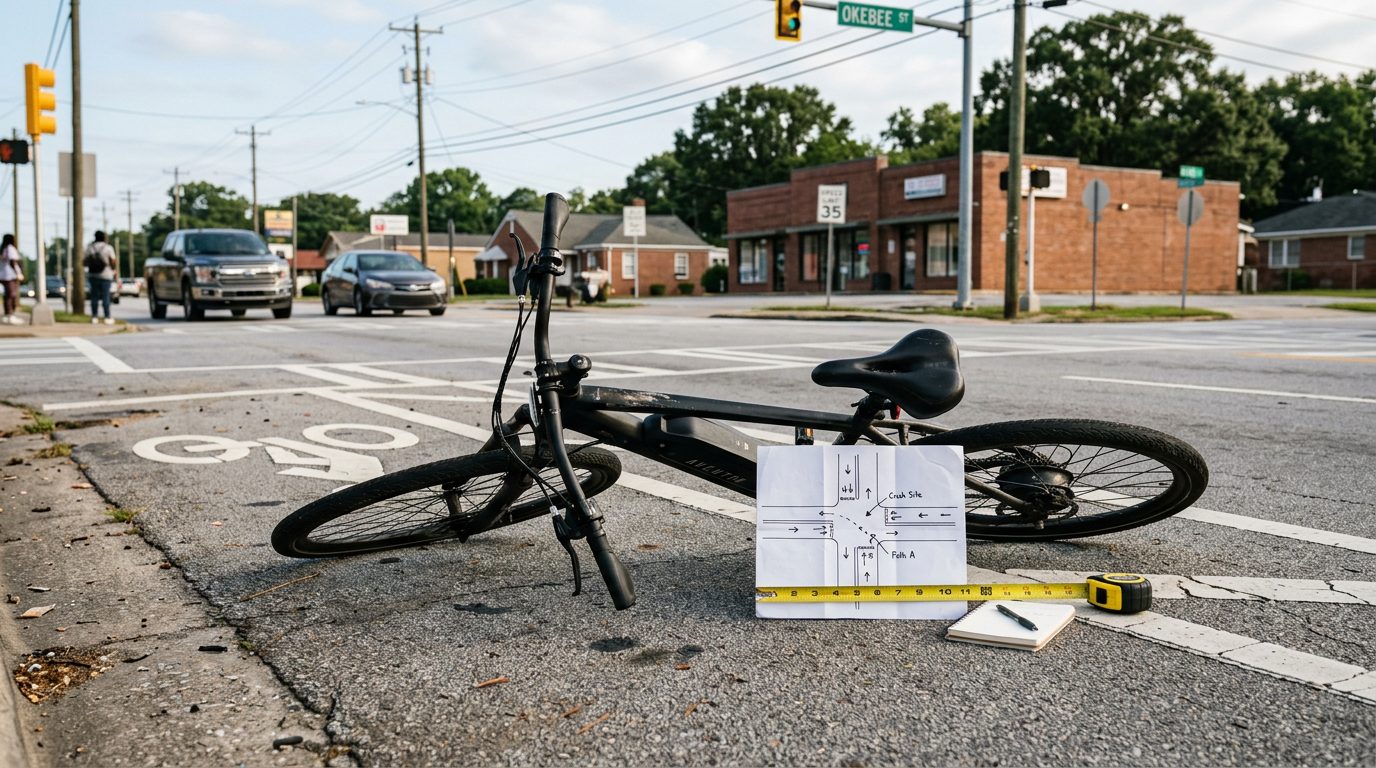
E-bike crash lawyer, Georgia
Hurt in an e-bike crash? Know what the fees and costs look like before you sign.
Terance Madden and the firm's team walk you through the fee agreement, case costs and what to ask at the first meeting, so you decide with clear facts.
The firm at a glance
1999
Serving Georgia clients since
Free
First consultation, confidential, no obligation
24/7
Call the firm any time
By Terance Madden · Published November 26, 2026
If you were hurt in a Georgia e-bike crash, you want to know what a lawyer will cost before you commit. The short answer: the fee is tied to what is recovered, and case costs are a separate line you need to understand before you sign.
This page explains both, and shows how the money moves from a settlement to you.
What an E-Bike Crash Lawyer Fee Is and Who It Covers
A lawyer’s fee is what you pay for the lawyer’s work. In e-bike crash cases, it is usually a share of what is recovered, not an hourly bill.
T. Madden & Associates, P.C. handles e-bike crash claims on a no-fee-unless-we-win basis. The firm is paid only if it recovers money for you. But you may still be responsible for court costs and case expenses.
The exact percentage and how it applies are written in the fee agreement. Ask for that agreement in writing, and read it before you sign.
This covers riders hurt when another driver causes a crash, and the families who manage what comes after. Your first consultation is free, confidential, and carries no obligation to continue.
The firm has practiced since 1999, with offices in Jonesboro, Atlanta, Decatur, Macon and Augusta. Terance Madden is the responsible lawyer for this page.
Not sure what your next step is?
Talk it through with our team — the first consultation is free, confidential, and carries no obligation.
Case Costs: What They Are and Who May Still Owe Them
Case costs are the out-of-pocket expenses of building your claim. They are separate from the fee, and they can add up.
Case expenses (also called case costs) are charges paid to move your claim forward. Common examples include:
- Court filing fees, if a lawsuit is filed
- Deposition charges (sworn questioning outside the courtroom) and transcripts
- Fees to get medical and billing records
- Outside reviews of the e-bike, battery, charger, controller or brakes
Terance Madden trained as an electrical engineer before law school. He starts by asking what the evidence shows and how the crash happened. That tells him which outside reviews are worth the cost. A battery or controller review can matter early, because parts and data can be lost or changed.
The written agreement should say whether case expenses come out of a recovery or are billed to you separately. Ask which one applies. At the free consultation, ask for a list of costs your case may create and when each usually comes up.
How the Money Moves From Settlement to Client
The money comes off in a set order, and you should see every step.
- The gross amount. This is the total settlement, or the final award from a judge or jury.
- The fee. It is calculated under the written agreement.
- Case costs. These are repaid as the agreement states.
- Medical bills and liens. A lien is a legal claim against money for a bill someone is owed. Georgia law makes charges for care given under a letter of protection (a promise to pay from the case) relevant and open to discovery (the formal process for requesting records). See O.C.G.A. § 51-12-1.1.
- Your net amount. This is what is left for you.
Medicare can change step four. Medicare may make a conditional payment (a payment made while a claim is pending). CMS guidance on secondary payer says it must be repaid when a settlement, judgment or other payment is made. Federal law takes precedence over state laws and private contracts.
Ask the family member managing the recovery to keep every bill, receipt and insurance letter in one folder. That makes it possible to check the net figure line by line. Understand every deduction before you agree to any settlement.
Why Big Insurance’s First Offer Is Rarely What the Claim Is Worth
A first offer from Big Insurance is rarely what your claim is worth. Big Insurance is not on your side, and its goal is to pay as little as it can.
Expect these tactics:
- A low offer made before your treatment is finished and the full bills are in
- A recorded statement asked for soon after the crash, while you are still hurting
- Delays in paying or in answering letters
- Disputes over whether your treatment was needed
- “Low impact” arguments that say an e-bike or car collision was too minor to cause real harm
Accepting a first offer can close the door on more money. The response is to look at every layer of coverage: the at-fault driver’s liability policy; your own uninsured or underinsured motorist coverage (protection when the other driver has no insurance or too little); any umbrella or excess policy (extra coverage above the main limits); and corporate coverage when a defective battery or part played a role.
The firm also looks at lifetime costs, not only the first bills. Talk with the firm before you give any statement to an insurance company.
Who Else May Be Liable, and How Fault Changes the Math
More than one party can be liable in an e-bike crash, and each may carry its own insurance. A driver who turned left into a rider is one example. A maintenance shop, a parts maker, or the maker of a defective lithium-ion battery can be others.
Georgia law says a product seller is not a manufacturer and is not liable as one under strict liability (a claim about a defective product). See O.C.G.A. § 51-1-11.1. That is why the chain of who made and who sold a part matters.
Georgia also reduces damages by your share of fault. Under O.C.G.A. § 51-12-33, damages are cut in proportion to your percentage of fault. A plaintiff who is 50 percent or more responsible cannot receive any damages. Each at-fault party pays only its own apportioned share.
For what the physical evidence shows in these crashes, read the e-bike speed and class crash guide.
What to Expect: Steps and Timing
The claim moves in four main steps, and timing starts on day one.
- Free case evaluation and intake. The firm reviews how the crash happened and what injuries you have.
- Evidence preservation. Ask that the e-bike, battery, charger and controller be kept. Scene and vehicle data are collected while they still exist.
- Records and demand. Treatment records and bills are gathered, and a settlement demand goes to Big Insurance.
- Negotiation, then a lawsuit if needed. Talks with the insurer come first. If they do not resolve the claim, a lawsuit may be filed, and the firm prepares for trial.
Timing matters. Under O.C.G.A. § 9-3-33, injury actions generally must be brought within two years after the right of action accrues. The statute has exceptions, so check your date early. For the full picture of medical bills, read who pays medical bills after an e-bike crash.
Not sure what your next step is?
Talk it through with our team — the first consultation is free, confidential, and carries no obligation.
Common Questions About E-Bike Crash Fees and Costs
Most fee questions come down to a written agreement and a clear list of costs. Here are the questions readers ask most.
Do I pay anything up front?
Ask for the written fee agreement, and read how case costs are handled before you sign.
What if nothing is recovered?
The written agreement explains how the fee and case costs are treated in that situation. Ask to see that section first.
Is the consultation really free?
Yes. Ask about any cost question at that meeting.
Who handles the bills while I recover?
Bring the family member who manages your paperwork to the consultation. They should understand each step and each bill.
Can a battery fire or defective part be part of my claim?
It may be. Claims can reach a battery maker or parts seller, and the firm handles lithium battery fire and product liability cases.
Start Your Free Case Evaluation Today
If someone else’s fault put you on the road to recovery, you should not have to sort out the fee and the costs alone. Get a clear answer to both questions before you decide anything.
Start your free case evaluation with T. Madden & Associates, P.C. Bring your bills, the crash facts, and the written questions you have. The firm can be reached 24/7. Your first consultation is free, confidential, and carries no obligation to continue.
Related practice areas
- E-Bike Accident Lawyer in Georgia
- What Is Personal Injury in Legal Terms? A Georgia Guide