

E-bike crashes | Clayton County, Atlanta, Decatur, Macon and Augusta
Hit on Your E-Bike by a Work Van or Truck? Find Out Who Pays
Commercial vehicles often bring more than one party into an e-bike claim. Here is how to sort out who may be responsible.
Firm background
1999
Year the firm began practicing
5
Georgia offices
24/7
Call us any time
By Terance Madden · Published November 22, 2026
If you or someone you love was riding an e-bike when a delivery van or work truck hit you, the questions pile up fast. Who pays the bills? Who caused this?
In Georgia, the driver is not always the only one who may be liable, meaning legally responsible for the harm. The company that runs the vehicle may be liable too. Sometimes the company’s own decisions helped cause the crash, and each of those parties can matter to the claim.
What Happens When a Work Vehicle Hits an E-Bike Rider
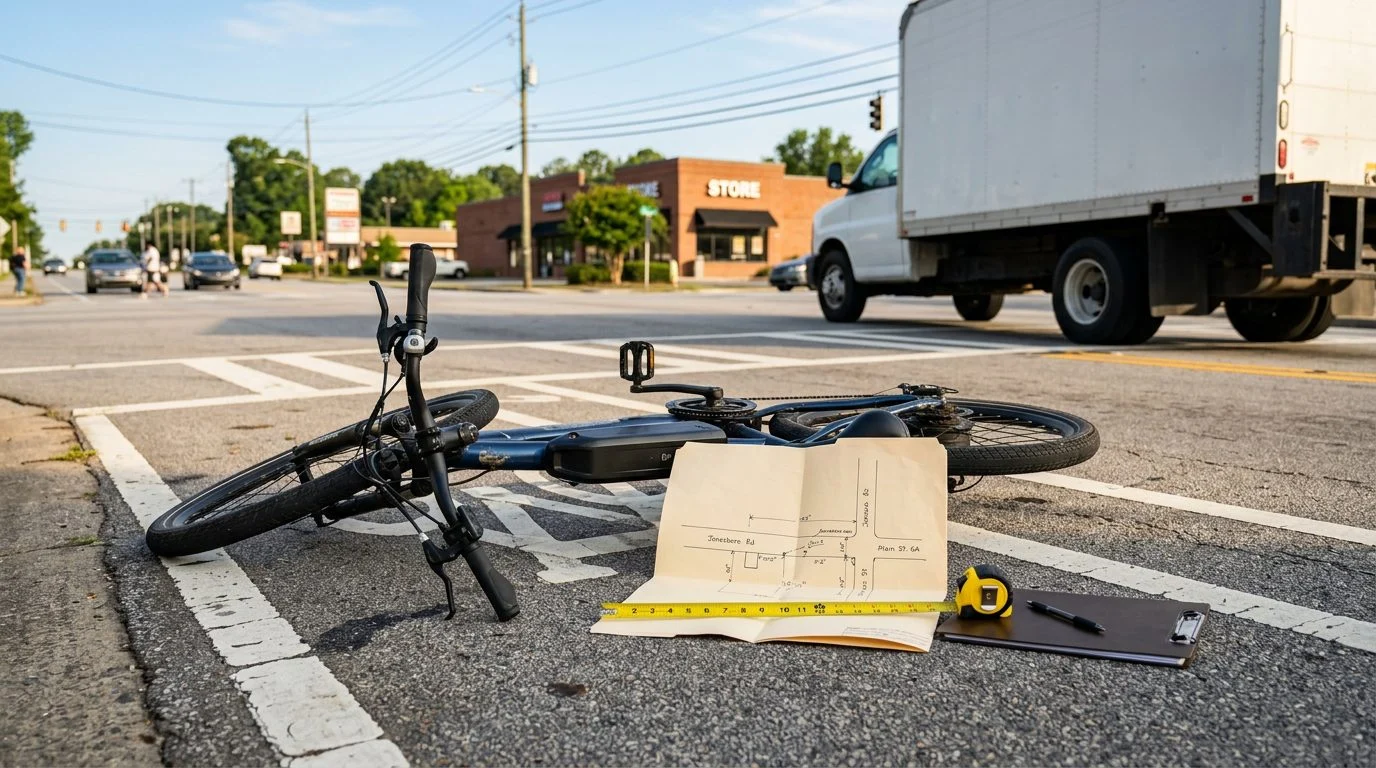
A delivery van, box truck, or company car striking an e-bike rider is often a crash that could have been prevented.
These crashes tend to happen in ordinary places: intersections, turns, and bike lanes. A driver makes a left turn without checking for a rider going straight. A van drifts into the lane where a rider already is. A driver glances at a phone or rushes to hit a delivery window.
Those are choices, not bad luck. Federal rules bar commercial drivers from texting while driving, except when necessary to communicate with law enforcement officials or other emergency services, and they bar motor carriers from allowing or requiring it. Federal texting rule for drivers
This page is written for two readers. The first is the injured rider. The second is the spouse, parent, or adult child now handling medical visits, paperwork, and calls with insurance adjusters. If that’s you, this page explains how claims against a company work in Georgia. Your case rests on your own facts, so the firm takes a close look at them before saying what your claim may be worth.
If a delivery van or work truck hit you or someone you love on an e-bike, you may have a claim, and you don't have to handle the insurance calls alone. Talk it through with our team — the first consultation is free, confidential, and carries no obligation.
Who Can Be Held Liable in a Commercial Vehicle Crash
More than one person or company can be liable in these crashes. Each liable party may bring its own insurance to the table.
Liability means legal responsibility for harm. In most of these claims, the key question is negligence. Georgia law describes ordinary diligence as the care an ordinarily prudent person would use in similar circumstances. The absence of that care is ordinary negligence. Georgia’s negligence definition
Three groups usually matter.
- The driver. The person whose careless choices caused the crash.
- The company. Georgia law makes a person liable for torts committed by a servant, meaning an employee, in the prosecution and within the scope of the business. This is respondeat superior, the rule that an employer answers for an employee’s wrongful acts on the job. Georgia’s employer liability law
- Other contributors. Maintenance vendors, parts makers, and cargo loaders can each play a part if their failure contributed to the crash.
Georgia’s fault apportionment law Each liable party then answers for its own share. That’s why finding every party early matters. More liable parties can mean more insurance available to pay the claim.
The Negligent Five: The Company’s Own Fault
Claims for negligent hiring, training, supervision, and retention are based on the alleged negligent acts of the employer, according to Quynn v. Hulsey, 310 Ga. 473 (2020).
- Negligent hiring. A claim based on the company’s decision to put this driver on the road.
- Negligent training. A claim based on how the company trained the driver for the job.
- Negligent retention. A claim that the company kept the driver on the job after problems came to light.
- Negligent supervision. A claim that the company failed to oversee the driver’s work.
Georgia’s Supreme Court has said claims for negligent hiring, training, supervision, and retention are based on the employer’s own alleged negligent acts. In Quynn v. Hulsey, the court held that the evidentiary rule barring negligent hiring, retention and supervision claims once an employer admitted respondeat superior liability no longer applies, while employer liability under O.C.G.A. § 51-2-2 remains in place: an employer is liable for torts its servant commits by the employer’s command or in the prosecution and within the scope of the employer’s business, whether by negligence or voluntarily; in assessing percentages of fault, O.C.G.A. § 51-12-33 requires the trier of fact to consider the fault of all persons or entities who contributed to the alleged injury or damages, but the fault of someone who is not a party is considered only if the plaintiff settled with that nonparty or a defending party gave notice at least 120 days before trial that the nonparty was wholly or partially at fault.
Picture a company that keeps a driver with repeated safety write-ups on the road. The question is what the company knew and what it did. Those answers live in hiring files, training records, complaints, and discipline notes. Hours records count too. Federal driver logbook rule Federal driver logbook rule
What the Evidence Shows and Why It Matters
Much of the proof in these cases sits inside the company’s equipment and paperwork.
- ECM data. The electronic control module, the vehicle’s onboard computer, can show speed, braking, and throttle before a crash.
- Driver logs. Electronic logging device (ELD) records show duty status and hours behind the wheel.
- GPS and telematics. Route, location, and timing.
- Dash cam video. Footage, if the vehicle had a camera.
- Maintenance records. Brakes, tires, and inspection history.
- E-bike data. The e-bike’s controller and app can record speed, power, and braking, which can answer questions the other side raises.
- Witness statements. Written down while memories are fresh.
Here’s what that means in plain terms. If the data shows the van sped up into a turn, that tells a different story than the driver’s first account. If the logs show more hours behind the wheel than the schedule allowed, that raises a question about the company.
Records get overwritten, lost, or archived. Preservation requests, sent early, ask the company and its vendors to keep this data.
Terance Madden trained as an electrical engineer before law school. He starts a case by asking what the evidence actually shows, how the crash happened, and which records exist and must be preserved. That habit helps him read vehicle and controller data, and he works from the data, not only from the story.
How Big Insurance Responds to an E-Bike Claim
Big Insurance is not on the injured rider’s side, and its first offer is rarely what a claim is worth.
Expect these tactics:
- A low first offer, made before the full cost of the injury is known.
- A recorded statement taken early, while you’re still hurt and worn out.
- Delays in paying or in answering.
- Disputes over whether your treatment was needed.
- “Low impact” or “the rider caused it” arguments.
Georgia has rules for written settlement offers in motor vehicle collision injury claims. Georgia settlement offer rules Don’t sign or accept any offer until someone has reviewed it.
The response starts with every coverage layer. Georgia law requires that uninsured motorist (UM) coverage be offered on auto liability policies and included unless the insured rejects it in writing, and UM coverage pays the insured for injuries caused by an uninsured driver. Georgia uninsured motorist law Underinsured motorist (UIM) coverage, umbrella policies (extra liability coverage above the limits of underlying policies such as auto or home), excess policies (extra limits above a base policy), and the company’s corporate coverage can each matter. Whether a policy applies depends on its wording.
Georgia separates special damages, such as medical bills and lost wages, which must be proved, from general damages, such as pain and suffering, which the law presumes flow from the wrong. Georgia damages statute A claim should reflect the lifetime cost of the injury, not only the bills so far.
Common Questions: Helmets, Deadlines, and Fault
Georgia generally gives two years to file a claim for injuries to the person. Georgia injury filing deadline Exceptions exist, and timing can change with the facts.
Helmets come up often. Georgia’s helmet rule for riders is written for motorcycle riders. Georgia rider helmet law Expect the other side to raise gear anyway.
Fault is the other big fight. Georgia reduces damages in proportion to the injured person’s share of fault. If that share is 50 percent or more, no damages are recoverable. Georgia fault reduction law Expect the other side to say the rider contributed. The data helps answer that claim.
Under the CMS Coordination of Benefits & Recovery Overview, if a person entitled to Medicare was in a crash or other situation where no-fault or liability insurance is involved, that insurance pays primary for the related health care services claimed or released. CMS secondary payer guidance Medicare may also make a conditional payment, which must be repaid from a settlement.
If you’re managing the recovery, keep every bill, explanation of benefits, pay stub, and a log of insurance calls. Those records prove the special damages.
Not sure what your next step is?
Talk it through with our team — the first consultation is free, confidential, and carries no obligation.
What to Expect When You Contact the Firm
After that, the process moves in four steps.
- Your story. The firm asks about the crash, the vehicle, the company, and the injuries.
- Preservation. The firm sends requests to keep vehicle, driver, and company records.
- Coverage. The firm identifies every party and every insurance layer that could pay.
- Valuation and options. The claim is measured against the full cost of the injury, and the firm explains the options, including filing suit if an offer isn’t fair.
The first consultation is free, confidential, and carries no obligation to continue. The firm works on a no-fee-unless-we-win basis, but you may still be responsible for court costs and case expenses.
T. Madden & Associates, P.C. has practiced in Georgia since 1999. It has offices in Jonesboro, Atlanta, Decatur, Macon, and Augusta, and serves Clayton County and the surrounding communities.
If a delivery van or work truck hit you or someone you love on an e-bike, you may have a claim, and you don’t have to handle the insurance calls alone. Start your free case evaluation, and call us anytime, available 24/7.
Frequently Asked Questions
Can I hold a company responsible if its delivery driver hit me on my e-bike in Georgia?
Often, yes. Under Georgia law, an employer can be held liable for harm its worker causes while doing the job (O.C.G.A. § 51-2-2). Whether the driver was on the clock and working for the company is a key question in these cases.
Can the company be liable for its own mistakes, not just the driver’s?
Yes. A company can be responsible for its own negligence, such as hiring or training a driver it should not have trusted, failing to supervise that driver, or keeping a driver on the road after warning signs. Those claims often depend on the company’s records and vehicle data.
Will the company’s insurance pay for my injuries from an e-bike crash?
It may, but commercial coverage is not always simple. Big Insurance often opens with a low offer and may dispute how badly you were hurt. Your claim may reach more than one layer, including the company’s liability policy, your own uninsured or underinsured motorist coverage, and any umbrella or excess policy, and a first offer is rarely what the claim is worth.
What if I was partly at fault for the e-bike crash?
Georgia uses modified comparative fault, which reduces your recovery by your share of the blame. Under O.C.G.A. § 51-12-33, you cannot recover if you are found 50 percent or more responsible for your own injuries.