

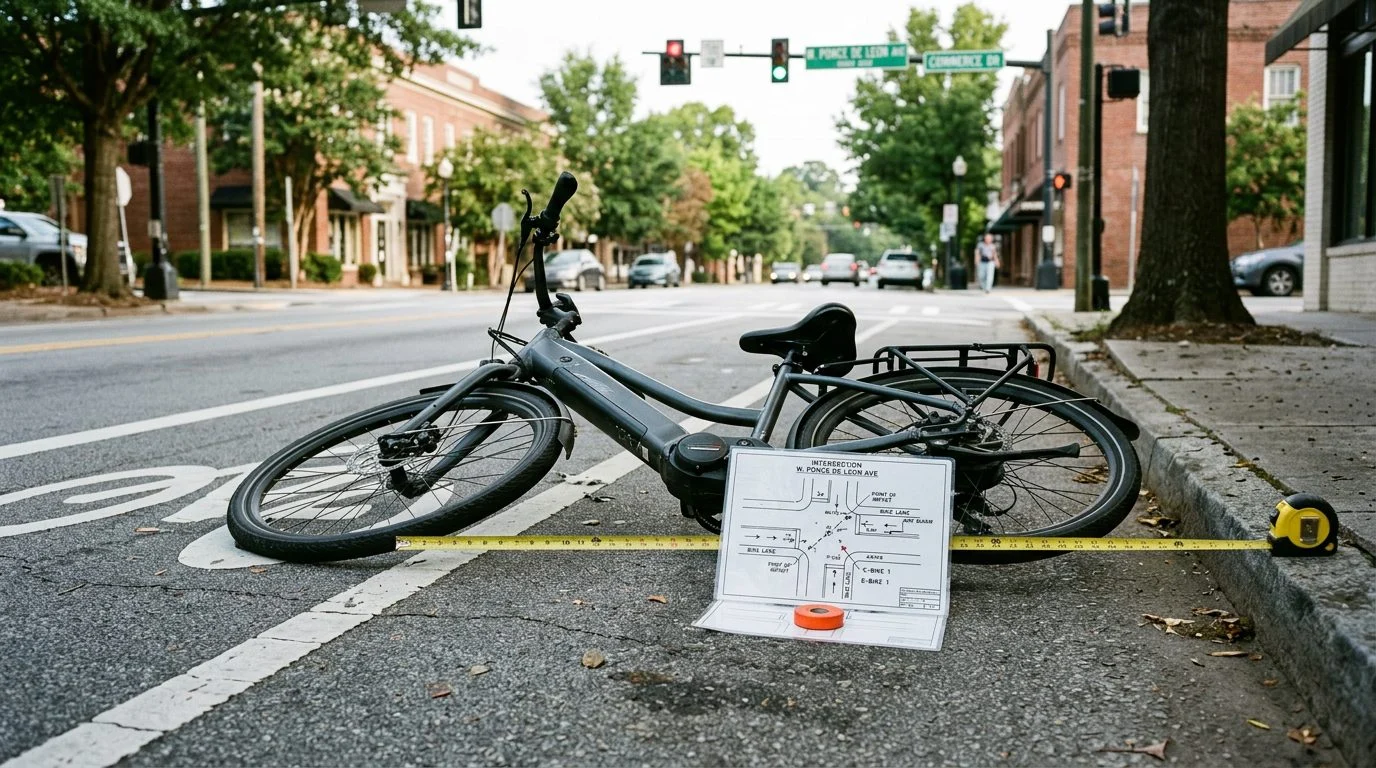
E-bike crashes in Georgia
Told your e-bike crash was 'low impact'? The physics may say otherwise.
Speed, weight and contact point shape how much force reaches your body. Here is how we look at those facts.
T. Madden & Associates, P.C.
Since 1999
Representing injured Georgians
5
Georgia offices: Jonesboro, Atlanta, Decatur, Macon and Augusta
By Terance Madden · Published November 24, 2026
When an insurer calls an e-bike crash “low impact,” that is a claim tactic, not a verdict on the injury. If you’re handling an e-bike low impact crash insurance claim in Georgia for someone you love, that phrase can stop you cold.
Here’s what it means, what the physics shows, and how a real response works.
Hear “Low Impact” and Your Guard Goes Up
Hearing “low impact” from an insurer is a signal to slow down, not to agree. The words often come in a short phone call or a letter. Nobody has read the medical records yet.
Picture the scene. The bike has a bent fork and a scraped wheel. In a photo, it looks fine enough to ride away. But the rider still can’t get out of bed without help, and the pain keeps getting worse.
That gap is where families get stuck. A bike that looks fine does not tell you what the body went through. The bike and the body are different evidence, and they answer different questions.
If you’re the one keeping track of appointments, rides, prescriptions and bills, you already know the injury is real. Your account counts. The sleep that didn’t come, the stairs that now take a long rest, the work that stopped: these are facts the claim needs. Write them down as they happen.
If a family member was hurt on an e-bike and an insurer has called the crash minor, you don't have to sort it out alone; the firm can talk it through with you in a free, confidential consultation. Talk it through with our team — the first consultation is free, confidential, and carries no obligation.
What Big Insurance Means by “Low Impact”
“Low impact” is an argument that the forces in the crash were too small to cause serious harm. Big Insurance often argues that a real injury is a small one.
In plain words, the argument goes like this: the bike was not hit very hard, so the rider could not have been hurt badly. That sounds simple. It usually rests on three things: a photo of the bike, a guess about speed, and a look at the damage to the bike instead of the person.
Notice what is often missing. The argument rarely relies on medical records. It asks you to accept a conclusion before the injury has been measured.
Two terms matter here. Liability means legal responsibility for harm. It answers who must pay.
Big Insurance does not have to prove the crash was small. It only has to plant doubt. Once that doubt is in the file, every later offer is built on it.
The Tactics Behind the Low-Impact Argument
Big Insurance tends to run the same play. It usually includes a few moves you should expect.
- A fast, low first offer. It often arrives before anyone knows the full cost of care.
- A request for a recorded statement. The adjuster asks questions on tape or in writing, often early.
- Delays. Slow files wear families down and push for a quick deal.
- Disputed treatment. The insurer says the care was too much, too soon, or not needed.
- The “minor damage” claim. The bike looks fine, so the injury must be small.
A first offer is rarely what a claim is worth. It comes before the medical picture is clear. The firm does not treat a low first offer as the answer. It is a starting point, and the firm tests it against the evidence.
About recorded statements: you don’t have to give one on the spot. You can ask to wait until you have your records. Anything said early can be used later, even if it was said while the rider was in pain and tired.
What the Physics Shows About an E-Bike Crash
Injury depends on how the body stops and moves, not only on how much the bike is dented.
Engineers measure a crash by delta-V, the change in speed during the impact. A visible scratch does not tell you the change in speed the rider’s body went through. A bent part can hide a light hit, and a clean frame can hide a hard stop.
Three facts drive the forces: the weight of the e-bike and rider, the speed before impact, and where the rider came to rest. Those facts come from the scene, the bike and the records. The answer depends on the facts of this crash, so the work starts with the evidence.
Before law school, Terance Madden trained as an electrical engineer and earned a B.S. in Electrical Engineering. He starts a case by asking what the evidence actually shows and how the crash happened. He looks at which records and data exist and which must be preserved before they are lost. That training is why he treats a “low impact” claim as a physics question, not a guess. The firm has practiced since 1999. For more on the physics, read the Georgia e-bike crash physics guide.
Why a Minor Bike Damage Photo Does Not End the Question
A photo of a bent fork or a scraped wheel shows the bike. It does not show the rider’s injury.
Injuries from a slow crash can show up later. Soft tissue harm, a head injury or a spine problem may not be obvious at the scene. Prompt medical care creates a record that ties symptoms to the crash.
Helmet use is one fact the evidence has to answer. Whether a helmet was worn, and how it sat on the head, are questions the record can address. Whether it changes the claim depends on the facts, and the helmet and e-bike claim guide explains how those facts get weighed.
The surface, the vehicle that caused the crash and the rider’s stopping point are facts too. Write down where you were hurt and what the scene looked like. Keep the bike. Don’t let anyone repair or sell it before the evidence is preserved.
The Response: Every Layer of Coverage and a Case Built for Trial
Check every coverage layer before anyone accepts a low number.
The at-fault party’s liability policy is the first layer most people think of. It may not be the only one. Depending on the facts, these may also apply:
- O.C.G.A. § 33-7-11 sets rules for uninsured motorist coverage, so a household auto policy is worth checking.
- Corporate or other liable parties, such as a maintenance vendor or a manufacturer, when the facts point to them.
Under O.C.G.A. § 51-12-33(c), the fault of all persons who contributed to the injury is considered, not only the driver’s.
Damages are more than the first bills. Medical expenses must be proved, and they are limited to the reasonable value of medically necessary care under O.C.G.A. § 51-12-1.1. Future medical costs and lost wages can be part of the claim, and the law lets the trier of fact reduce them to present value under O.C.G.A. § 51-12-13.
The firm has represented injured people in Georgia since 1999. A low offer gets tested against the evidence, not accepted by default.
Not sure what your next step is?
Talk it through with our team — the first consultation is free, confidential, and carries no obligation.
Georgia Rules That Shape the Argument
Georgia’s fault rules can cut a recovery, so the rider’s share of fault matters from the first call.
Under O.C.G.A. § 51-12-33(a), the judge reduces the damages in proportion to the injured person’s percentage of fault. Under § 51-12-33(g), a plaintiff who is 50 percent or more responsible recovers no damages.
Under O.C.G.A. § 51-12-4, if an injury is small or the mitigating circumstances are strong, only nominal damages are given. That is why the “small injury” argument matters so much to the number.
Under O.C.G.A. § 9-3-33, actions for injuries to the person must generally be brought within two years after the right of action accrues. Check that deadline early.
Your Next Step When the Insurer Says “Low Impact”
When an insurer calls the crash minor, the decision in front of you is when to speak and who reads the evidence first.
Do I have to give a recorded statement?
You don’t have to give one on the spot. You can ask to wait until you have your records and have talked with the firm.
Does health insurance pay first?
Under CMS’s coordination rules, who pays first for crash-related care can depend on the facts, including whether Medicare has paid for the care. When that insurer will not pay promptly, Medicare may pay conditionally, and that payment must be repaid from a settlement.
If you’re managing a family member’s recovery after an e-bike crash, you don’t need every answer tonight. Talk with the firm about what the evidence shows and which coverage layers may apply. The first consultation is free, confidential and comes with no obligation to continue. The firm works on a no-fee-unless-we-win basis, but the client may still be responsible for court costs and case expenses. The firm has offices in Jonesboro, Atlanta, Decatur, Macon and Augusta. Start your free case evaluation at the firm’s contact page.