

E-Bike Crash Lawyer | Georgia
Hit by a Car Turning Left? Let's Look at Who Had the Duty to Yield
Signal timing, sight lines and the crash scene often tell the story. Here is how the firm reviews them.
The firm at a glance
1999
In practice since
5
Offices across Georgia
By Terance Madden · Published November 12, 2026
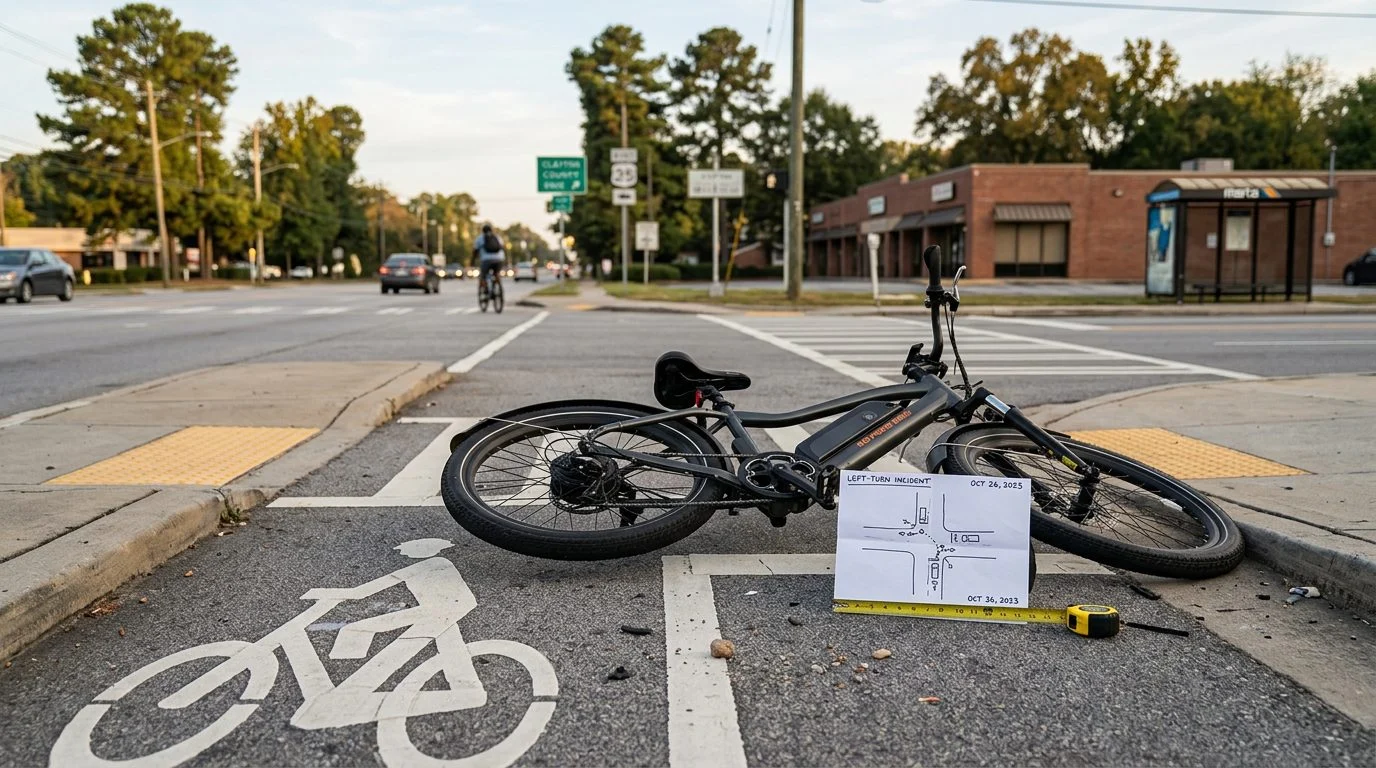
A car turned left and hit your e-bike. Now the driver says you came out of nowhere. That claim is common, and it does not settle who is at fault.
When a car turns left and hits an e-bike in Georgia, the real questions are who had to yield and what the evidence shows. The evidence is often clearer than the driver wants it to be.
The Driver Says You Came Out of Nowhere. Georgia Law Says Otherwise
A driver turning left across a bike lane or path can create a dangerous conflict with a cyclist. To yield means to let other traffic go first. Right-of-way is the priority one road user has over another.
Most of these crashes follow one pattern. A rider goes straight through. A driver turns left across that path. Then comes the line: “I never saw you.”
That line asks you to believe the rider appeared from nowhere. The physical facts are how you test that story.
If a driver turned left into your e-bike and now says you came out of nowhere, you do not have to test that story alone. Talk with the firm in a free first consultation. Talk it through with our team — the first consultation is free, confidential, and carries no obligation.
How Georgia Splits Fault When Both Sides Made Mistakes
Georgia splits blame by percentage. A rider found 50 percent or more at fault recovers nothing (O.C.G.A. § 51-12-33; Quynn v. Hulsey (2020)).
Comparative negligence (shared fault) means each person’s share of blame is weighed. Under O.C.G.A. § 51-12-33, the judge reduces the damages in proportion to the injured person’s percentage of fault. At 50 percent or more, no damages are recovered.
The trier of fact must consider the fault of everyone who contributed to the injury, not only the driver. That matters when more than one party played a part.
The driver may say the rider was speeding or weaving. Who was at fault is often the central question in a crash claim. The firm tests each claim against the scene, the damage and the timing. Shared-fault arguments rise or fall on the facts.
What the Evidence Shows in a Left-Turn E-Bike Crash
The physical evidence usually answers the “came out of nowhere” story. Five pieces matter most:
- Sightlines: what the driver could see from the driver’s seat as the turn began.
- Turn signal: whether it was on, and for how long.
- Speed and stopping distance: how fast the car was moving and how far it needed to stop.
- Point of impact: where the bike struck the car. A strike on the side of the car often means the car was already across the rider’s path.
- Rest position: where the bike and rider came to rest. That shows direction and force.
Scene photos, nearby video, witness statements and the driver’s phone records, where they can be obtained, can answer the timing question. Some of these records disappear fast, so they must be preserved early.
Before law school, Terance Madden trained as an electrical engineer. Before law school, he trained as an electrical engineer. So he starts a case by asking what the evidence shows and how the crash happened. He works through the timing, the sightlines and the damage pattern, and he identifies which records must be preserved. When the facts call for it, the firm can bring in an engineering review of the scene and vehicles.
How Big Insurance Handles a Left-Turn E-Bike Claim, and How the Firm Responds
Big Insurance is not on your side. Its first offer is rarely what your claim is worth.
Expect the familiar moves. A fast, low offer may arrive before you know the full extent of your injuries. A recorded statement may be requested while you are still in treatment. Some claims take weeks to move forward, even when the facts are clear. Your treatment may be questioned. And the “low impact” argument says a bike hit at modest speed could not cause much harm.
Here is the response. Your medical records, your doctors’ notes and the damage pattern answer “low impact.” The firm also considers lifetime damages, along with the bills already received. Georgia law lets future medical costs and lost earnings be reduced to present value, meaning today’s dollar figure for money paid later. O.C.G.A. § 51-12-13 sets out that rule.
Every coverage layer gets examined. The driver’s auto liability policy comes first. O.C.G.A. § 33-7-11 covers that requirement. An umbrella policy can add a layer above the auto policy, but under O.C.G.A. § 33-7-11(a)(3), the uninsured motorist coverage required by paragraph (1) does not reach umbrella or excess liability policies unless such a policy itself, or a policy endorsement, affirmatively provides for that coverage. If the driver was working, Georgia law can hold the employer liable for negligence within the scope of the job. O.C.G.A. § 51-2-2 states that rule. Which policies apply depends on the policies and the facts.
Settlement offers have rules too. For a motor vehicle claim, a written offer prepared with an attorney’s help must allow at least 30 days from receipt to accept. Payment cannot be due in less than 40 days. O.C.G.A. § 9-11-67.1 sets those terms for offers made from the time a cause of action accrues until the named defendant files an answer or, with multiple named defendants, until all of them have filed initial answers or been found in default. Any time-limited offer should be reviewed before you answer it.
The firm prepares every case as if it will go to trial. That is how it approaches each claim from the first day.
Steps to Take Now After a Left-Turn E-Bike Crash
Get medical care first, then protect the proof. Your health comes before everything else.
Keep every record. That includes follow-up visits, imaging, prescriptions and therapy notes. Gaps in treatment give the other side an opening.
Photograph the intersection, the car, the bike and any damage to the e-bike. Keep the e-bike unrepaired until it can be examined.
Get the driver’s name, insurance details and the names of any witnesses. Write down what you remember while it is fresh.
Hold off on a recorded statement to the other side until you have talked with a lawyer. What you say early can be used to shape the other side’s defense.
Watch the clock. Georgia’s general filing period for personal injury claims is two years. O.C.G.A. § 9-3-33 sets a two-year deadline for actions for injuries to the person, except for actions for injuries to the person involving loss of consortium, which shall be brought within four years after the right of action accrues.
The Person Managing the Recovery Needs a Plan Too
The person managing the recovery needs a written system from day one. That is often a spouse, a mother or an adult daughter handling appointments, bills, missed work and calls from the insurer.
Keep a log of every call. Write down the date, the time, the name of the person you spoke with and what was said.
Forward every letter from the insurer to the firm instead of answering it alone. Save receipts for prescriptions, and track mileage to medical visits. O.C.G.A. § 51-12-7 treats necessary expenses from an injury as a legitimate part of the damages estimate.
T. Madden & Associates, P.C. keeps the injured rider and the family manager informed in plain English, with no gaps in communication. Ask questions. A family carrying this load should never feel lost.
Your family has carried each other through hard seasons before. Keep the pace steady, and let one person hold the paperwork.
Not sure what your next step is?
Talk it through with our team — the first consultation is free, confidential, and carries no obligation.
What a Free Consultation Covers for a Hit Rider in Clayton County, Jonesboro or Atlanta
A free first consultation is a good place to start when a car turned left into your e-bike. For the full picture of e-bike claims in Georgia, read the e-bike accident lawyer guide.
The firm has offices in Jonesboro, in Clayton County, and in Atlanta. Riders in Clayton County, Jonesboro and Atlanta can bring their facts to the firm.
The first consultation is free, confidential, and with no obligation to continue. The firm works on a no-fee-unless-we-win basis, but the client may still be responsible for court costs and case expenses.
Terance Madden is the responsible lawyer for this page.
Quick Answers
Who is at fault when a car turns left into an e-bike?
Fault depends on who had the duty to yield and what the evidence shows.
Can I still recover if I was partly at fault?
Yes, unless your share reaches 50 percent. Georgia reduces your damages by your percentage of fault (O.C.G.A. § 51-12-33; Quynn v. Hulsey (2020)).
Should I give a recorded statement?
Talk with a lawyer before you give one.
If a driver turned left into your e-bike and now says you came out of nowhere, you do not have to test that story alone. Request a free case evaluation and let the firm look at the facts.