

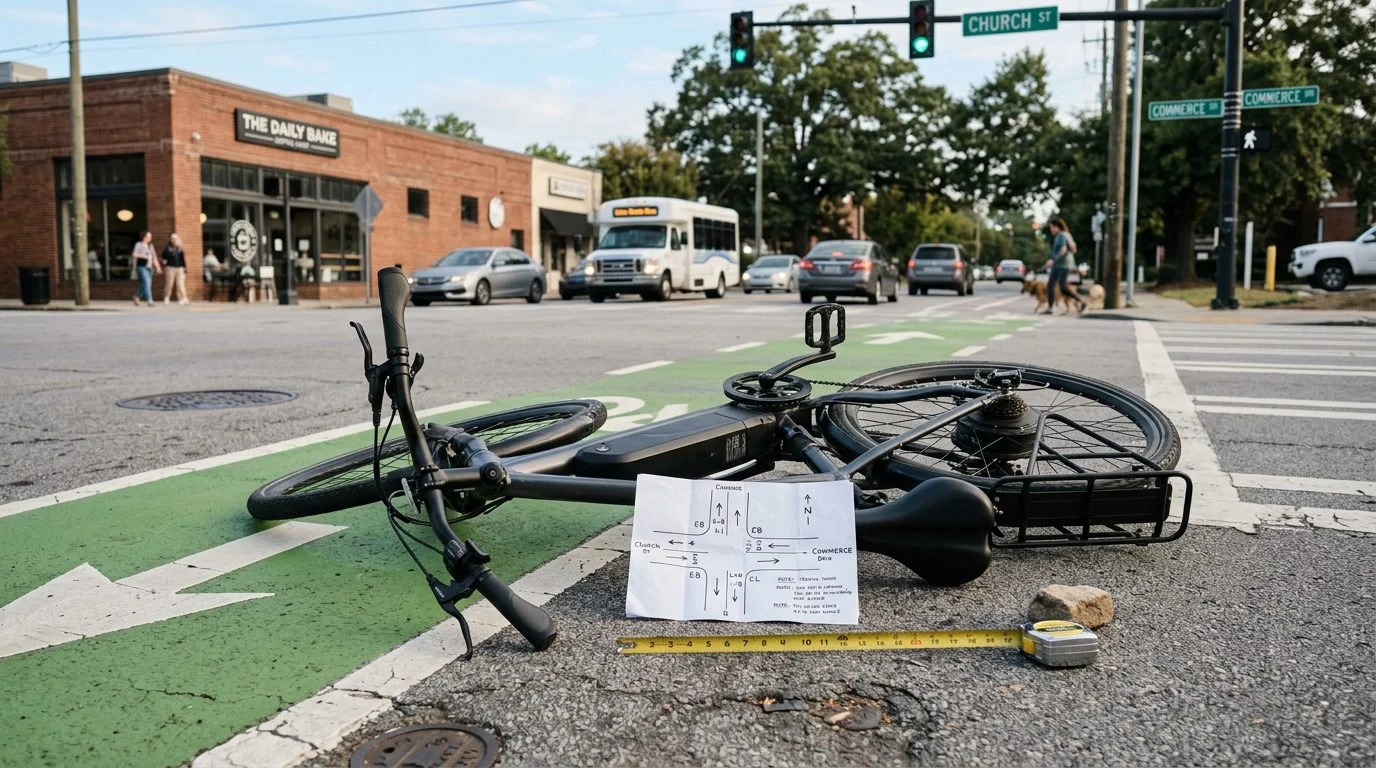
E-bike crashes · Georgia
Hurt on an E-Bike? Your MedPay May Help Cover Medical Bills
Your own auto policy may hold a payment option you have not used yet. Here is how to check it, and what to do before you talk to any insurer.
About T. Madden & Associates, P.C.
1999
Practicing personal injury law in Georgia since
5
Offices in Jonesboro, Atlanta, Decatur, Macon and Augusta
24/7
Call line for injured Georgians
By Terance Madden · Published November 22, 2026
Your e-bike took a hit from a car, and the medical bills are already piling up. You want to know if your own insurance can pay them now.
MedPay may help, but only if your policy’s wording reaches the crash. MedPay, or medical payments coverage, is an optional part of an auto policy that pays certain medical bills after a crash. Whether it reaches an e-bike rider depends on the policy, not just on the fact that you were riding a bike.
What MedPay Means in a Georgia Auto Policy
MedPay is an optional coverage that pays medical bills from your own auto policy, up to a set limit. Not every policy includes it, so the first step is checking the policy itself.
The declarations page lists the coverages you bought and their limits. If MedPay is listed, the limit is the most it can pay. If it isn’t listed, it may not be on the policy at all.
The policy’s definitions decide who is covered. Those definitions, not the label on the bike, control the question. Depending on how the policy defines an insured person, a household member’s policy can matter too.
Read the whole policy, not just the summary. A quick phone answer can miss the one line that changes everything.
Not sure what your next step is?
Talk it through with our team — the first consultation is free, confidential, and carries no obligation.
Can MedPay Apply When a Car Hits an E-Bike Rider?
Yes, it can, if the policy wording reaches the crash. Some riders qualify under MedPay and some do not.
Three questions matter most. First, whose policy is it: yours or a household member’s? Second, who counts as an insured person under that policy? Third, how does the policy describe the vehicle and the way the crash happened?
An e-bike is not a car. Many policies were written with cars and trucks in mind, so the wording needs a close read.
The firm reads the policy and the crash facts side by side. Those facts include the police report, the speed, the path of the car and the photos taken at the scene. The Georgia Department of Public Safety policy says state troopers investigate crashes to find whether traffic laws were violated, and may take enforcement action. That finding is separate from the fault question decided in your claim.
The Other Insurance Layers That May Apply
MedPay is only one layer. The firm looks at every layer that may apply, not only the first one an insurer names.
Liability coverage. The at-fault driver’s liability policy pays for the injury claim against that driver. MedPay is a separate layer from it.
Uninsured and underinsured motorist coverage. Georgia requires auto liability policies to include uninsured motorist coverage unless the insured rejects it in writing. The O.C.G.A. § 33-7-11 statute also sets out how that coverage works alongside the at-fault driver’s liability limits. Your own policy may hold this coverage, so read it closely.
Umbrella and excess coverage. Some families carry an umbrella policy, which adds limits above the auto policy. Excess coverage works in a similar way. A serious injury can need more than the first policy pays.
Employer coverage. If you were riding on a work errand, the company may answer for its driver. Under O.C.G.A. § 51-2-2, a person is liable for torts committed by his servant within the scope of his business. Workers’ compensation is a separate system with its own rules, so review it with the firm.
How Big Insurance Slows and Shrinks an E-Bike Claim
Big Insurance is not on your side. A first offer is rarely what your claim is worth.
Expect a few moves. A low offer often arrives before treatment ends and before the full costs are known. A request for a recorded statement often comes fast, while you are still sore and short on facts. Words said on that recording can be pulled out later and used against you.
Claims can also slow down while paperwork is reviewed. Waiting weeks for replies and new documents is hard on families, and some accept less just to end the wait.
Treatment gets disputed too. An insurer may argue that the ER visit, the scans or the follow-up care were not needed or not tied to the crash.
Watch for the low-impact argument. Big Insurance may say a bike hit at low speed could not cause serious harm. Crash physics and speed evidence answer that argument, and that evidence must be gathered early.
Georgia also sets rules for settlement offers. Under O.C.G.A. § 9-11-67.1, from the time a cause of action accrues until the filing of an answer by the named defendant (or, if there are multiple named defendants, until all of them have filed their initial answers or been found in default), an offer to settle a motor vehicle collision claim that is prepared by or with the assistance of an attorney on behalf of a claimant must give a payment date not less than 40 days from receipt of the offer.
The firm prepares the claim as if it will go to trial. It documents every injury and expense, and it pursues every coverage layer, including the full cost of the injury over time.
Medical Bills, Liens and Georgia’s Fault Rules
A lien is a legal claim that lets a hospital, doctor or insurer get repaid from your settlement or judgment. Liens must be sorted out before the money is final.
Medicare can also have a claim. The CMS Medicare Secondary Payer overview states that when a person entitled to Medicare was in an accident or other situation where no-fault or liability insurance is involved, that insurance pays primary for the related health care services claimed or released. It also says Medicare may make a conditional payment when a liability insurer will not pay promptly, and that payment must be repaid from a settlement.
Georgia counts health insurance in the medical bill evidence. Under O.C.G.A. § 51-12-1.1, if you have any form of health insurance, the evidence includes both the amount charged and the amount actually needed to satisfy the charge under that insurance.
If a provider treated you under a letter of protection, a promise to be paid from a future settlement, that letter and the itemized charges are relevant and can be requested in your case.
Fault matters too. Under O.C.G.A. § 51-12-33, damages are reduced by your percentage of fault. A plaintiff who is 50 percent or more responsible recovers nothing. That is why the crash facts get reviewed closely.
Timing matters. Georgia generally gives two years to file an injury lawsuit, under O.C.G.A. § 9-3-33.
The Family Member Managing the Recovery
If you are the spouse, mother or adult daughter keeping the bills and calls straight, you hold the paper trail that makes the claim work.
Keep one simple record. Save every bill, every explanation of benefits and every receipt. Log every call with an insurer: the date, the person’s name and what was said.
Track every missed day of work and the reason for it. Under O.C.G.A. § 51-12-7, necessary expenses from an injury are a legitimate item in the estimate of damages, so those receipts matter.
Do not give a recorded statement or sign a release until you have talked with the firm. A release usually ends the claim, so read every paper with the firm first.
Keep the rest of the family in the loop. The firm gives plain-English updates, so no one has to guess what the claim means for the next bill.
Not sure what your next step is?
Talk it through with our team — the first consultation is free, confidential, and carries no obligation.
Talk to the Firm Before You Answer the Adjuster
If an adjuster wants a recorded statement and your MedPay payment looks small, slow down and get advice first.
Before law school, Terance Madden trained as an electrical engineer and earned a B.S. in Electrical Engineering. He starts a case by asking what the evidence shows and how the crash happened. For an e-bike claim, that means looking at speed, the path of the car, the bike’s condition and which records must be preserved before they disappear. His engineering training also helps him work through crash physics when Big Insurance argues a low-impact collision.
T. Madden & Associates, P.C. has practiced in Georgia since 1999, with offices in Jonesboro (Clayton County), Atlanta, Decatur, Macon and Augusta. Terance Madden is the responsible lawyer for this page.
The firm works on a no-fee-unless-we-win basis, but you may still owe court costs and case expenses. The first consultation is free, confidential and comes with no obligation to continue.
If a careless driver left you hurt on your e-bike and the bills keep coming, you don’t have to sort out MedPay, liens and the other layers alone. Request a free case evaluation before you give that recorded statement.

Frequently Asked Questions
What is MedPay coverage in Georgia?
MedPay, short for medical payments coverage, is an optional part of an auto insurance policy that pays medical bills after a crash, up to the policy limit. It pays regardless of who caused the crash, and it is separate from any claim against the at-fault party.
Can MedPay pay for an e-bike crash?
It depends on the policy wording. Some policies cover injuries to the named insured and family members while riding a bicycle or other non-motor vehicle, and others do not, so the exact language matters. Have the policy reviewed before assuming it applies.
Does MedPay still pay if the crash was my fault?
In most cases, yes. MedPay is generally not tied to fault, but the policy’s terms, limits and exclusions still control what is paid. If you were hurt in a crash that was someone else’s fault, call the firm for a free, confidential consultation, and the team will explain your options.
Does using MedPay affect a claim against the other driver?
It can affect how the claim is handled, so do not sign any reimbursement or release paperwork without reviewing it first. Big Insurance often opens with a low offer, and a first offer is rarely what a claim is worth. Georgia’s general time limit for most personal injury claims is two years, so it is important to act early.