

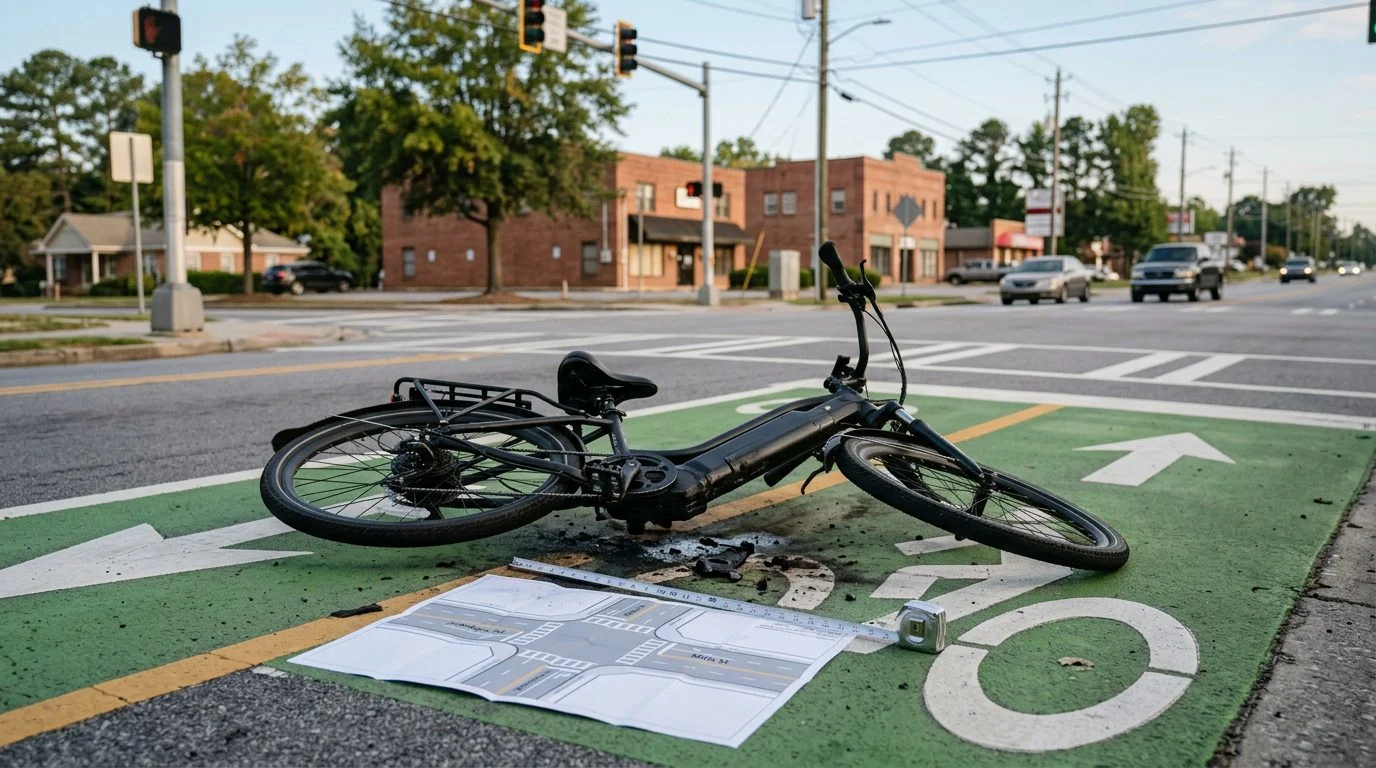
E-Bike Battery Fire Claims | Jonesboro, Atlanta, Decatur, Macon and Augusta
Hurt in an e-bike battery fire? Get answers from a Georgia lawyer who reads the evidence.
Off-brand and defective lithium-ion batteries can burn fast and leave families with serious injuries and losses. Here is how we look at these cases and where to start.
T. Madden & Associates, P.C.
1999
In practice since
5
Georgia offices: Jonesboro, Atlanta, Decatur, Macon and Augusta
24/7
Call us any time
By Terance Madden · Published November 14, 2026
Your e-bike battery caught fire. Now you’re dealing with burns, medical bills and a home that smells like smoke.
Georgia law may let you hold the companies behind a defective battery responsible, even if you never bought anything from them. That is the core of a product liability claim (a suit saying a product was defective and caused harm).
Can You Hold a Company Responsible for a Battery Fire in Georgia?
Often, yes. If a defect caused the fire, Georgia’s product liability law can reach the company that made the product.
Georgia’s main product liability statute, O.C.G.A. § 51-1-11, makes a manufacturer liable in tort (a civil wrong that causes harm). That liability applies without privity (a direct contract between buyer and seller). Under O.C.G.A. § 51-1-11, the manufacturer of personal property sold as new property is liable in tort, even without a direct contract, to any natural person who may use, consume, or reasonably be affected by the property and who suffers injury to his person or property, when the property as sold by the manufacturer was not merchantable and reasonably suited to the use intended, and that condition was the proximate cause of the injury.
An off-brand battery has no known brand behind it, or it is sold without a recognized safety certification mark. A recall is a public call-back of a product by its maker or a regulator. Both facts matter, and the firm checks both.
Georgia also has a statute of repose, which is an outer time limit that runs from a set date rather than from when an injury was discovered. Under O.C.G.A. § 51-1-11(b)(2), no action may be commenced for an injury more than ten years after the date of the first sale for use or consumption of the personal property that caused the injury. Subsection (c) applies the same limit to many negligence claims against a manufacturer, with exceptions for certain claims involving a disease or birth defect and for conduct showing a willful, reckless, or wanton disregard for life or property. In Chrysler Corp. v. Batten, the Georgia Supreme Court said that “the exclusion places failure-to-warn causes of action outside the ambit of the statute of repose.”
This page serves injured riders, bystanders, and the families who manage recovery or lose a loved one. The firm handles e-bike crash and lithium battery fire cases from offices in Jonesboro (Clayton County), Atlanta, Decatur, Macon and Augusta.
If an off-brand or recalled e-bike battery burned you or someone you love, you may have a claim, and our team can help you start. Talk it through with our team — the first consultation is free, confidential, and carries no obligation.
What Can a Battery Fire Claim Cover?
A claim can seek medical costs, lost pay, pain and suffering, property loss and, after a death, the family’s losses.
- Medical costs: emergency care, burn treatment, surgery, rehab and future care.
- Lost wages: time off work, and lost earning ability if burns or crush injuries limit your job.
- Pain and suffering: scarring, emotional harm and loss of daily life.
- Property: your home, garage, belongings or vehicle.
Georgia splits losses into two groups. General damages are presumed to flow from the wrong and need no exact dollar proof. Special damages, like bills and lost wages, must be proved under O.C.G.A. § 51-12-2.
Property claims run on their own clock. Georgia gives four years for injury to personal property under O.C.G.A. § 9-3-31. Start a log of bills, receipts, mileage and missed work now. Those papers carry the numbers.
Who Can Be Liable for an Off-Brand or Recalled Battery?
More than one company can be liable, not only the brand on the bike.
- The maker of the e-bike and of the battery pack.
- Cell makers and parts suppliers whose defective parts failed.
- Importers and distributors who brought the product to market.
- Sellers, including online stores, that sold a recalled or uncertified product.
- Charger makers and repair or conversion shops that changed the battery or charging system.
Georgia treats sellers differently from makers. Under O.C.G.A. § 51-1-11.1, a seller that is not the manufacturer is not liable as one under strict liability. In Alltrade, Inc. v. McDonald, a company that only put its name on a product, with no input into making it, was a product seller and not a manufacturer. That is why the paper trail matters.
More defendants can mean more insurance to pursue.
How Does the Physical Evidence Show What Went Wrong?
The battery, the charger and the fire scene show where the failure started, and they can be lost fast.
- Preserve the battery, charger, bike, packaging, receipts and online orders.
- Do not repair, throw away or charge a damaged battery pack.
- Photograph the scene, the damage pattern, and every label, marking and serial number before anything moves.
Terance Madden brings engineering training to his cases, so he starts by asking what the evidence shows and how the crash happened. Before law school, he trained as an electrical engineer, so he starts with what the evidence shows and how the fire began. Battery fires often leave clues in cell damage, venting and the protection circuitry inside the pack. Reading those clues can separate a cell defect from a bad charger or a modification, and each answer points to different companies.
Safety groups such as UL Solutions publish material on lithium-ion battery incident reporting and the value of recording incident details early.
How Does a Battery Fire Claim Move Forward?
A claim moves from a free first consultation to evidence work, a demand for payment, and a lawsuit if a fair offer is not made.
- Free first consultation. The initial consultation is free, confidential and carries no obligation to continue.
- Preservation and records. The firm sends preservation letters and asks for product records, recall notices and sales history.
- Cause investigation. The fire’s cause is traced through the chain of makers and sellers.
- Coverage review. Every source of insurance is identified, including liability, UM/UIM where it applies, umbrella, excess and corporate coverage.
- Demand and negotiation. The claim is built as if it will go to trial.
- Suit when needed. Georgia’s general deadline for injury to the person is two years after the right of action accrues under O.C.G.A. § 9-3-33, with exceptions, so timing runs from when the claim accrued, not from the first call.
Simple claims can settle in months. Serious injury, several defendants or a death often take longer.
The client may still be responsible for court costs and case expenses.
What Does Big Insurance Do After a Battery Fire Claim?
Big Insurance is not on your side, and its first offer is rarely what your claim is worth.
Expect these tactics:
- A quick, low first offer before the full damage is known.
- A recorded statement taken early, while you are still hurting and confused.
- Delays in paying for treatment, or disputes over whether treatment was needed.
- Arguments that the fire came from a modification or misuse.
The response is to pursue every coverage layer: liability, UM/UIM where it applies, umbrella, excess and corporate policies. The firm values the claim over lifetime damages, including future care. It prepares every case as if it will go to trial. Speak with a lawyer before you give a recorded statement or sign a release.
Not sure what your next step is?
Talk it through with our team — the first consultation is free, confidential, and carries no obligation.
What Does the Firm Bring to a Battery Fire Case?
T. Madden & Associates, P.C. has practiced personal injury law in Georgia since 1999, and attorney Terance Madden leads the firm.
- Responsible lawyer: Terance Madden. The firm’s lawyers include Terance Madden and Shenia Madden, supported by assistants and office staff.
- Offices: Jonesboro (Clayton County), Atlanta, Decatur, Macon and Augusta.
- Communication: Our team explains each step of your case in plain English.
- Community: The Terance Madden Foundation supports community work across Georgia.
- Practice areas: product liability, lithium battery fire, e-bike crash, catastrophic injury and wrongful death matters.
Your Questions About Battery Fire Claims, Answered
What laws apply to e-bikes in Georgia?
A battery fire claim turns mostly on whether the product was defective and who made and sold it.
Should I talk to the insurance company?
Don’t give a recorded statement or sign a release before you speak with a lawyer.
Can a family bring a claim after a fatal fire?
Under O.C.G.A. § 51-4-2, a surviving spouse may recover the full value of the decedent’s life, as shown by the evidence. If there is no surviving spouse, the children may.
What if I was partly at fault?
Under O.C.G.A. § 51-12-33, damages are reduced by your share of fault, and you recover nothing if you are 50 percent or more responsible.
Talk to a Georgia Lawyer About Your E-Bike Battery Fire Today
If a battery that was off-brand or recalled burned you, a family member or your home, the evidence needs protecting now. Call T. Madden & Associates, P.C. any time, 24/7, or start your free case evaluation and talk through your options.