

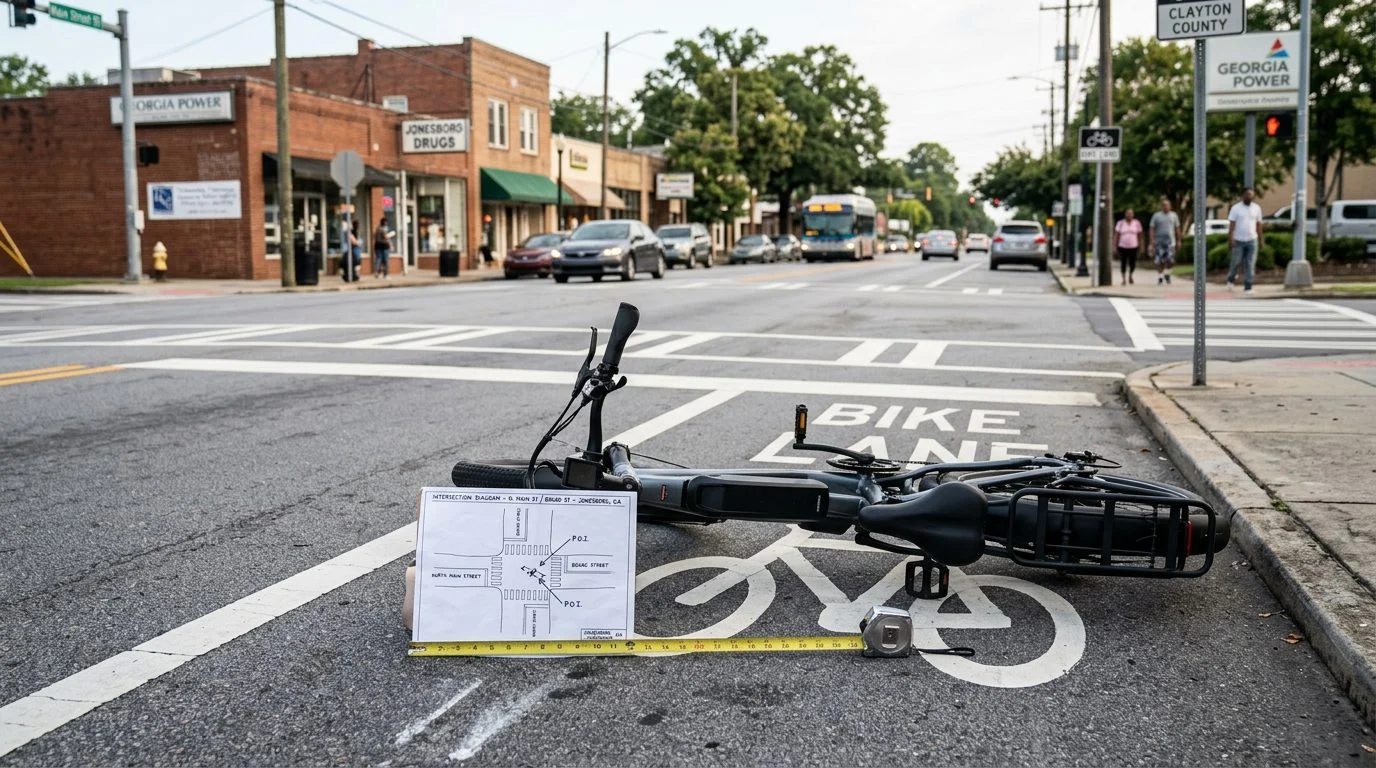
E-bike accident lawyer | Georgia
Hit on the Sidewalk by an E-Bike? Start With What Happened.
Pedestrians hurt by e-bike riders often ask one question first. The answer turns on the facts, and the firm can help you sort them out.
The firm at a glance
1999
Practicing since
5
Offices across Georgia
By Terance Madden · Published November 21, 2026
If an e-bike rider hit you on a sidewalk or in a crosswalk, the first question is who pays. A store, seller or bike maker can be liable if a defect caused the crash. Which one applies depends on what went wrong, and the evidence decides it.
“Liable” means legally responsible for harm done to another person. This page explains how Georgia sorts that out. For the wider picture, read our Georgia e-bike crash guide.
Who Can You Claim Against After an E-Bike Rider Hits You?
Several people may be responsible, and the rider is only one of them. Start with the rider. Careless riding can mean speed too high for people on foot, attention on a phone, or failing to slow for someone in the path.
A product claim is different. It asks whether the bike, the battery or a part was defective. A store may be a defendant if it sold, assembled or repaired the bike. A bike or battery maker may be a defendant if its design or parts caused the harm.
Often one question leads to another. A battery that overheats and throws the rider off a sidewalk raises a product question. A rider who was going too fast raises a conduct question. Some crashes raise both.
If an e-bike rider hit you or someone you love on a sidewalk or in a crosswalk, someone may be responsible, and our team can talk through your options with you. Talk it through with our team — the first consultation is free, confidential, and carries no obligation.
How Georgia Decides Who Was at Fault
Georgia reduces your money by your share of fault. A high enough share can cut your recovery to zero. Negligence is the core idea. It means failing to use the care an ordinarily prudent person would use in the same circumstances. Georgia calls that failure ordinary negligence (O.C.G.A. § 51-1-2).
Georgia uses a modified comparative fault rule. Comparative fault means each person’s share of blame is weighed. Under O.C.G.A. § 51-12-33, the judge reduces your damages by your percentage of fault.
The line that matters most is 50 percent. The statute says a plaintiff who is 50 percent or more responsible recovers no damages (O.C.G.A. § 51-12-33; Quynn v. Hulsey (2020)). At 50 percent, you get nothing.
Fault can also be split. Damages are divided by each person’s percentage, and that liability is not joint. Each at-fault person pays only its own share.
The question is simple to say and hard to prove. Who did what, and did it fall short of reasonable care?
When the Rider Is Responsible on a Sidewalk or Crosswalk
A rider who hits a pedestrian on a walkway or in a crosswalk can be liable for careless riding. The rider’s choices in the seconds before impact are the facts that matter most.
Georgia’s pedestrian statute says drivers of vehicles must use due care to avoid colliding with any pedestrian upon any roadway (O.C.G.A. § 40-6-93).
Look at the choices that matter. Was the rider moving fast on a crowded sidewalk? Did the rider cut through a crosswalk without slowing? Was the rider looking at a phone? Did the rider see a child or an older adult and keep going? These are the points a claim turns on.
Accounts often conflict. The rider tells one story, you tell another, and witnesses may remember it differently. The story gets checked against video from phones, doorbells and nearby businesses. It also gets checked against physical marks, such as where the bike came to rest and where the person landed.
The rider made a choice that day. The person who was hit lives with what came next.
When a Store, Seller or Bike Maker May Be Responsible
A store, seller or maker may be responsible when a defect in the bike or its parts caused the harm. This is called product liability. It means a claim that a product was defective and the defect caused the injury.
Defects come in three types. A design defect means the design itself is unsafe. A warning defect means the maker knew of a danger and did not warn about it.
Common problems in e-bike crashes include lithium-ion battery failures, controller problems, brake failures, and off-brand or counterfeit parts that were not built to the same standard.
Merchantable goods must be fit for the ordinary purposes for which they are used (O.C.G.A. § 11-2-314).
Timing matters. Under O.C.G.A. § 51-1-11(b)(2) and (c), the ten-year statute of repose does not end a manufacturer’s duty to warn once it knows of a danger, as discussed in Chrysler Corp. v. Batten.
A seller is treated differently from a maker. Under O.C.G.A. § 51-1-11.1, a seller that is not the manufacturer is not liable as one under strict liability. Other claims against a seller may still apply, but this Code section does not itself grant a cause of action in strict liability in tort or any other legal theory.
Keep the bike, battery, charger and parts as they are. Don’t let them be repaired or thrown out before the evidence is saved.
What the Evidence Shows and How Terance Madden Evaluates It
The evidence decides whether the claim points at the rider, the product, or both.
Before law school, Terance Madden trained as an electrical engineer, so he looks at the evidence first and asks what it shows about how the crash happened. Before law school, he trained as an electrical engineer. So he starts a case by asking what the evidence shows and how the crash happened. He looks at battery cells, charging circuits, controllers and brakes. He also identifies which records must be preserved before they are lost.
Several kinds of evidence usually matter here. Video from phones, doorbells and businesses near the crash. Photos of the scene, the bike and your injuries. Skid or brake marks, and where the bike and the people came to rest. The battery, charger, controller and brake parts. Any app or onboard data that records speed and braking. Repair, maintenance and purchase records.
Each one answers a different question. A battery that failed under load points toward a product claim. A rider who was moving too fast points toward a conduct claim. Speed and braking data can answer that question quickly. That data can also disappear once the bike is repaired or scrapped.
Other parties may share fault too. A parts vendor, a repair shop or a maker can carry part of the responsibility. Each may carry its own liability insurance, which can add coverage to the claim.
How Big Insurance Handles an E-Bike Claim
Big Insurance is not on your side. A first offer is rarely what a claim is worth. Its job is to pay as little as it can.
Expect tactics. A low first offer that arrives fast, before the full medical picture is known. A request for a recorded statement, often while you’re still in treatment. Delays on medical bills and paperwork. Arguments that the crash was “low speed” or “minor contact,” or that your treatment wasn’t needed.
Here is the response. Find every coverage layer. That can include the rider’s liability policy, a household or renters policy that may cover the rider, your own uninsured or underinsured motorist coverage where it applies, umbrella and excess policies, and business or corporate policies for a store or maker.
Damages in Georgia are generally compensation for injury that can be estimated in money, but if an injury is small or the mitigating circumstances are strong, only nominal damages are given (O.C.G.A. § 51-12-4). The firm pursues that full cost, not only the bills on the table today.
The firm prepares every claim as if it will go to trial. That means building the file for a courtroom from the first day, not only for a settlement table.
Not sure what your next step is?
Talk it through with our team — the first consultation is free, confidential, and carries no obligation.
Time Limits and What the Family Should Keep
Georgia generally gives two years to file a lawsuit for an injury to the person. Under O.C.G.A. § 9-3-33, actions for injuries to the person must generally be brought within two years after the right of action accrues, except for actions for injuries to the person involving loss of consortium, which must be brought within four years after the right of action accrues. The clock runs from when the claim arises, so don’t wait to find out when it starts.
Some claims follow different steps, so check the timeline early.
Keep a clear file. Photos of your injuries and the scene. Names and phone numbers of witnesses. The bike, battery, charger and parts. Medical records and bills. A written log of missed work, pain and daily limits.
If you’re the spouse, mother or adult daughter handling appointments, bills and insurance calls, you’re holding this together. Keep the log every day. Send insurance calls to a plan instead of answering on the spot. Don’t give a recorded statement until you’ve talked with a lawyer about it.
If the injured person has Medicare, the federal program’s rules matter. CMS explains that Medicare may make a conditional payment, which must be repaid from a settlement or judgment. Federal law takes precedence over state laws and private contracts (CMS). Raise this early.
Hurt on a Sidewalk or in a Crosswalk by an E-Bike? Talk to the Firm
If an e-bike rider hit you or someone you love, you’re facing a hard choice. Who pays? Should you speak with the rider’s insurer, and should you keep the bike and battery as evidence?
Before you answer a recorded statement or accept an offer, contact T. Madden & Associates, P.C. about the crash. Terance Madden is the responsible lawyer for this page. The firm has offices in Jonesboro, Atlanta, Decatur, Macon and Augusta.
The first consultation is free, confidential, and comes with no obligation to continue. The firm works on a no-fee-unless-we-win basis, but you may still owe court costs and case expenses if the case is not won.
Contact T. Madden & Associates about your crash.

Frequently Asked Questions
Can I file a claim if an e-bike rider hit me while I was walking in Georgia?
Yes, if the rider’s careless choices caused your injuries, you may have a claim against the rider and possibly other parties. The firm can review what happened, including who was at fault and what coverage may apply, during a free, confidential consultation with no obligation to continue.
How long do I have to file a lawsuit after a pedestrian is hit by an e-bike in Georgia?
Most Georgia personal injury claims must be filed within two years of the injury, under O.C.G.A. § 9-3-33, and some claims have shorter or different deadlines. Do not wait to get the facts and the deadline checked.
What if the rider says I was partly at fault for the crash?
Georgia uses a modified comparative fault rule, so you can still recover if you were partly at fault, as long as you were less than 50 percent responsible, under O.C.G.A. § 51-12-33. Your recovery is reduced by your share of fault, so the evidence of who did what matters.
Who pays if the e-bike rider has no insurance?
Depending on the policies involved, coverage may come from the rider’s household liability policy or from your own auto policy’s uninsured motorist coverage. Whether coverage applies depends on the policy language, so if you were hurt by a careless rider, call the firm to talk through your options.