

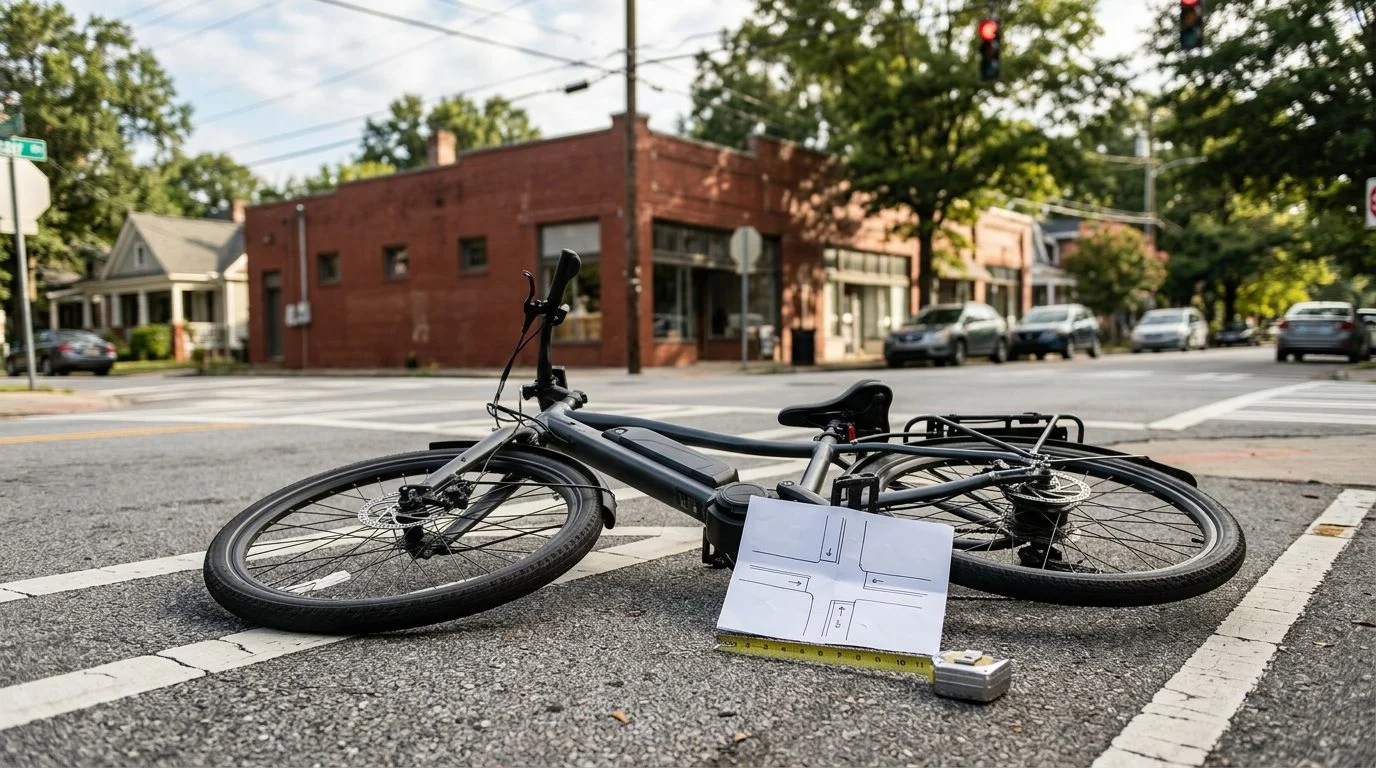
E-bike crash claims in Georgia
Hurt on an e-bike? Find out who pays your claim.
Several policies may be in play after a crash, and the first offer you receive is rarely the final word. Here is how to sort through them.
T. Madden & Associates, P.C.
1999
Year the firm began representing injured people
5
Georgia offices: Jonesboro, Atlanta, Decatur, Macon and Augusta
24/7
Call us any time
By Terance Madden · Published November 11, 2026
You’re hurt, you’re on an e-bike, and the bills are already coming in. The first question is usually which insurance pays.
In most Georgia e-bike cases, the first source is the at-fault driver’s liability insurance. If another driver’s carelessness caused the crash, that driver’s policy is where the claim starts. If that policy is too small, or the driver can’t be found, your own coverage may step in. Several other policies can matter too.
Start With the At-Fault Driver’s Liability Coverage
The at-fault driver’s liability insurance is usually the first place to look when another driver caused the crash.
Liability insurance is coverage that pays what a policyholder owes another person for harm the policyholder caused. A driver who runs a red light and hits a rider has that kind of exposure. The rider makes the claim against that driver’s insurer.
Georgia also uses a shared-fault rule. Under O.C.G.A. § 51-12-33, the trier of fact (the person or group who decides fault) sets each person’s percentage of fault. If you are 50 percent or more at fault, you cannot recover damages. The Georgia Supreme Court quoted this statute in Quynn v. Hulsey (2020).
Every policy has limits, which is the most it will pay. A serious injury can cost more than a standard limit covers. That gap is why the next layers matter.
If someone else's choices left you hurt on your e-bike, you may have a claim, and our team can help you sort out which policies apply. Talk it through with our team — the first consultation is free, confidential, and carries no obligation.
Does Bike Insurance Cover an E-Bike Crash?
Sometimes, but only what the policy’s wording says.
Some riders buy a separate e-bike policy. These can cover injuries to the rider, liability to others, theft, or damage to the bike. Read the wording before you assume any of it applies to your crash.
Many riders carry no e-bike policy at all. That’s common, and it means other policies often matter more. A homeowners or renters policy usually covers claims made against the policyholder for harm they cause. Depending on the policy, it may also cover theft of or damage to the bike.
Gather every policy that might apply, including ones held by household members. Put them in one pile and review them together. A policy you forgot about can be the one that pays.
Your Own Auto Policy: Uninsured and Underinsured Motorist Coverage
Your own auto policy may pay when the at-fault driver has no insurance or not enough.
Uninsured motorist (UM) coverage pays when the at-fault driver has no insurance. Underinsured motorist (UIM) coverage fills the gap when the at-fault driver’s limits are too low for your losses. Under O.C.G.A. § 33-7-11, an automobile liability policy must include uninsured motorist coverage for the insured’s bodily injury, loss of consortium, death or property damage caused by an uninsured driver, unless an insured named in the policy rejects that coverage in writing, and that coverage applies within limits, not counting interest and costs, that the insured chooses; this requirement does not apply to umbrella or excess liability policies unless the policy or a policy endorsement provides for it.
This matters even if you don’t own a car. A rider may be covered under a household member’s auto policy. Who counts as covered depends on that policy’s wording, so check it line by line.
UM and UIM claims are made by the injured person against their own insurer. Your own insurer may ask for a recorded statement and early medical records. Answer carefully. Stick to what you know, and don’t guess about speed, timing or what you saw.
When the Driver Leaves the Scene
When the driver flees, UM coverage often becomes the main source of payment.
Georgia law requires a driver in a crash that causes injury to stop at the scene. The driver must give a name, address and vehicle registration number, and must render reasonable help to anyone hurt, under O.C.G.A. § 40-6-270. If a driver knowingly fails to stop after a crash that causes serious injury or death, the law makes it a felony. The penalty is one to five years in prison.
Reporting matters too. Under O.C.G.A. § 40-6-273, a driver in a crash that causes injury, or property damage of $500.00 or more, must immediately, by the quickest means of communication, notify the local police if the crash occurs within a municipality, or the county sheriff or nearest state patrol office if it occurs outside one.
Collect what you can. Take photos of the scene and the bike. Get witness names and phone numbers. Write down the police report number. Note any nearby business camera. These facts help show what happened when the driver is gone.
Work, Delivery Vehicles and Other Liable Parties
Coverage can come from a job, a delivery company or a faulty part, not only from the driver.
If you were working when you were hurt, workers’ compensation may apply. Workers’ compensation is the state system that pays for work-related injuries. Under O.C.G.A. § 34-9-11, those benefits exclude and replace your other rights and remedies against your employer for that injury, unless the employer has expressly agreed in writing to specific additional rights and remedies. You still keep the right to sue a third-party tort-feasor, which is any outside person or company whose wrongful act caused your harm, except an employee of the same employer, a person who provides workers’ compensation benefits under a contract or agreement with the employer, a construction design professional in the limited situations the statute describes, or an employee of a construction design professional who is assisting in the performance of professional services on the construction site on which the employee was working when injured. O.C.G.A. § 34-9-11 reads: “unless the construction design professional specifically assumes by written contract the safety practices for the project.”
A delivery van, rideshare vehicle or company car may carry a commercial or corporate policy. Those policies can have higher limits than a personal policy. Ask who the vehicle belongs to and who was driving it for work.
Each one can bring another insurance policy into the claim. Under O.C.G.A. § 51-12-33, each liable person’s share is its own. Damages are not joint, and the trier of fact must consider the fault of everyone who contributed. That’s why finding every liable party is part of pursuing every coverage layer.
Health Insurance, Medical Payments and Medical Bills
Health insurance often pays your bills first, while your claim is still pending.
Health plans usually expect repayment from any settlement. That repayment right is called a lien, which is a claim against settlement money for what was already paid. Medical payments (med-pay) coverage on an auto policy may pay some medical costs no matter who caused the crash. It depends on the policy.
Georgia law also shapes how medical bills are proven. Under O.C.G.A. § 51-12-1.1, medical expenses are limited to the reasonable value of medically necessary care. If you have health insurance, the evidence includes both the amounts charged and the amounts actually needed to satisfy those charges under your policy. That’s true whether or not you used the insurance.
Some providers treat injured patients under a letter of protection, which is a promise to be paid from the claim instead of up front. Discoverable means the other side can request them during a case.
Keep every bill, explanation of benefits and treatment note. Insurers often look for gaps in treatment, so keep your appointments and tell your doctor about every symptom.
Not sure what your next step is?
Talk it through with our team — the first consultation is free, confidential, and carries no obligation.
What the Bike’s Data Can Show About Who Pays
The bike’s controller and app data can show how fast it was moving and how hard the motor was working.
E-bike controllers can record data like speed, pedal-assist level, battery status and sometimes braking or timing details around a crash. An app may keep trip logs too. Read in plain words, that data can show whether the rider, the other driver or a part of the bike played a role. Which party caused the crash decides which insurance responds.
In his practice, he reads technical evidence like this himself, including how a controller records speed and power.
Save the bike, the battery, the charger and any app data on your phone. Don’t sell the bike or strip its parts before someone has looked at it. Evidence that disappears can’t help your claim.
How Big Insurance Handles E-Bike Claims
Big Insurance is not on your side, and its first offer is rarely what your claim is worth.
Big Insurance adjusters, the people who evaluate claims for insurers, often use familiar tactics. They may make a low first offer. They may ask for a recorded statement early, before you know the full extent of your injuries. They may delay payment, dispute whether your treatment was needed or argue that a “low impact” crash could not cause serious harm.
The response is to pursue every coverage layer. It also means counting the full lifetime cost of an injury that lasts, not just the first bills. And it means preparing the claim as if it will go to trial.
T. Madden & Associates, P.C. has practiced since 1999, with offices in Jonesboro, Atlanta, Decatur, Macon and Augusta. Our team builds every claim with that preparation in mind.
Parents and Caregivers of a Hurt Teen Rider
A parent or guardian usually manages a teen rider’s care and calls with insurers.
Many e-bike riders are teenagers. If your child was hurt, you’re likely the one scheduling appointments, sorting bills and taking calls from insurers. That’s a lot to carry. Your family has always looked out for each other, and this is no different.
Your family’s own policies may count too. Review the auto, home and health policies in your household, along with any policy that covers the bike. A teen’s injury can touch more than one of them.
Keep a dated log. Write down symptoms, appointments, missed school days, medications and every call with an insurer, including who called and what was said. A log turns memory into records, and records carry weight later.
Deadlines Georgia Riders Should Know
Georgia generally gives two years from the date of injury to file a personal injury lawsuit (O.C.G.A. § 9-3-33; Kenneth B. Cameron v. Jmp Pizza, Inc (2026)).
Under O.C.G.A. § 9-3-33, actions for injuries to the person must be brought within two years after the right of action accrues. A statute of limitations is the legal deadline to file a lawsuit. Claims for loss of consortium, which means a spouse’s loss of companionship and support, have four years under the same statute.
Waiting also makes proof harder. Photos fade, witnesses move and bike data can be lost. Start gathering records early, even while you focus on your recovery.
Next Step After an E-Bike Crash
If you were hurt on an e-bike and don’t know which policy will pay, start with the questions you can answer today.
Can I still recover if I was partly at fault?
Georgia reduces your damages by your share. At 50 percent or more, you recover nothing (O.C.G.A. § 51-12-33; Quynn v. Hulsey (2020)).
How long do I have to file?
Georgia generally gives two years from the injury to file a personal injury lawsuit (O.C.G.A. § 9-3-33; Kenneth B. Cameron v. Jmp Pizza, Inc (2026)).
Does a separate e-bike policy always pay?
No. It pays only what its wording covers, so read the coverage terms closely.
If you were hurt by a driver who didn’t stop, or by a crash that wasn’t your fault, you may have a claim against the people and policies behind it. The firm offers a free first consultation, which is confidential and carries no obligation to continue. Start a free case evaluation and let our team map out which policies may pay.