

Truck Accident Lawyer | Clayton County, GA
Hurt in a Semi Crash in Clayton County? Start With These Steps
The first hours and days after a big-rig collision matter. Here is what to do, and how T. Madden & Associates, P.C. can help you protect your claim.
Serving Georgia Injury Victims
Since 1999
Representing injured people
5
Offices across Georgia
Free
Confidential first consultation
By Terance Madden · Published October 30, 2026
What do I do if a semi hits my car?
Call 911 first, get medical checks, and move out of traffic if you can. Those three steps come before anything else. If you’re wondering what to do after a semi crash in Clayton County, this page walks through the order most people need it on the day of the crash.
A semi crash is often more complicated than a typical car wreck. Trucks are large, more than one vehicle may be involved, and the trucking company may keep records you cannot see from the roadside. Some facts fade fast. These include where vehicles stopped, what the truck’s markings say, and what witnesses saw.
You might be reading this for yourself. You might be reading it for a family member who was hurt or is still shaken. Either way, the steps below are arranged in the order that matters most.
- Call 911.
- Get medical care.
- Stay safe at the scene.
- Document the truck and the scene.
- Exchange information and watch what you say.
- Tell your own insurer the facts.
A semi crash can leave you dealing with injuries, repairs, and insurance calls all at once. You don't have to sort it out alone, and our team can talk with you about your options. Talk it through with our team — the first consultation is free, confidential, and carries no obligation.

Call 911 and get a police report
Call 911 right away, even if the crash looks minor. Ask for police and emergency medical services if anyone is hurt.
Tell the dispatcher your exact location. Give the road name, the nearest exit or landmark, your direction of travel, and say that a commercial truck is involved. Responders can reach you faster when they know these details.
Ask the officer for the report number and the agency name. Ask how you can get the written crash report later. Describe what happened in plain facts. Do not guess about speed or who was at fault. A guess made in shock can cause problems later.
Get checked by medical services, even if you feel fine
Yes, get checked even if you feel fine. A large truck can cause back, neck, head, and internal injuries. Some of these are hard to spot at the roadside, even for a trained crew.
Accept an evaluation from the emergency medical crew at the scene. If pain, numbness, dizziness, or headaches start later, get seen at an emergency department or urgent care that same day. Don’t wait to see if the symptoms fade.
Keep a written list. Write down each symptom, when it started, and every provider you saw. Include the date and time. These notes help show what happened and when.
Tell each provider how the crash happened, using the same plain facts you gave the officer. Your medical records often reflect what you reported at each visit, so keep your account consistent and accurate.
Stay at the collision site when it is safe to do so
Stay at the scene unless you must move for safety or medical care. Leaving can create legal problems of its own.
If you can, move to the shoulder or another safe spot away from traffic. Turn on your hazard lights.
Stay clear of the roadway and the truck’s cargo area. Trailers can shift, and loads can fall. Heavy trucks are dangerous to stand near, so do not stand between the truck and the road. Stay away from any fluid leaking from either vehicle.
Federal truck rules also say they do not require delaying necessary medical attention after a crash. They also allow a driver to leave the scene for the time needed to get emergency care. You can read the wording in 49 C.F.R. § 382.303.
Document the scene and collect evidence
Take photos and write down the truck’s details before you leave, if you can do it safely. Records made at the scene are hard to recreate later.
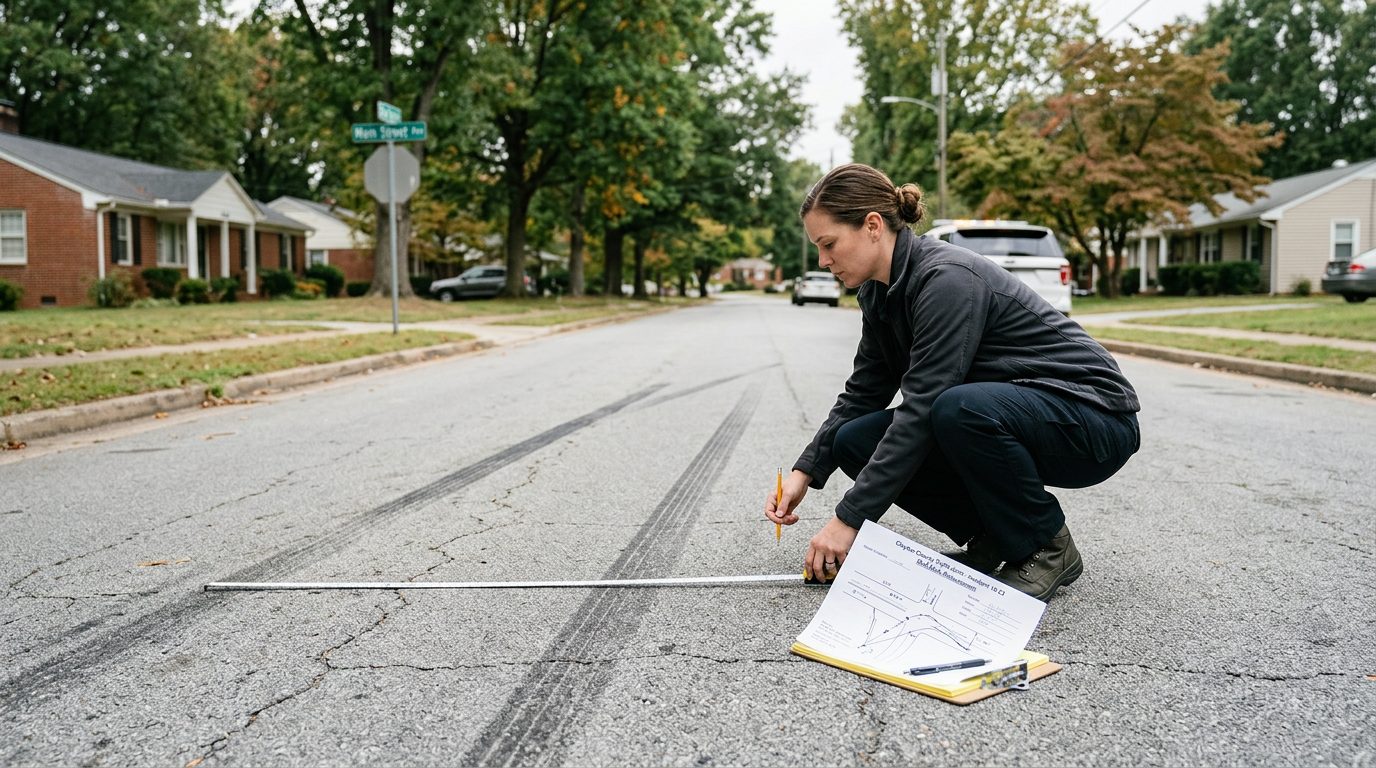
Photograph both vehicles from several angles. Capture the damage, the cab and trailer markings, skid marks, traffic signs, road conditions, weather, and lighting. Take wide shots and close-ups.
Write down the truck’s identifying details. Note the company name, the driver’s name and license information, the USDOT number, the trailer or unit number, and the tag or plate. Federal rules require commercial vehicles to be marked. If another company’s name appears on the truck, the operating carrier’s name must be followed by the identifying information required by paragraphs (b)(1) and (2) of this section, including the USDOT number, and be preceded by the words “operated by.” See 49 C.F.R. § 390.21T for the marking rules.
Collect witness names, phone numbers, where each person stood, and what they say they saw. Save dashcam footage, time-stamped phone photos, and notes you write while the memory is fresh.
Federal rules also apply to the driver. After certain crashes, the employer must test each surviving driver for alcohol as soon as practicable. For a crash in which someone has an injury that needs immediate medical treatment away from the scene, or a vehicle must be towed away, alcohol testing is required if the driver is cited within 8 hours for a moving traffic violation arising from the accident. After a crash involving a fatality, federal rules require drug and alcohol testing of each surviving driver who was performing safety-sensitive functions with respect to the vehicle, whether or not a citation is issued. The federal post-accident testing rule sets the timing. The driver also must not use alcohol for eight hours after the crash or until tested, under 49 C.F.R. § 382.209.
Exchange information and be careful about what you say
Exchange names, phone numbers, insurance details, and vehicle information. Say little about how the crash happened.
Get the driver’s name, phone number, insurance company, and policy number. Note the license plate and a description of the vehicle. Write down any passengers in either vehicle.
Do not admit fault. Do not apologize in a way that sounds like an admission. Do not guess about speed or how the crash happened.
This matters because Georgia reduces damages by a person’s share of fault. Under O.C.G.A. § 51-12-33, the court reduces damages in proportion to the plaintiff’s fault. A plaintiff who is 50 percent or more responsible receives no damages. Under O.C.G.A. § 51-12-33, when a plaintiff is partly responsible for the injury or damages claimed, the judge reduces the damages awarded in proportion to the plaintiff’s percentage of fault, and a plaintiff who is 50 percent or more responsible is not entitled to receive any damages.
Send a simple message to family or friends. For example: “I was in a truck crash on [road]. I’m getting checked by medical staff now. I’ll share more when I can.”
Limit social media posts about the crash, your injuries, and your activities. Insurers and other parties may see them.
Not sure what your next step is?
Talk it through with our team — the first consultation is free, confidential, and carries no obligation.
If the truck driver leaves the scene
Call 911 and report what you saw, even if the truck has already left. Give the dispatcher the truck’s color, company markings, direction of travel, and any part of the plate you saw.
Ask witnesses to stay if they can, and get their contact details. Police and insurers rely on these details when the driver is not at the scene.
If the driver cannot be identified, Georgia’s uninsured motorist law sets conditions. Under O.C.G.A. § 33-7-11, a vehicle is deemed uninsured if the owner or operator is unknown. For an unknown driver, physical contact with your vehicle is generally required. An eyewitness other than you can corroborate your account instead, so every witness detail counts.
Notify your insurer and understand how Georgia handles fault
Tell your own insurer about the crash as soon as reasonably possible. Stick to the facts you know, such as dates, places, and injuries. Skip guesses about fault.
Read any release, settlement paper, or recorded-statement request before you respond. Ask questions about any term you do not understand.
Suing a motor carrier’s insurer in the same case is limited. Under O.C.G.A. § 40-1-112, a person with a claim against a motor carrier may join the carrier’s insurance carrier only in certain cases. Those cases include when a related carrier is insolvent or bankrupt, or when personal service cannot be made after reasonable diligence on the driver or the carrier.
Georgia also sets a filing deadline. Under O.C.G.A. § 9-3-33, a personal-injury lawsuit must be brought within two years after the right of action accrues, except that an action for injuries to the person involving loss of consortium must be brought within four years.
Should I call 911 after a minor semi crash?
Yes. Call 911 even if the damage looks small, because some injuries are not obvious right away.
Do I need a doctor if I feel fine?
Get checked anyway. Some injuries cause symptoms later, so write down any changes you notice.
What if I was partly at fault?
Georgia reduces your recovery by your share of fault. At 50 percent or more, you receive no damages (O.C.G.A. § 51-12-33; Quynn v. Hulsey (2020)).
How long do I have to file a lawsuit?
Georgia law sets a two-year filing period for personal-injury lawsuits. Other deadlines can apply, so act early.

Talk with T. Madden & Associates about your crash
If you’re juggling medical visits, vehicle repairs, and time away from work, you don’t have to work out your next steps alone. Our team can talk with you in a free, confidential first consultation, with no obligation to continue. You can start through our free case evaluation page.
We charge no fee unless we win, but you may still be responsible for court costs and case expenses.
For the wider truck accident process, read our Georgia truck accident guide next.
Terance Madden is the responsible lawyer for this page. T. Madden & Associates, P.C., in practice since 1999, has offices in Jonesboro (Clayton County), Atlanta, Decatur, Macon and Augusta. Contact details are on our contact page. Past results do not predict future outcomes. This page is general information, not legal advice.
What to Do After a Semi Crash
1. Get Medical Care Right Away
Truck crash injuries, including head, back, and internal injuries, can appear hours or days later. Get checked by a doctor even if you feel fine, and follow every treatment recommendation.
2. Call 911 and Document the Scene
Ask for police and emergency medical help. If you are able, photograph the truck, its trailer and markings, vehicle damage, skid marks, road conditions, and injuries.
3. Collect Key Information
Write down the truck company name, driver details, DOT number if visible, insurance information, and witness contact details. Keep notes on what happened while it is fresh.
4. Talk to a Lawyer Before Big Decisions
Insurance companies for trucking businesses move quickly. Speak with our team before you give a recorded statement or sign anything.
How Our Firm Can Help
Focused on Injury Claims
T. Madden & Associates, P.C. has represented people hurt in car, truck, and other crashes since 1999, including semi truck collisions.
Respectful, Personal Attention
You are dealing with pain, bills, and stress. Our team works to explain each step in plain language so you know what is happening.
Free, Confidential Consultation
Your first consultation is free, confidential, and comes with no obligation to continue.
No Fees Unless There Is a Recovery
Our fee comes from a recovery. You may still be responsible for court costs and case expenses, which we will explain before you decide.
Reach Us 24/7
Call or start your free case evaluation at any hour, including nights and weekends, when a crash has left you with questions.
Watch Out for Early Insurance Calls
An adjuster for the trucking company may call you soon after the crash. Be careful about what you say, do not post details about the crash on social media, and do not accept a quick settlement before you understand your injuries.