

Truck Accident Lawyer | Georgia
Jackknife Truck Crashes: Key Facts for Georgia Accident Victims
Terance Madden has represented people hurt in Georgia since 1999. Learn what a jackknife crash is, what can cause one, and how to protect your claim. Then talk with our team about your case.
T. Madden & Associates, P.C. at a Glance
1999
Year our practice began
5
Georgia offices: Jonesboro, Atlanta, Decatur, Macon, Augusta
Free
First consultation, confidential and with no obligation
By Terance Madden · Published October 17, 2026
Short answer: is a jackknife considered an accident?
A jackknife is a type of truck crash. In everyday speech, most people call it an accident, because it is an unplanned event on the road. Whether it counts as a legal accident in an injury claim depends on the facts, especially what caused the trailer to swing out. This page explains what a jackknife is, what causes one, and how Georgia looks at fault and time limits.
If you're trying to make sense of a jackknife crash you didn't choose, we'd be glad to talk through your facts. Start with a free case evaluation at https://www.tmaddenlaw.com/contact/. Talk it through with our team — the first consultation is free, confidential, and carries no obligation.
What a jackknife is
A jackknife is a tractor-trailer crash where the cab and trailer move in different directions. The trailer swings out to one side while the cab folds toward it, forming a V shape. Once that happens, the truck can block several lanes at once.
There are two common ways this looks on the road. In one, the trailer swings out and pushes the cab sideways. In the other, the cab swings out and the trailer follows at an angle. Either way, the truck loses its straight path and can no longer stay in its lane.
A jackknifed truck can also cause secondary crashes. Drivers behind it may hit the stopped rig, and drivers trying to avoid it may strike other vehicles. These extra impacts can add to the injuries and damage from the first crash.
What causes a jackknife crash
Hard braking that locks the wheels is one of the main triggers. When the wheels lock, the trailer can slide past the cab and push the truck out of line. Speed that is too high for the road is another common factor.
Slick pavement adds risk. Rain, ice, or spilled fluid can reduce the grip a truck needs to stop. Among the brake performance standards in § 393.52 of the Federal Motor Carrier Safety Regulations, a motor vehicle or combination of motor vehicles found on a public highway, under any condition of loading, must upon application of its service brakes be capable of stopping from 20 miles per hour within a distance not greater than the one listed in the table in paragraph (d). That distance is measured from the point at which movement of the service brake pedal or control begins. The federal tire rule at § 393.75 of the Federal Motor Carrier Safety Regulations requires any tire on the front wheels of a bus, truck, or truck tractor to have a tread groove pattern depth of at least 4/32 of an inch at any point on a major tread groove. Other tires generally need at least 2/32 of an inch in a major tread groove, and neither measurement may be taken where tie bars, humps, or fillets are located.
Cargo can play a role too. The general cargo securement rule in § 393.106 of the Federal Motor Carrier Safety Regulations requires cargo to be firmly immobilized or secured on or within a vehicle by structures of adequate strength, dunnage or dunnage bags, shoring bars, tiedowns, or a combination of these. The cause of a jackknife is usually worked out from physical evidence after the crash, such as skid marks and the trailer’s final position. It is not assumed from the outcome alone.
Is a jackknife an accident in the legal sense?
In a Georgia injury claim, the key question is negligence. A crash can be unplanned and still involve negligence, such as following too closely or driving too fast for conditions.
Georgia reduces damages by the injured person’s share of fault. Under O.C.G.A. § 51-12-33 (Quynn v. Hulsey, 310 Ga. 473 (2020)), damages are reduced in proportion to the plaintiff’s percentage of fault (O.C.G.A. § 51-12-33; Quynn v. Hulsey, 310 Ga. 473 (2020)). If the injured person is 50 percent or more responsible, that section bars any recovery of damages (O.C.G.A. § 51-12-33; Quynn v. Hulsey, 310 Ga. 473 (2020)).
The same section divides the award among each person found liable. Generally, each liable person pays the share tied to their own fault rather than a joint amount, although joint liability can still apply in some situations, such as concerted action. Under Georgia law, the fact-finder generally weighs the fault of others who contributed to the injury, including people not named in the suit, but only when a defendant has given proper notice of nonparty fault under O.C.G.A. § 51-12-33(d).
Time limits matter too. Under O.C.G.A. § 9-3-33, actions for injuries to the person generally must be brought within two years after the right of action accrues.
Who may be involved and what evidence matters
The driver is not always the only party in a jackknife claim. The trucking company, maintenance providers, and whoever loaded the trailer may each have a role in the brakes, tires, or load.
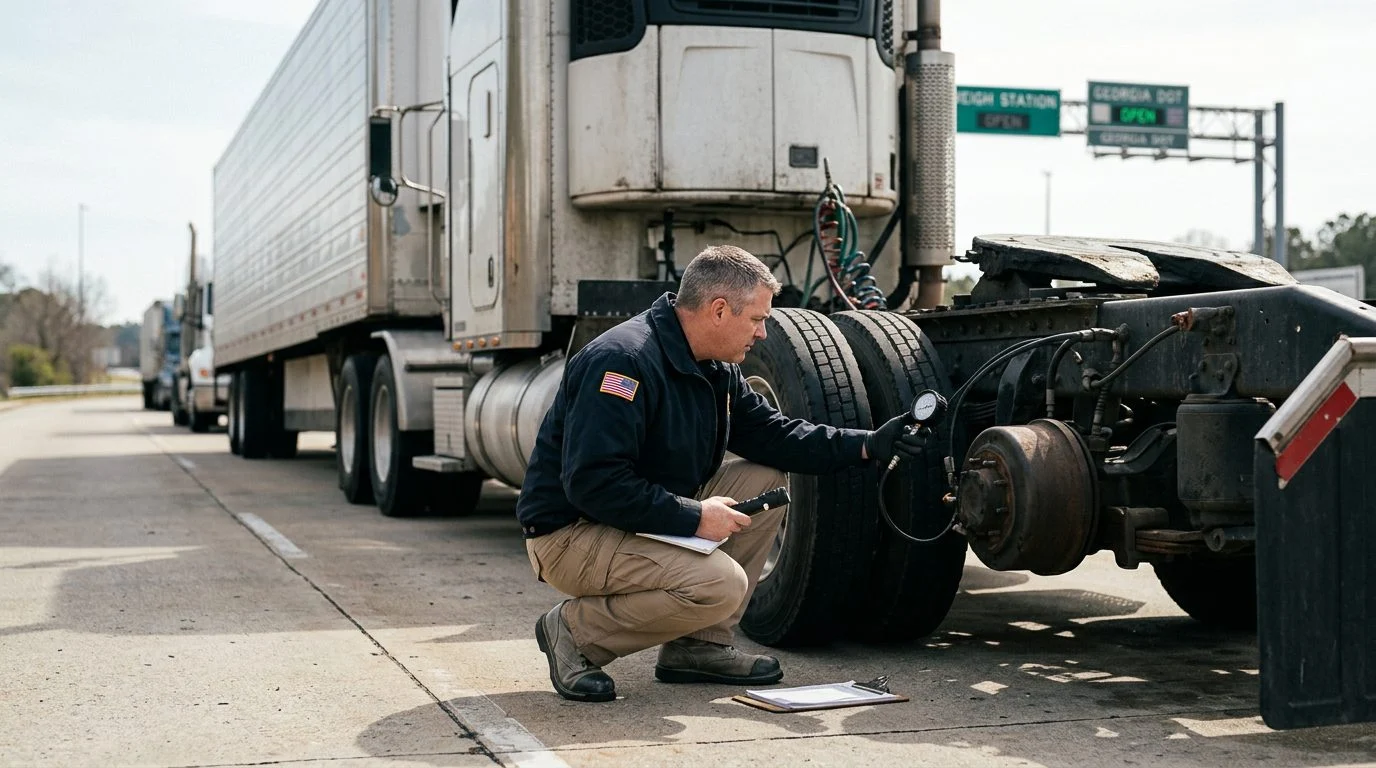
Useful evidence often includes the police crash report, photos of skid marks and the trailer’s final position, witness statements, and dash camera footage. Electronic logging device data also matters. According to § 395.26 of the federal hours-of-service rules, an electronic logging device (ELD) automatically records these data elements: date; time; CMV geographic location information; engine hours; vehicle miles; driver or authenticated user identification data; vehicle identification data; and motor carrier identification data.
Trucking paperwork matters as well. Under § 396.11, every driver shall prepare a report in writing at the completion of each day’s work on each vehicle operated, and the report shall cover at least the service brakes, steering mechanism, lighting devices and reflectors, and tires. The report must identify the vehicle and list any defect or deficiency that would affect the safety of operation of the vehicle or result in its mechanical breakdown. The federal inspection, repair, and maintenance rule at § 396.3 of the Federal Motor Carrier Safety Regulations requires the records it covers to be kept for 1 year where the vehicle is either housed or maintained. Because these records are kept for limited periods, early action matters.
Injuries from jackknife crashes and what a claim may address
Truck crashes can cause serious injuries, and a claim may address the losses those injuries create. Head and brain injuries, spinal injuries, broken bones, and soft tissue injuries are all reported after large truck crashes. Some symptoms, such as headaches, stiffness, or back pain, can take days to appear.
A claim may address losses such as medical bills, lost income, and pain and suffering. A medical record made soon after the crash helps connect the injuries to the crash. Every case turns on its own facts and its own medical record.
Quick answers
Is a jackknife considered an accident? In everyday speech, yes, it is an unplanned crash. In a Georgia claim, the question is negligence.
Who can be responsible for a jackknife crash? The driver, the trucking company, maintenance providers, or the loading party may all be part of a claim.
How long do I have to file in Georgia? Generally two years for injuries to the person, under O.C.G.A. § 9-3-33.
Not sure what your next step is?
Talk it through with our team — the first consultation is free, confidential, and carries no obligation.

Talk with Terance Madden about your jackknife crash
If you were hurt in a jackknife crash, or you are helping a family member through one, the questions pile up fast. You may be trying to understand what happened on the road while also caring for someone who was hurt. Terance Madden of T. Madden & Associates, P.C. has been in practice since 1999, and he can talk through the facts of your crash with you. The first consultation is free, confidential, and carries no obligation to continue. Our Jonesboro (Clayton County) office takes calls 24 hours a day, and you can start with a free case evaluation.
How We Approach Your Truck Accident Case
Reach us any time
Call us 24/7 to report your crash and ask questions. Our team is ready to listen.
Early evidence review
We help identify and preserve records such as crash reports, photos, and trucking company documents while they are still available.
Protecting your rights
We advise you on dealing with insurance companies and the trucking company so that your statements do not hurt your claim.
Focused on the people we represent
We fight for fair compensation for medical bills, lost income, and the pain that a serious truck crash can cause.
Clear communication
We explain each step of your case in plain language so you can make informed decisions.
Fees only if there is a recovery
You pay no attorney fees unless there is a recovery. You may still be responsible for court costs and case expenses.
Important: Do Not Give Up Your Claim Too Soon
Insurance adjusters may contact you quickly after a jackknife crash. Before you give a recorded statement or sign any paperwork, call us to talk through your options. A free consultation is confidential and comes with no obligation to continue.
Key Facts to Know After a Jackknife Crash
What a jackknife looks like
A jackknife happens when the tractor and trailer fold toward each other in an angle, often when the trailer swings out and the rig loses control.
Common contributing factors
Sudden braking, slick or uneven road surfaces, speed, load shifts, and trailer brake problems can all play a role in how a jackknife develops.
Evidence that often matters
Photos, witness names, the police report, dashcam footage, and the truck's electronic logging device data can all help show what happened.
Why act early
Evidence can be lost or overwritten over time. Speaking with a lawyer early gives your case the best chance to be documented.
Madden & Associates, P.C. About Your Jackknife Crash
Related practice areas
- Commercial Vehicle Accident Settlements in Georgia