

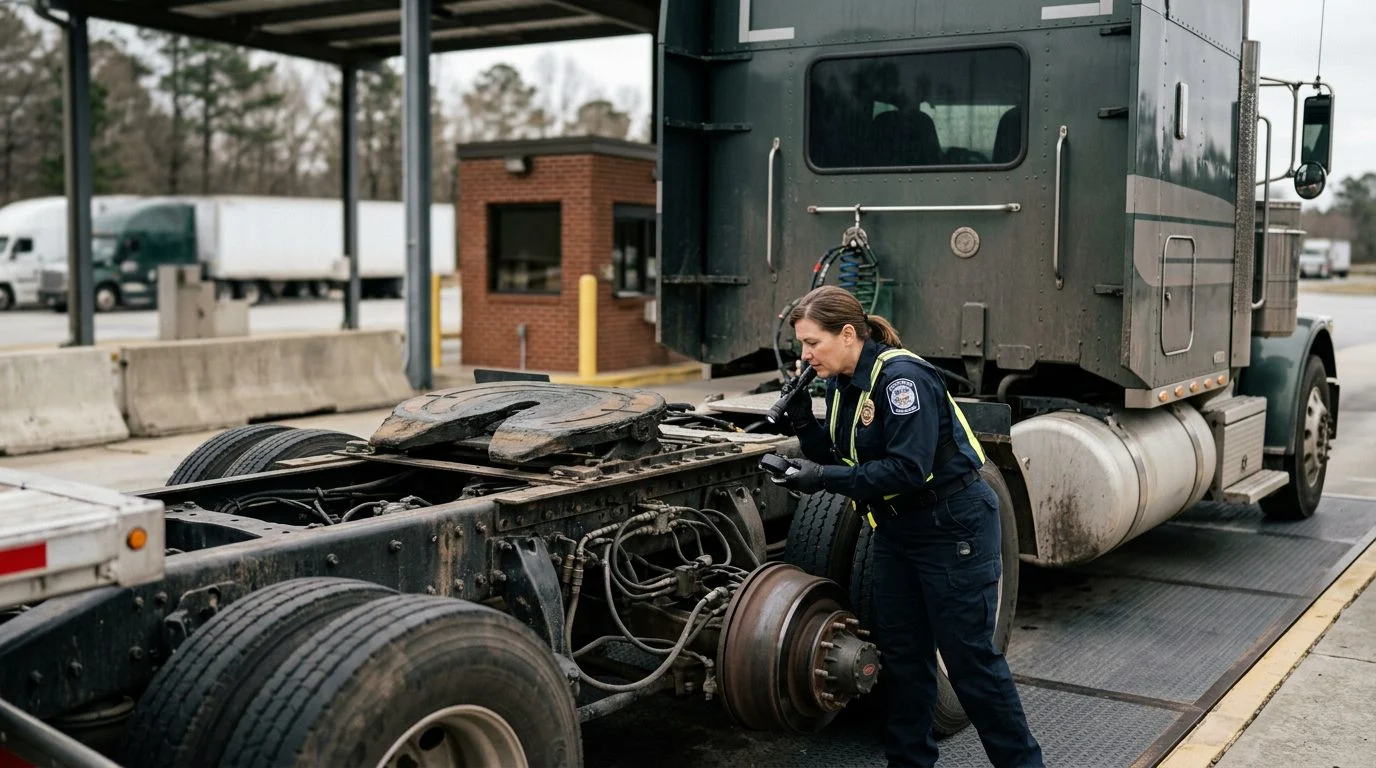
What Can You Sue a Trucking Company For in Georgia?
By Terance Madden · Published October 20, 2026
Can You Sue a Trucking Company After a Crash in Georgia?
Yes. In many Georgia truck crashes, the injured person can bring a claim against the trucking company as well as the driver. Whether that claim works depends on the facts of the crash.
A crash with a large truck is frightening. Many families are left with hospital bills, missed paychecks and a long list of questions. What you can sue a trucking company for is often one of the first.
This page explains the answer in plain terms. It covers who can be named, the legal grounds used against trucking companies, the trucking rules that often matter, how fault and evidence work, the kinds of damages that may be recoverable, and Georgia’s filing deadline.
You don’t need legal training to follow along. We explain each term the first time it appears. Terance Madden has been in practice since 1999, with offices in Jonesboro, Atlanta, Decatur, Macon and Augusta.

Who Can Be Named as a Defendant in a Trucking Crash Case?
Several parties can be named, and each may have a different role in the crash. The driver is the most obvious one. The company that operates the truck is often the next.
The driver can be responsible for his or her own careless driving. Speeding, distraction and unsafe lane changes are common examples.
The motor carrier is the company that runs the truck. It may employ the driver or hire the driver under a contract. Its choices about drivers, schedules and equipment can all matter.
The truck’s owner may be a different company from the one that operates it. When ownership and operation split, both can be reviewed.
Other parties can also share fault. A company that loads or secures cargo can be responsible when a poorly secured load contributed to the crash. A repair shop whose brake or tire work was careless can be too. A parts maker can be named when a defective part played a role.
Georgia’s fault statute adds a key rule. Each liable person then pays only its own share, not a joint amount. Georgia fault apportionment statute
What Legal Grounds Can Support a Claim Against a Trucking Company?
A trucking company can be sued for its own choices. In many cases, it can also be sued for what its driver did on the job.
The first path is responsibility for a driver. An employer may be held responsible for an employee’s negligence while the employee does the company’s work. Questions about when an employer may be held responsible for an employee’s actions often come up in these cases.
The second path looks at the company’s own decisions. A claim can focus on how a company hired, trained, supervised or kept a driver. It can also focus on giving a truck to a driver who was not fit to drive it.
Equipment is a third area. Brakes, lights and other parts must meet safety rules. Georgia motor carrier safety statute
Schedule pressure is a fourth area. Dispatch demands or tight delivery windows can push drivers past legal limits. When that happens, the company’s planning may become part of the case.
Many people assume the driver is the only target. Looking at the company’s role early keeps more options open.
Which Trucking Rule Violations Can Support a Claim?
Federal trucking rules set standards for driving hours, records, driver files and testing. A broken rule can help show what went wrong in a crash.
Driving hours are a common focus. A driver may not drive without first taking 10 consecutive hours off duty. A driver also may not drive after 14 consecutive hours on duty that follow that break. Within that window, the driving limit is 11 hours. federal driving time rule
Breaks matter too. Driving is not permitted after more than 8 hours of driving time without a 30-minute break. Certain short-haul drivers have exceptions. federal driving time rule
Records matter as well. Except for a private motor carrier of passengers (nonbusiness), under 49 C.F.R. § 395.8(a)(1), a motor carrier subject to the requirements of this part must require each driver it uses to record the driver’s duty status for each 24-hour period. federal duty status rule
The driver qualification file can also matter: under 49 C.F.R. § 391.51(a), each motor carrier must maintain a driver qualification file for each driver it employs. A motor carrier must keep each driver qualification file for as long as the driver is employed by that carrier and for three years thereafter, except that certain records in the file, such as the annual motor vehicle record and the annual review note, may be removed three years after their date of execution. federal driver file rule
Testing is also covered. The FMCSA describes federal rules that require post-accident and pre-employment drug and alcohol testing for commercial truck drivers. FMCSA testing guidance
Georgia law adds its own standards. Georgia motor carrier safety statute
A rule violation can show what went wrong. It does not, by itself, prove that the violation caused your injury.
How Is Liability Proven in a Trucking Company Lawsuit?
Liability is proven with evidence of what the driver and the company did before the crash. Strong cases usually combine general crash evidence with records from the trucking side.
General crash evidence includes the police report, photos of the scene and vehicles, witness statements, medical records and repair estimates.
Trucking evidence can be harder to reach. The company may hold electronic logging data, dispatch and phone records, driver files, maintenance and inspection logs, and data from the truck itself. Some of these records exist only with the company.
Timing matters. Trucking companies and insurers may hold key records, so asking early that those records be kept helps protect them.
Fault is the other piece. Georgia reduces damages in proportion to the injured person’s share of fault. If that share is 50 percent or more, no damages can be recovered. Georgia fault apportionment statute
A common mistake is posting about the crash online. Those posts can be used to argue about fault.
What Damages Can Be Recovered From a Trucking Company?
Recoverable damages can include medical bills, lost income, property damage and pain and suffering. The exact losses vary with the injury and the proof.
Economic losses are money costs. These include past and future medical bills, lost wages, lower earning ability and property damage.
Non-economic losses are harder to put on a bill. They include pain and suffering, emotional distress and loss of enjoyment of life.
When a crash causes death, Georgia law sets who may bring the action. Where death results from criminal or other negligence, the personal representative may also recover funeral, medical and other necessary expenses. Georgia wrongful death statute
Punitive damages have a higher standard. They punish or deter. They do not compensate. Georgia punitive damages statute
Each claim is valued on its own records and facts.
How Long Do You Have to Sue a Trucking Company in Georgia?
Except as otherwise provided in this article, O.C.G.A. § 9-3-33 generally sets a two-year period, running from when the right of action accrues, for filing a lawsuit for injuries to the person, except injuries to reputation (one year) and loss of consortium (four years). Georgia injury filing deadline
The statute sets different periods for some other claims.
Insurers and trucking companies often have staff and lawyers working on their side early. The process can feel one-sided to an injured person. Each case also moves at its own pace.

Talk With Terance Madden About Your Truck Crash Questions
A free first consultation is a good place to ask what you can sue a trucking company for in your situation. Here are quick answers to common questions.
Quick Answers About Suing a Trucking Company
Can you sue the driver and the trucking company?
Often, yes. A claim can name more than one party when the facts support it.
How long do you have to file?
Except as otherwise provided by law, injury claims generally must be filed within two years after the right of action accrues; injuries to reputation have one year, and loss-of-consortium claims have four years (O.C.G.A. § 9-3-33; Cameron v. JMP Pizza, Inc. (2026)).
Can you recover if you were partly at fault?
Georgia reduces damages by your share of fault. At 50 percent or more, no damages can be recovered (O.C.G.A. § 51-12-33; Quynn v. Hulsey, 310 Ga. 473 (2020)).
If a truck crash has left you hurt, or you’re worried about someone you love who was hurt, you may be facing more than you expected. You may be asking whether the trucking company can be held responsible. Reach out to talk through what happened and which options may fit your situation.
Your first consultation is free, confidential and carries no obligation to continue. Terance Madden works on a no-fee-unless-we-win basis, but you may still be responsible for court costs and case expenses.
Responsible lawyer: Terance Madden, T. Madden & Associates, P.C., with offices in Jonesboro, Atlanta, Decatur, Macon and Augusta, Georgia. Request a free case evaluation