

Georgia E-Bike Crash Lawyer | Jonesboro, Atlanta, Decatur, Macon, Augusta
Asked for a Recorded Statement After Your E-Bike Crash? Get Advice First
An insurance adjuster may ask to record your account within days of a crash. Here is how to protect yourself before you say a word.
T. Madden & Associates, P.C.
1999
Serving injured Georgians since
5
Georgia offices
24/7
Call us anytime
By Terance Madden · Published November 13, 2026
You were hurt on an e-bike, and now an insurance adjuster wants to record a phone call. Do you have to say yes?
You do not have to give a recorded statement today. You can ask to hold the call until you understand your claim. Here is what the statement is for and how it gets used against injured riders.
The short answer: you do not have to give a recorded statement today
You can say no to a recorded statement right now, or ask to schedule it for later. The other driver’s insurer is not your insurer. Its adjuster works for that company, not for you.
The call often comes a few days after the crash. You are sore, the e-bike is in a yard or a shop, and the family is juggling work, rides to appointments and bills. Big Insurance adjusters often push for speed at exactly that point. Slowing down is a reasonable move, and it protects your claim.
If someone else's driving left you hurt on an e-bike, and an adjuster wants a recorded statement, we can talk through your options with you. Talk it through with our team — the first consultation is free, confidential, and carries no obligation.
What a recorded statement is and why the insurer wants one
A recorded statement is a question-and-answer session, usually by phone, that the insurer records and keeps in its file. The adjuster may ask where you were riding, how fast you were going, whether you were on your phone, and how the crash happened.
The first questions are friendly. Are you doing okay? Then the questions narrow. A short reply like “I think I was fine” or “maybe I was going a little fast” can be pulled out of context later. Your words become the insurer’s evidence.
Georgia’s fault rule makes this matter. Under O.C.G.A. § 51-12-33, a judge reduces an injured person’s damages by that person’s percentage of fault (Quynn v. Hulsey). If the plaintiff is 50 percent or more responsible, the plaintiff may not receive any damages. One careless sentence can shift the fight over fault.
How Big Insurance uses a recorded statement against an injured rider
Big Insurance uses these calls to lower what a claim is worth. The tactics repeat, and each one has a response.
First, blame. Loose words get turned into a story where the rider caused the crash, and the fault rule above does the rest. Second, the “low impact” argument. The insurer says the e-bike barely touched the car, so the injuries cannot be serious. Third, treatment. A casual “I’m fine” on tape gets quoted later to dispute an emergency room visit, a scan or physical therapy.
Delays follow. A slow claim wears people down and pushes them to take less. Then comes the lowball offer. An insurer’s first offer is rarely what a claim is worth.
The firm’s response is to build the case before anyone talks about a number. It pursues every coverage layer: the at-fault driver’s liability coverage, your own uninsured and underinsured motorist (UM/UIM) coverage, any umbrella or excess policy, and corporate coverage when a business is involved. It also counts the full cost of the injury over time. Medical bills and lost wages are special damages under Georgia law, which means they must be proved. The firm builds each case so it is ready if it goes to trial.
What the evidence shows that a recorded statement cannot
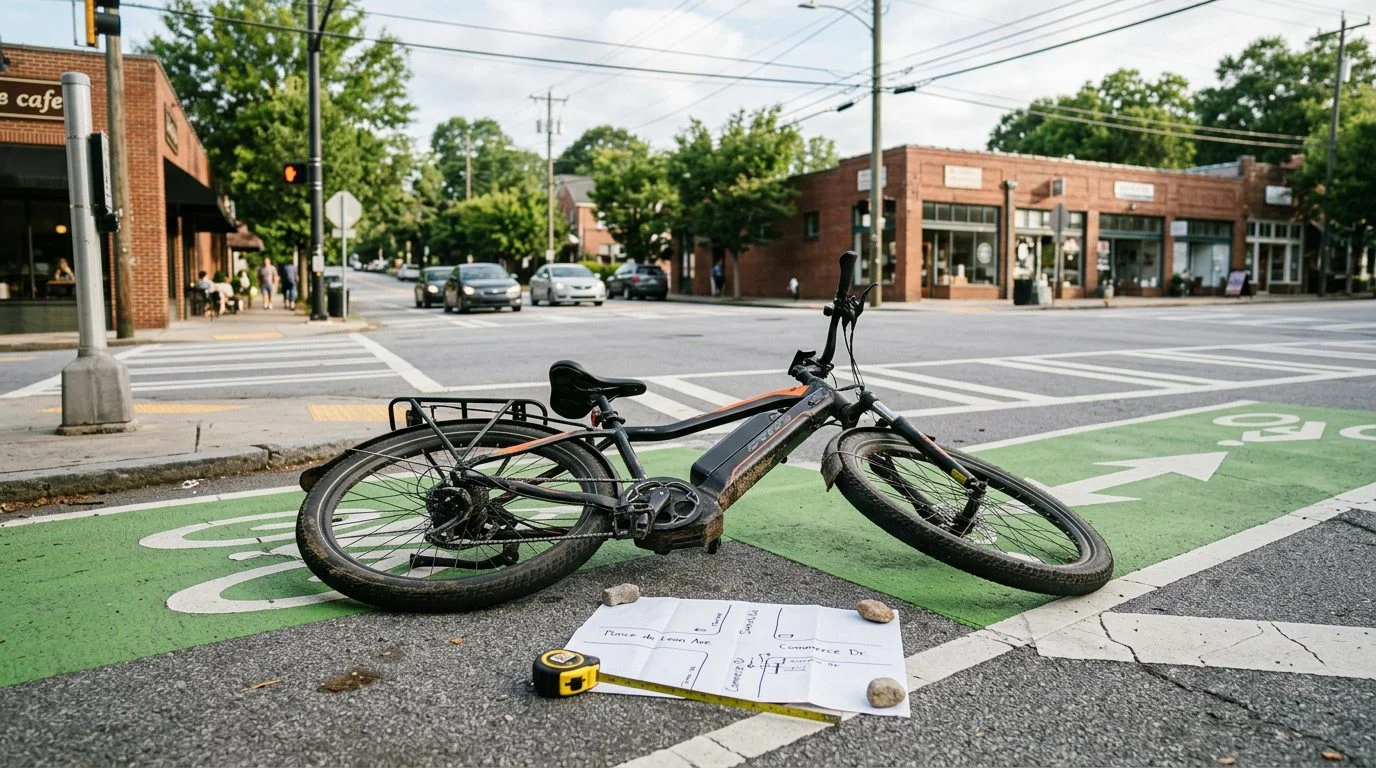
The crash is decided by evidence, not by a phone answer. Scene photos, damage to the bike and the vehicle, witness accounts, phone records, traffic or business video and medical records all tell the story.
Crash physics matters here. The change in speed during impact shows how hard the rider was hit and how the bike and the vehicle moved. That answers a “low impact” claim with data instead of opinion.
Terance Madden trained as an electrical engineer and earned a B.S. in Electrical Engineering before law school. He starts a case by asking what the evidence shows, how the crash happened, and which records must be saved before they are lost. Some video is kept only for a short time. That training helps him read photos, damage patterns and timelines the way an engineer would, then explain them in plain words.
Your own policy may matter more than the other driver’s
Your own auto policy may include uninsured and underinsured motorist coverage. That coverage can matter when the other driver has too little insurance or none. Georgia law requires that an auto liability policy include an endorsement that pays the insured for bodily injury caused by an uninsured motor vehicle’s owner or operator, within limits set by the statute. O.C.G.A. § 33-7-11 sets that framework.
Whether that coverage applies to your crash depends on the facts and the policy wording. Look at each policy in your household, not just your own. Find out what each one says before you sign anything. Read the notice and cooperation terms too, because they set what you must do after a crash. Then decide what to share and when.
Deadlines to keep in mind while you decide
Georgia generally allows two years from the injury to bring a personal injury lawsuit. O.C.G.A. § 9-3-33 sets two years for injuries to the person, except that actions for injuries to the person involving loss of consortium must be brought within four years after the right of action accrues.
Claims against government entities move faster. Under O.C.G.A. § 36-33-5, a claim against a city must be presented in writing to its governing authority within six months of the event. Under O.C.G.A. § 50-21-26, written notice of a tort claim against the state must be given within 12 months of when the loss was discovered or should have been discovered.
If a government vehicle or employee may be involved, do not wait on the statement decision before checking these deadlines.
Not sure what your next step is?
Talk it through with our team — the first consultation is free, confidential, and carries no obligation.
If you are managing a loved one’s recovery
If you are the one taking the calls and keeping the medical appointments, you are carrying a lot. This section is for you.
Keep a call log. Write the date, the time, the caller’s name, what was asked and what was said. Keep the bills, the photos of the bike, the helmet and the receipts in one place. Do not repair or sell the e-bike until its damage is photographed.
Do not answer for the injured person on a recorded line. The injured person decides whether to speak with an insurer. You can pass the questions along to the firm so they are answered in writing and with the facts in front of everyone.
Your family has taken care of each other for years, and this is no different. Your job is to protect the person you love while they heal, and you do not have to do it by guessing at answers.
Talk with the firm before you answer the insurer’s questions
If a crash someone else caused has left you hurt, and an adjuster is asking for a recorded statement, you do not have to decide alone. The firm can look at your situation with you before you answer anything.
Common questions
Can I wait to give a recorded statement?
Yes. You can ask the adjuster to call back after you have reviewed your claim.
How long do I have to file?
Georgia generally allows two years from the injury. Deadlines for government claims are shorter.
Does my own insurance help?
It may, through uninsured or underinsured motorist coverage, depending on the facts and the policy wording.
If you were hurt on an e-bike in Georgia, T. Madden & Associates, P.C. offers a free first consultation. It is confidential and carries no obligation to continue. The firm has offices in Jonesboro, Atlanta, Decatur, Macon and Augusta. Request a free case evaluation and talk through your claim before you answer the insurer’s questions.