

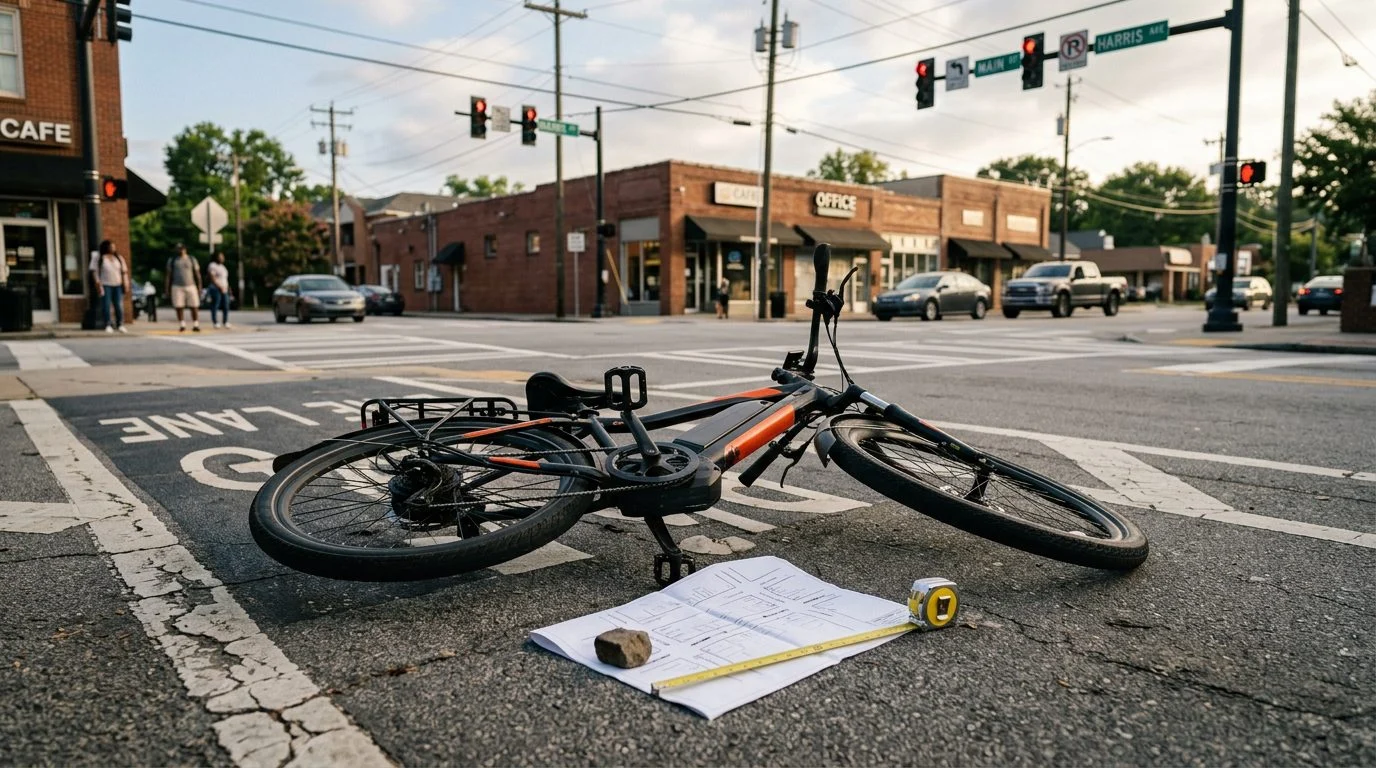
E-bike crash lawyer | Georgia
Hurt in an E-Bike Crash in Georgia? Start With the Clock
Get clear answers early, while the crash details, the bike, and the battery are still easy to document.
Serving Georgia since 1999
1999
Year T. Madden & Associates, P.C. began practice
5
Georgia offices: Jonesboro, Atlanta, Decatur, Macon and Augusta
Free
First consultation, confidential and with no obligation to continue
By Terance Madden · Published November 16, 2026
Hurt in an e-bike crash and wondering how long you have? In most Georgia injury cases, you have two years from the crash to file a lawsuit (O.C.G.A. § 9-3-33; Kenneth B. Cameron v. Jmp Pizza, Inc (2026)). Miss that date, and a court can refuse to hear your claim. Here is how the clock works and what can change it.
The Short Answer: Two Years From the Crash in Most Cases
For most injury claims from an e-bike crash, Georgia gives you two years to file a lawsuit (O.C.G.A. § 9-3-33; Kenneth B. Cameron v. Jmp Pizza, Inc (2026)).
The main rule is in O.C.G.A. § 9-3-33. It says actions for injuries to the person must be brought within two years after the right of action accrues, except for actions involving loss of consortium, which must be brought within four years. Treat the crash date as your working start date from day one.
For the wider picture, read our guide to e-bike crash claims in Georgia.
Not sure what your next step is?
Talk it through with our team — the first consultation is free, confidential, and carries no obligation.
Why Insurance Talks Do Not Stop the Clock
Insurance companies are businesses that watch their costs, so an early offer may not reflect the full value of your claim. Expect these tactics:
- A low first offer, made before anyone knows the full cost of your injury.
- A request for a recorded statement, asked for soon after the crash, while you are still hurting.
- Slow replies that stretch across months.
- Disputes over your treatment, including claims that your care was not needed.
- A “low impact” argument, the idea that a slow-moving e-bike crash can’t cause serious harm.
Here is the response. An insurer’s first offer is rarely what a claim is worth. The firm tracks the filing deadline from day one. It pursues every coverage layer that may apply: liability coverage from the at-fault driver, uninsured and underinsured motorist coverage (UM/UIM, the part of your own auto policy that can respond when the at-fault driver has too little or no insurance), umbrella and excess policies, and any corporate coverage. The firm prepares each claim as if it will go to trial, and it counts the full lifetime cost of the injury, not just the first bills.
For how your own auto policy can apply to a rider, see auto policy coverage for e-bike crashes.
Wrongful Death After a Fatal E-Bike Crash
Its date may not match the crash date, so check it early.
If you are the spouse, parent or adult child handling this, you’re grieving and reading legal papers at the same time. Take it one step at a time, and start with the dates.
Georgia law says that when no one else has the right to sue, the administrator or executor (the person appointed to handle the deceased’s estate) may bring the action. The recovery is for the benefit of the next of kin. Under O.C.G.A. § 51-4-5, when death results from a crime or from criminal or other negligence, the personal representative may also recover funeral, medical and other necessary expenses from the injury and death.
Don’t assume the wrongful death date matches the injury date. Get that date checked early, while the estate paperwork is still moving and the family can plan.
Claims Against a City, County, or State Can Have Shorter Notice Rules
Under O.C.G.A. § 36-33-5, a person with an injury claim against a city must present that claim in writing to the city’s governing authority within six months of the event, stating the time, place and extent of the injury and the negligence that caused it. The city then has 30 days to consider and act on the claim, and unless that action settles the claim, it does not bar a lawsuit. O.C.G.A. § 36-33-5 reads: “(c) Upon the presentation of such claim, the governing authority shall consider and act upon the claim within 30 days from the presentation; and the action of the governing authority, unless it results in the settlement thereof, shall in no sense be a bar to an action therefor in the courts.” That is the rule to watch if a city may be responsible for the crash.
Lawyers call this formal written claim ante litem notice (notice given before a lawsuit). Potholes, broken signals and missing warning signs on public property can all trigger these rules.
For a city, O.C.G.A. § 36-33-5 requires a written claim to the governing authority within six months of the event. The claim must state the time, place and extent of the injury, and the negligence that caused it. It must also state the specific dollar amount of damages sought, and it must be served on the mayor or the chair of the city council or commission.
For a county, O.C.G.A. § 36-11-1 requires claims within 12 months. O.C.G.A. § 36-11-1 reads: “All claims against counties must be presented within 12 months after they accrue or become payable or the same are barred, provided that minors or other persons laboring under disabilities shall be allowed 12 months after the removal of the disability to present their claims.” For the state, O.C.G.A. § 50-21-26 requires written notice within 12 months of when the loss was discovered or should have been discovered. Notice goes in writing by certified mail or statutory overnight delivery, return receipt requested, or by personal delivery with a receipt obtained, to the Risk Management Division of the Department of Administrative Services, with a copy personally delivered or mailed by first-class mail to the state agency involved. No suit can start until that department denies the claim or 90 days pass without action.
Property Damage Has a Different Deadline
Damage to your e-bike, helmet, phone or other personal property generally has a four-year limit. Under O.C.G.A. § 9-3-31, actions for injuries to personal property must be brought within four years after the right of action accrues.
That four-year date does not extend the two-year deadline for your injury claim. Track the two claims on separate calendars. A replaced bike is not a reason to wait on your injury claim.
What Can Pause or Change the Clock
A few Georgia rules can change when the clock starts or stops. Whether one applies depends on the facts, so treat them as backups, not plans.
Minors are one example. Under O.C.G.A. § 9-3-90, a person under 18 when a cause of action accrues gets the same time after turning 18 that other people get. A parent should still track the date rather than rely on that rule.
Criminal cases are another example. If the driver who hit you commits a crime, O.C.G.A. § 9-3-99 can pause, or toll, the civil clock from the date of the crime until the prosecution of that crime has become final or otherwise terminated. That pause cannot run more than six years.
Claims against a city can also get a pause. The same city-claim statute suspends the limitations period while a written demand is pending without action, under O.C.G.A. § 36-33-5.
Relying on an exception is risky. Use the standard two-year date as your working deadline, and treat any pause as extra time you may not get.
Not sure what your next step is?
Talk it through with our team — the first consultation is free, confidential, and carries no obligation.
Preserve the Evidence Before the Deadline Gets Close
The evidence from your crash can disappear fast, so protect it now.
Keep the e-bike as it is after the crash. Don’t repair, sell or scrap it yet. Keep the battery, the controller and any display or app data. Keep your helmet and clothing. Save phone photos, texts, ride-tracking data and video. Write down names and phone numbers for anyone who saw the crash.
The duty to preserve evidence arises not only when a suit is pending but when litigation is reasonably foreseeable to the party that controls the evidence, as Phillips v. Harmon (2015) explains. Your side should act as if it applies too.
Terance Madden trained as an electrical engineer before law school. That training helps him read what battery, controller and phone data show, and explain it in plain words. Read more about technical evidence in e-bike crashes. For the steps to take at the scene and afterward, see what to do after an e-bike crash.
If You Were Hit While Riding and the Clock Is Running
If a car or truck hit you while you rode an e-bike, the two-year clock may already be running. An insurer may be asking for a recorded statement. Medical bills may be stacking up. The deadline can feel far off right up until it isn’t.
You don’t have to sort out the deadline, the coverage and the evidence alone. T. Madden & Associates, P.C. has been in practice since 1999, with offices in Jonesboro, Atlanta, Decatur, Macon and Augusta. Terance Madden is the responsible lawyer for this page.
The firm works on a no-fee-unless-we-win basis, but you may still be responsible for court costs and case expenses.
Our team offers a free first consultation, confidential and with no obligation to continue. You can start with a free case evaluation today.
Frequently Asked Questions
How long do I have to sue after an e-bike crash in Georgia?
Georgia generally gives you two years from the date of injury to file a personal injury lawsuit, under O.C.G.A. § 9-3-33. The firm offers a free first consultation, confidential and with no obligation to continue.
When does the two-year clock start?
In most cases the clock starts on the date you were hurt, which is usually the date of the crash. Some situations involve injuries that were not discovered right away, so the exact start date should be reviewed as soon as possible.
Does the deadline change if a government entity is involved?
Yes. If a city, county, or state agency may share responsibility, for example because of a dangerous road condition or a government vehicle, you may first need to file a formal notice of claim.
Is there a different deadline for damage to my e-bike?
Georgia generally allows four years to sue for damage to personal property under O.C.G.A. § 9-3-31.