

E-Bike Accident Lawyer | Georgia
Hit by a Car on Your E-Bike? Get Answers Today.
T. Madden & Associates, P.C. has represented Georgia riders and their families since 1999, from Jonesboro and Atlanta to Macon and Augusta.
Why people call the firm
1999
Serving Georgia clients since
24/7
Phone line open any time
Free
First consultation, no obligation
By Terance Madden · Published November 15, 2026
A car turned across the bike lane, and now you’re hurt. Or someone you love is, and the bills and insurance calls have already started.
If a car turned into an e-bike rider in a Georgia bike lane, the rider may have a claim against the driver. Georgia asks who failed to use reasonable care, and how much fault each person carries. Here is how that plays out, and what to protect now.
What a car turning across the bike lane does to an e-bike rider
A car that turns across a bike lane often leaves the rider no time to stop or swerve.
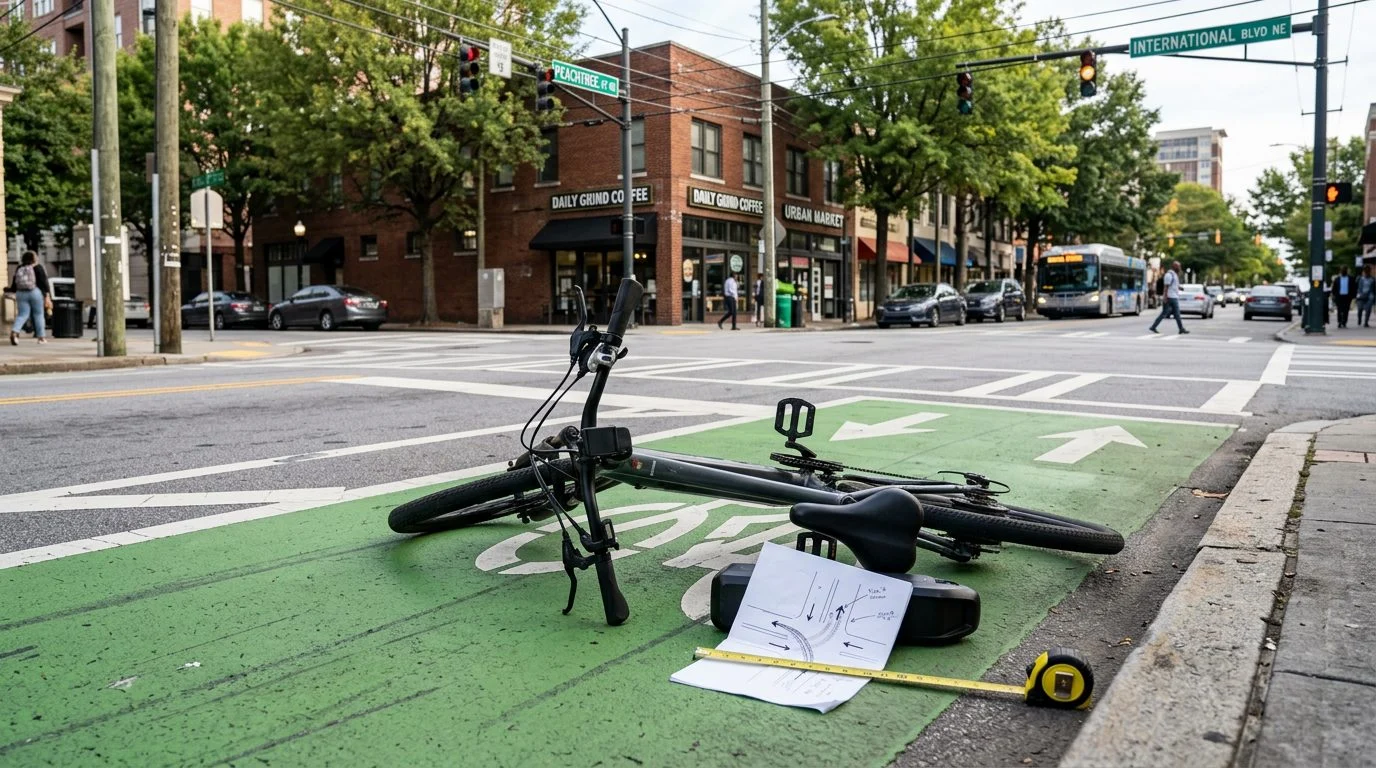
A bike lane is a marked part of the road set aside for bikes and e-bikes. The right-of-way is the legal right to go first at a turn or crossing. When a driver cuts across that lane without checking for riders, the rider’s choices shrink to a second or two. Speed, braking and the angle of the turn decide what happens next.
This page is for the injured rider and for the family member running the show. That person may be a spouse, a mother or an adult daughter who is making the calls, filling out forms and driving to medical visits. You don’t need the legal words yet. We define them as we go.
T. Madden & Associates, P.C. is a Georgia personal injury firm that has practiced since 1999. The firm has offices in Jonesboro (Clayton County), Atlanta, Decatur, Macon and Augusta. Terance Madden is the responsible lawyer for this page. The firm takes e-bike and other crash claims, and it also represents families in wrongful death cases.
If a car turned across the bike lane and hurt you or someone you love, you don't have to sort it out alone; the firm can talk it through with you in a free, confidential consultation. Talk it through with our team — the first consultation is free, confidential, and carries no obligation.
Why the turn decides who is liable
Most turn crashes come down to one question: did the driver use reasonable care before turning?
Georgia calls a failure to use that care negligence. Under O.C.G.A. § 51-1-2, ordinary diligence is the care an ordinarily prudent person uses in similar circumstances. Its absence is ordinary negligence.
Expect the other side to ask about your choices, too. They may ask about speed, lane position or helmet use. Georgia uses comparative fault (shared fault). A judge reduces damages by the rider’s share of fault. Under O.C.G.A. § 51-12-33, a person who is 50 percent or more responsible for the harm may not receive any damages. The early evidence has to answer those questions head on.
Big Insurance often calls a crash “low impact” when the car was slow or the bike looks fine. Physics doesn’t stop at the bumper. The car’s speed, the rider’s speed and the angle of the hit all shape how the forces moved the body. That is a question the evidence can answer, not one to guess at.
Evidence to protect in the first days
The first days matter most, because scene details and crash data can disappear fast.
Keep these items:
- Photos of the scene, both vehicles and the damage to each
- The e-bike, its battery, charger, helmet and clothing
- Names and phone numbers of anyone who saw the crash
- Every medical visit, bill and prescription record
- Any crash data the car or the e-bike may have stored
Terance Madden’s electrical engineering training came before his law school years, and he still draws on it when reviewing a case. He approaches a crash by asking what the evidence shows, how it happened, and which records exist and must be preserved. In a turn crash, that can mean the car’s damage pattern, its speed and braking data, and any data the e-bike’s electronics kept. Those pieces help show whether the car turned without yielding.
If a battery, charger or part failed, the story changes. A defect points to the maker and seller of that part, which can mean more insurance to pursue. A lithium-ion battery that overheats or sparks can also raise a product claim, and the firm handles those too.
How Big Insurance responds to a turn-across-the-lane claim
Big Insurance is not on your side, and its first offer is rarely what your claim is worth.
Expect these tactics:
- A quick, low offer made before the full medical picture is known
- A recorded statement taken before you understand your injuries
- Delays in paying bills or answering letters
- Disputes over whether your treatment was needed
- “Low impact” or “you were in the wrong lane” arguments
The response starts with coverage. Every layer matters: the driver’s liability coverage, your own uninsured or underinsured motorist coverage (insurance for a driver with no or too little coverage), any umbrella or excess coverage, and corporate coverage where it applies. The firm values the full lifetime cost of the injury, not only the first bills. It prepares every case as if it will go to trial.
Georgia also sets rules for some written settlement offers in motor vehicle crash claims. Under O.C.G.A. § 9-11-67.1, an offer that falls under the statute must give at least 30 days from receipt to accept, when sent by certified mail or statutory overnight delivery.
Other parties who may share responsibility
When a company vehicle or a defective part is involved, more than one party may share responsibility.
Claims for negligent hiring, training, supervision, and retention are based on the alleged negligent acts of the employer (Quynn v. Hulsey, 310 Ga. 473 (2020)). In Quynn v. Hulsey (2020), Georgia’s Supreme Court held that claims for negligent hiring, training, supervision and retention are based on the employer’s own alleged negligent acts. The firm calls these employer duties the Negligent Five: hiring, training, entrustment, retention and supervision.
Georgia treats a product seller differently from a manufacturer. In Alltrade, Inc. v. McDonald, the court held that a company that only labels a product as its own, with no input into its making, is a product seller, not a manufacturer. The firm reviews these parties at intake. No party’s responsibility is promised here.
How a claim with T. Madden & Associates works
The process starts with a free consultation and moves through evidence, investigation and negotiation.
- Free consultation. You tell us what happened. The firm’s first consultation is free, confidential and carries no obligation to continue. La consulta inicial es gratuita, confidencial y sin compromiso de continuar.
- Intake and evidence. We send letters asking the right parties to keep records and data.
- Investigation. We gather medical records, bills and the crash facts. We build the damages picture over time, including lifetime impact where the injuries warrant it.
- Demand and negotiation. We pursue every coverage layer and prepare the case for trial from the start.
Expect plain English, no gaps in communication, and dignity for you and your family. A consultation gives you a clear picture of the next steps before you decide anything.
Not sure what your next step is?
Talk it through with our team — the first consultation is free, confidential, and carries no obligation.
Questions families ask about e-bike turn crashes in Georgia
Most questions come down to evidence, fault and deadlines. Each has a plain answer.
What should I do first after a car turned into me on my e-bike?
Get medical care and keep every record. Save photos, witness names, and the e-bike and its battery.
Can I still recover if I was partly at fault?
Often yes, but Georgia reduces your damages by your share of fault. At 50 percent or more, the law bars any recovery (O.C.G.A. § 51-12-33; Quynn v. Hulsey (2020)).
How long do I have to file?
Georgia generally gives two years to bring an injury claim under O.C.G.A. § 9-3-33. Have the deadline reviewed early, because some cases follow different timing.
Do I have to talk to the other driver’s insurer?
Be careful with a recorded statement, because Big Insurance may ask for one early. You can ask that insurer calls go through the firm.
What if the driver has no insurance?
Georgia law sets out uninsured motorist coverage in car policies under O.C.G.A. § 33-7-11, and your own policy may apply. Bring your policy to your consultation.
Still researching? Many families read pages like this while managing a loved one’s care, bills and insurance calls. If a car turned across the bike lane and hurt you or someone you love, you don’t have to sort it out alone. Start a free case evaluation with T. Madden & Associates, any time of day or night.