

Georgia Crash Claims | Jonesboro, Atlanta, Decatur, Macon & Augusta
Who Does the Insurance Company Say Caused Your Crash?
An adjuster's first answer is often not the last word. Here is what the evidence can show and how to protect your side of the story.
T. Madden & Associates, P.C.
1999
Practicing law since
5
Georgia offices
24/7
Call us anytime
By Terance Madden · Published November 27, 2026
A crash left someone you love hurt, and now an insurance company is asking who was at fault. Insurance companies decide who is at fault by building a picture from evidence first, then applying Georgia’s fault rules to that picture. Their first call is an opinion, not a court ruling, and you can challenge it.
The short answer: insurers decide fault from evidence, then from Georgia law
Insurers decide fault by gathering evidence, forming a view of how the crash happened, and then applying Georgia’s fault rules. Those rules answer a basic question: who is legally responsible for the harm? That legal responsibility is called liability. The insurer’s view is only its opinion. If the case goes to court, a judge or jury settles the facts.
Fault is often shared. Under O.C.G.A. § 51-12-33, the jury or judge deciding the facts, called the trier of fact, must consider the fault of everyone who contributed to the harm. That includes people who were never sued: the trier of fact must consider the fault of all persons who contributed to the harm, regardless of whether they were or could have been named as a party, and a nonparty’s fault is considered if the plaintiff entered into a settlement agreement with them or a defending party gives notice not later than 120 days prior to the date of trial that they were wholly or partially at fault. A vehicle maker, a parts vendor, or a company that owned the vehicle can be assigned a percentage of fault if the plaintiff entered into a settlement agreement with it or a defending party gives notice not later than 120 days prior to the date of trial that it was wholly or partially at fault, but that percentage is used only in determining the fault of the named parties, and findings of fault do not subject it to liability in any action.
If a crash someone else caused left a family member hurt and an insurer is already asking questions, you may have a claim worth reviewing, and the firm can look at the facts with you. Talk it through with our team — the first consultation is free, confidential, and carries no obligation.

What the adjuster looks at first: the police report, photos, and witnesses
The adjuster starts with the police report, the photos, and what witnesses saw. A crash report usually records vehicle positions, damage, each driver’s statement, any citations, and the officer’s diagram. That makes it strong evidence, but not the final word. An adjuster can read the same report and reach a different view.
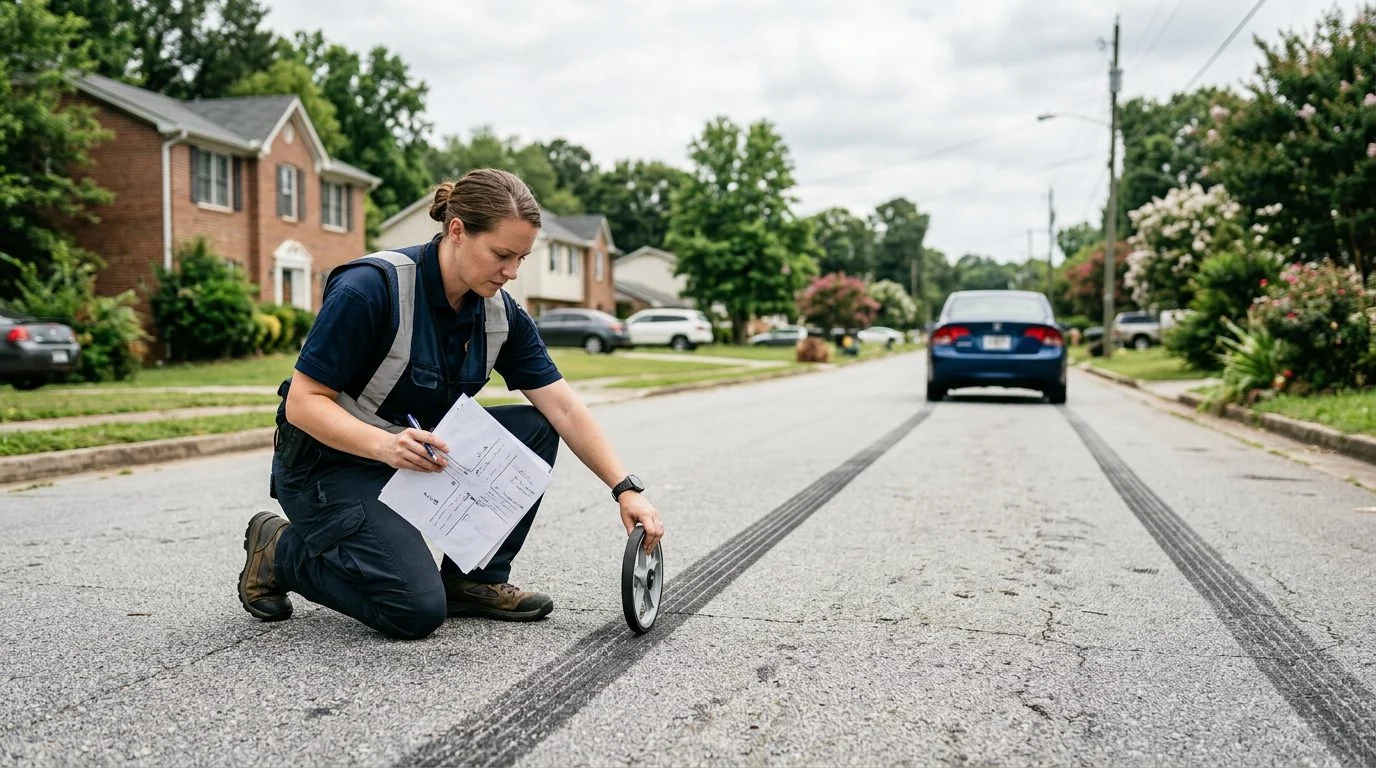
Photos and dash cam video often decide close calls. Scene measurements, skid marks, and where debris came to rest show speed and position. Witness names matter, because memories fade fast.
Evidence also disappears. Cars get repaired or crushed, cameras overwrite footage, and road marks wash away within days. Photos you take on your phone, before anything changes, can matter more than anything gathered later.
E-bike crashes raise the same questions with a twist. Adjusters want to know where the rider was in the lane, whether a signal was given, how fast each person was moving, and where each one was when the crash began.
Vehicle and device data: what it shows and how an engineer reads it
Vehicle data can show what a driver was doing in the seconds before impact. Many newer vehicles carry an event data recorder, a small unit that logs speed, braking, and throttle position when a crash happens. The engine control module (ECM) tracks engine timing and related data. Commercial trucks add black box, ECM, and driver-log records, which can show speed, braking, and on-duty time.
That data only helps if someone saves it. Records can be overwritten or lost once a vehicle is repaired, sold, or sent to salvage.
Before law school, Terance Madden trained as an electrical engineer. He starts a case by asking what the evidence shows, how the crash happened, and which records exist and must be kept. He reads crush damage and tire marks alongside the data, because the two can tell different stories. A careful reading can change who the insurer blames.
Physics matters when an insurer calls a crash “low impact.” Delta-V, the change in speed during impact, measures how hard the vehicles hit. Reading it next to the vehicle data shows whether a “too minor to hurt anyone” argument fits the facts.
How Georgia’s fault rules change the number
Your own share of fault can cut what you recover, and a high enough share can end it. Georgia uses modified comparative fault, a rule where shared fault reduces your recovery and can bar it. Under O.C.G.A. § 51-12-33, the jury sets your percentage of fault, and the judge reduces your damages by that percentage. If you are 50 percent or more responsible for the harm, you cannot recover any damages.
Each percentage point matters. Fault is often disputed after a crash, and each percentage point assigned to the injured person lowers the amount they can recover. Whether any fault lands on you depends on the facts.
Company vehicles add another layer. In Quynn v. Hulsey, the Supreme Court of Georgia held that claims for negligent hiring, retention, supervision, training and entrustment are claims of the employer’s own fault. Entrustment means lending a vehicle while knowing the driver is incompetent or habitually reckless. The firm calls these five the Negligent Five.
Why the first fault decision is rarely the final one
A first fault call is an opening position, and a first offer is rarely what a claim is worth. Big Insurance uses familiar tactics. Expect a low first offer, an early recorded statement, slow payment, disputes over whether your treatment was needed, and a “low impact” argument that says the damage was too small to cause injury. Each one can shrink the claim on paper.
The response is to pursue every layer of coverage. That means the at-fault driver’s liability coverage, your own uninsured and underinsured motorist (UM/UIM) coverage, umbrella and excess policies, and corporate coverage where a business is responsible. Georgia requires auto liability policies to include uninsured motorist coverage that pays for injuries caused by an uninsured driver, within the policy limits Georgia law sets out.
O.C.G.A. § 9-11-67.1 says that a written request for clarification is not treated as a counteroffer, but seeking to modify the material terms under paragraph (1) of subsection (b) is not a clarification.
Serious injuries carry lifetime damages, meaning the full future cost of the harm. That includes future medical care and lost earning capacity, not just the bills so far. The firm looks closely at the evidence in each case before deciding how to proceed.
What not to say to an insurance company after a crash
Early calls can shape the file, so slow down. A recorded statement is taken for the insurer’s own file. Words about your speed, what you were distracted by, or how much you hurt can be quoted back later. You don’t have to answer detailed questions about fault or medical history before you get advice.
Start a log. Write down dates, times, names of everyone you spoke with, and what each person said. Keep bills, receipts, and medical records in one folder.
If you’re managing recovery for a parent, spouse, or adult daughter, you can keep that log for them. The person who takes the calls and tracks appointments often holds the facts that matter most.
Quick answers
Does a police report decide who is at fault?
A police report is strong evidence, but it doesn’t settle fault by itself. An insurer can weigh it against photos, vehicle data, and witness accounts.
Who pays first if I’m on Medicare?
When a person on Medicare is hurt in a crash involving liability insurance, that insurance pays first for crash-related care. If you are entitled to Medicare and are hurt in a crash or other situation where no-fault or liability insurance is involved, that insurance pays first for the related health care services, according to CMS.
Not sure what your next step is?
Talk it through with our team — the first consultation is free, confidential, and carries no obligation.

Still deciding whether to act? Start with the facts of your crash
Start by writing down what you know while it’s fresh. A family member is hurt, an insurer is asking questions, and an offer may already be on the table. That’s a hard place to decide anything alone. A careful review of the facts can show what the evidence says and which coverage may apply.
T. Madden & Associates, P.C. has practiced since 1999 and has offices in Jonesboro, Atlanta, Decatur, Macon and Augusta. The first consultation is free, confidential, and comes with no obligation to continue. The firm works on a no-fee-unless-we-win basis, but you may still be responsible for court costs and case expenses.
If a crash someone else caused left you or a loved one hurt, start a free case evaluation and let the firm review what the evidence shows.