

Can You Sue a Semi-Truck Driver in Georgia?
By Terance Madden · Published October 18, 2026
Short answer: yes, a semi-truck driver can be sued
Can you sue a semi-truck driver for hitting you? Yes. In Georgia, a driver whose negligence caused a crash can be named as a defendant in a personal injury lawsuit.
“Sue” here means filing a civil claim to seek money for your injuries and losses. It is not a criminal charge. Negligence is a term that comes up often in car and truck crash claims. Speeding, following too closely, driving while exhausted, and running a red light are common examples.
To recover compensation, you generally need to show two things: that the truck driver acted negligently, and that this negligence caused your injuries. Establishing each point depends on evidence, much of which the trucking company often controls.
Truck crashes often involve more parties and more records than a typical car wreck. Many people hurt in them are dealing with pain, vehicle damage, and calls from insurers while they try to understand their options. The sections below explain who can be named, who may pay, and which Georgia rules set the timing.

Who can be named in a claim after a truck crash
Several parties can be named after a truck crash, not just the driver. Who ends up on the list depends on what caused the wreck.
- The truck driver. The driver made the choices behind the wheel that led to the crash.
- The trucking company. The company that employed or contracted the driver is often named, and its commercial insurance is often involved.
- The truck’s owner or lessor. If another company owns or leases the truck, it may share responsibility.
- Cargo loaders, maintenance providers, and parts makers. An unsafe load, a bad repair, or a defective part can each play a role.
- Other motorists. A car that cut in front of the truck or braked suddenly may have contributed.
Georgia law looks at all of these parties. Knowing every contributing party early helps you see the full picture.
How the trucking company becomes responsible for the driver
A trucking company can be held responsible for its driver’s negligence when the driver was working for the company at the time.
The details of the trip decide which side of that line a crash falls on.
The company can also face claims of its own.
Company records matter here. Hiring files, training records, and driver qualification files can show what the company knew and when it knew it.
Proving negligence in a semi-truck accident case
Every injury claim is different, and a lawyer can explain how the facts of your case relate to the issues involved. Federal trucking rules help show what safe operation required. They give a clear, written standard to compare against.
Hours of service. A driver may not drive without first taking 10 consecutive hours off duty. The federal hours-of-service regulation for drivers of property-carrying commercial motor vehicles limits driving time to a total of 11 hours during the period specified in paragraph (a)(2) of that section. A 30-minute break is required after 8 hours of driving time.
Duty-status records. Federal regulation § 395.8 requires a motor carrier subject to these rules to have each of its drivers record the driver’s duty status for each 24-hour period, generally using an electronic logging device (ELD), with limited situations in which manual records are allowed. No one may tamper with an electronic logging device so that it fails to record data accurately.
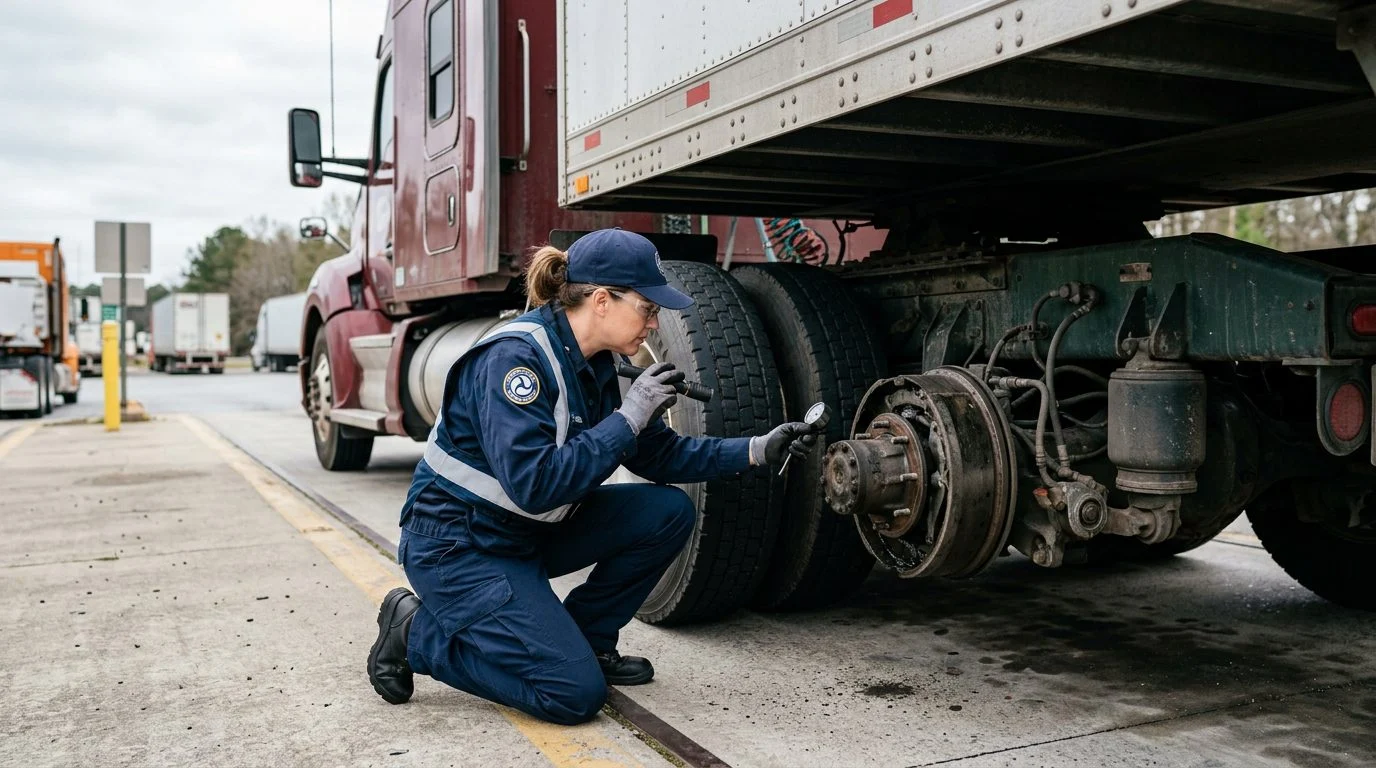
Vehicle upkeep. Federal regulation § 396.3 requires motor carriers and intermodal equipment providers to systematically inspect, repair, and maintain the motor vehicles and intermodal equipment under their control, and states that parts and accessories shall be in safe and proper operating condition at all times. They must keep records of that work.
Qualification files. Federal regulation § 391.51 requires every motor carrier to keep a qualification file on each driver it employs, including the driver’s employment application and a copy of the motor vehicle record from each driver’s licensing authority. Federal regulation § 390.11 places responsibility on the motor carrier: when these regulations prescribe a duty for a driver or impose a prohibition on the driver, the motor carrier must require observance of it, and a driver who is also the motor carrier is likewise bound.
Evidence worth preserving includes the police report, photos of the scene and the truck, dash camera and vehicle data, witness names, and your own notes written soon after the crash.
Who pays: insurance, policy limits, and personal assets
Insurance usually pays first. A trucking company’s commercial policy is often the main source of payment, and the driver’s own policy may also be involved.
Federal rules set minimum insurance levels for carriers. The public liability schedule in federal regulation § 387.9 sets a minimum level of financial responsibility of $750,000 for for-hire carriage of nonhazardous property in interstate or foreign commerce in vehicles with a gross vehicle weight rating of 10,001 or more pounds. That is the least the carrier must carry. The policies that apply to your crash decide what is actually available.
Policy limits set the most a policy will pay. If your losses are higher than the coverage available, other sources may come into play. An individual driver’s personal assets can also be at stake if insurance does not cover a full judgment.
Georgia also limits when you can add a motor carrier’s insurer to a lawsuit. That is why knowing each defendant matters.
Georgia deadlines and fault rules to know
Georgia generally gives you two years to file a personal injury lawsuit. Under O.C.G.A. § 9-3-33, actions for injuries to the person must be brought within two years after the right of action accrues. Don’t let that clock run while you wait on treatment or paperwork.
Georgia also uses modified comparative fault. Under O.C.G.A. § 51-12-33, a judge reduces damages in proportion to the injured person’s share of fault. If you are 50 percent or more responsible, you recover nothing. Under O.C.G.A. § 51-12-33, where a plaintiff is to some degree responsible for the injury or damages claimed, the judge shall reduce the amount of damages otherwise awarded to the plaintiff in proportion to his or her percentage of fault.
Under the same statute, damages apportioned to a liable person are generally that person’s own liability, and they are generally not joint. Exceptions can apply, including concerted action and an employer held vicariously liable for its driver.
Under O.C.G.A. § 50-21-26, a claim against the State must be given in writing within 12 months of the date the loss was discovered or should have been discovered. Notice goes to the Risk Management Division of the Department of Administrative Services. No lawsuit may start until that claim is denied or more than 90 days pass.
Talk with T. Madden about your crash
Yes, a semi-truck driver can be sued in Georgia when negligence causes the crash. The company, the owner, and others may also be part of the picture.
Can you sue a semi-truck driver for hitting you?
Yes, if you can show the driver’s negligence caused your injuries. The two-year filing deadline still applies.
Can you sue the trucking company and the driver both?
Yes. A claim can name both when the facts support responsibility for each.
Who pays after a semi-truck crash?
Insurance usually pays first, and the policies involved set the limits. An individual driver’s own assets may be at risk if insurance falls short.
This page is general information, not legal advice. Terance Madden is the responsible lawyer for T. Madden & Associates, P.C., which has practiced since 1999 with offices in Jonesboro, Atlanta, Decatur, Macon, and Augusta. The firm offers a free first consultation that is confidential and carries no obligation to continue. It works on a no-fee-unless-we-win basis, but you may still be responsible for court costs and case expenses.
If a truck crash has left you wondering who should answer for your losses, our team is ready to talk it through with you. Reach out through our contact page.