

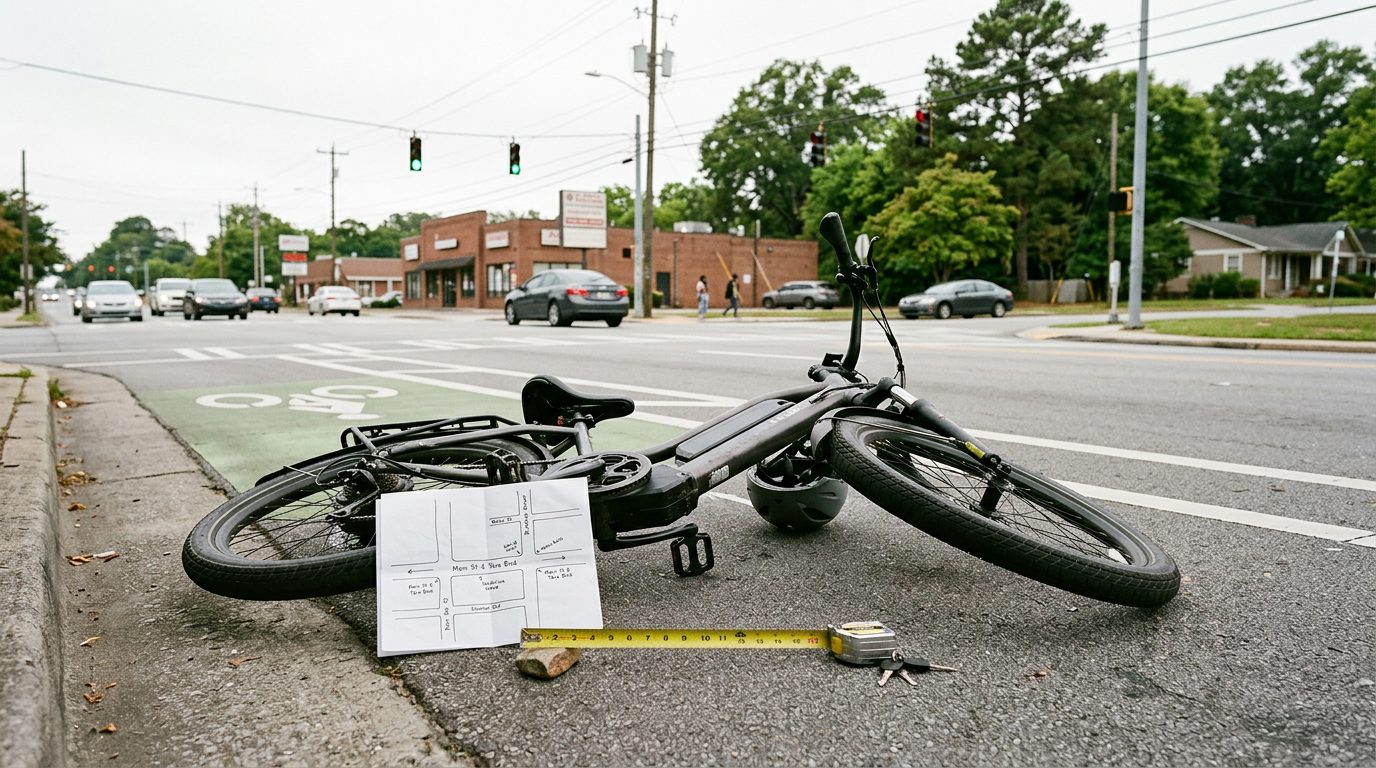
Bike Crash Help in Georgia
Hurt in a bike crash? Start with these steps.
Your health and your evidence come first. Here is how to protect both while you decide what comes next.
T. Madden & Associates, P.C.
1999
In practice since
5
Georgia offices
24/7
Call us anytime
By Terance Madden · Published November 22, 2026
A bike crash that looks minor can still hurt you badly. Some injuries take hours or days to show up. The first few days also decide what proof exists.
If you’re searching for what to do after a minor bike crash in Georgia, here is the short answer. Get checked by a doctor the same day, report the crash to police, photograph the scene, and keep the bike and battery as they are. Talk to a lawyer before you give any insurer a recorded statement.
A Crash That Looks Small Can Still Hurt You
A low-speed crash can still cause head injuries, soft tissue damage and broken bones. Many of these do not hurt right away. Adrenaline and shock can mask pain for hours or days.
If you’re the one hurt, you’re probably deciding what to do while your body is still sore. If you’re the spouse, parent or adult daughter handling the calls and appointments, you’re carrying that weight too. Both of you are in the right place to start.
The first days matter because they build the record. Medical notes, police reports, photos and the bike’s own data all show how the crash happened and what it did to you. Lose one piece, and the proof gets harder to rebuild.
For a wider view of these cases, read the firm’s e-bike crash guide for Georgia.
If you were hurt in a bike crash that looked small, or you're managing the visits and bills for someone who was, our team can talk through your options with no obligation to continue. Talk it through with our team — the first consultation is free, confidential, and carries no obligation.
What to Do at the Scene
At the scene, your first job is safety. Then you build a clear record of who was there and what happened.
Move out of traffic if you can, and check on everyone involved. Then call 911 so police and medical help come to the scene.
If a crash involved a vehicle and caused injury, death, or apparent property damage of $500.00 or more, Georgia law requires the driver to notify police, the sheriff or the state patrol right away. Under O.C.G.A. § 40-6-273, that means the local police, or the county sheriff or state patrol outside a city. Ask the officer for a name and a report number before you leave.
Get names, phone numbers and insurance details from every driver and passenger. Ask any witness what they saw while they are still standing there. Witnesses move on, and memories fade.
Keep your words plain. Say where you were, what you saw and where you hurt. Skip guessing about fault or apologizing. The goal is a clear record, not an argument about who was right.
Protect the Evidence: Photos, the Bike and the Battery
Keep the bike and battery exactly as they are until a lawyer has reviewed them. Do not repair, sell, recharge or throw them away.
Take photos from several angles before anyone moves the bike. Shoot the bike, the battery, the controller, the road, the lighting, any signs, skid marks and vehicle damage. Wide shots show the scene. Close shots show the damage.
Here’s why the device matters. An e-bike controller and battery can store records such as speed, power draw (how hard the motor pulls on the battery), fault codes (error messages the system logs) and charging history. Those records can help show how the crash unfolded and whether the bike was working as it should. The controller and battery crash evidence guide explains this in more detail.
Terance Madden holds a B.S. in Electrical Engineering and trained as an electrical engineer before he went to law school. That shapes how he approaches a case like this. He asks what the device recorded, how the crash unfolded, and which records must be kept before they are lost. He works the physical evidence first, then builds the claim around it.
See a Doctor the Same Day, Even If You Feel Fine
Get checked by a doctor the same day, even if you feel fine. Many bike injuries, including head injuries, soft tissue damage and fractures, may not hurt right away.
A doctor will evaluate you first. Depending on your symptoms, the doctor may order imaging, recommend pain care and set a follow-up plan. The doctor decides the treatment, not an insurer.
Keep every appointment. Tell the doctor about every new symptom, even small ones like headaches, dizziness, numbness or trouble sleeping. Save bills, prescription receipts and mileage to appointments.
If you’re the one keeping track for a family member, start a simple log. Write down daily symptoms, missed work, tasks that have become hard, and what the doctor said. Bring it to every visit. A written record is much easier to explain later than memory.
Recovery time depends on the injury and the person. Your doctor is the right source for that timeline.
If the injured person has Medicare, the bill rules are different. When an insurer does not pay promptly, usually within 120 days, a provider may bill Medicare. Medicare may then make a conditional payment (a payment it covers now and may later recover from a settlement). See Medicare.gov coordination rules.
Big Insurance Is Not on Your Side, and Its First Offer Is Rarely the Value
Big Insurance is not on your side, and its first offer is rarely what your claim is worth.
Expect calls soon after the crash. Adjusters often ask for a recorded statement (a taped answer to questions) before anyone knows how hurt you are. Other common tactics include a quick, low offer, questions about gaps in treatment, and “low impact” arguments that say a slow bike crash could not cause real harm.
Do not give a recorded statement or sign a release (a document that gives up your right to sue) until you’ve talked with a lawyer. Do not accept any settlement before you know the full extent of your injuries.
Georgia also sets rules for written settlement offers in motor vehicle claims. Under O.C.G.A. § 9-11-67.1, a qualifying offer must allow at least 40 days from receipt for payment. It must also include medical records sufficient to evaluate the claim.
The response is to look at every coverage layer that may pay. That can include the at-fault driver’s liability coverage (insurance that pays when that driver is legally responsible for harm), uninsured motorist coverage, underinsured motorist coverage, umbrella or excess coverage, and corporate or other responsible parties. Under O.C.G.A. § 33-7-11, a Georgia auto liability policy includes uninsured motorist coverage unless the insured rejected that coverage in writing, and the insured may also affirmatively choose uninsured motorist limits lower than the liability limits.
The firm prepares every case as if it may go to trial. For serious injuries, the claim should reflect the full cost, including future care.
Georgia Generally Gives Two Years to File Suit
Georgia generally gives two years to file most personal injury lawsuits. Many legal deadlines can apply to a claim like this, and the firm can review which ones apply to your case. O.C.G.A. § 9-3-33 sets a two-year deadline for actions for injuries to the person, except for injuries to the reputation (one year) and loss of consortium (four years).
Waiting costs more than time. Witnesses move, camera footage gets overwritten, and device data can be lost.
Georgia also uses shared fault, called comparative fault. The judge reduces damages by the injured person’s share of fault. Under O.C.G.A. § 51-12-33, a person who is 50 percent or more responsible for the injury receives no damages.
What should you do after a minor bike accident?
Get checked by a doctor the same day, report the crash to police, photograph the scene, and keep the bike and battery unchanged. Then talk to a lawyer before giving any recorded statement.
Do I have to call the police after a bike crash in Georgia?
If a vehicle was involved in a crash that caused injury, death, or apparent property damage of $500.00 or more, Georgia law requires the driver to give notice immediately, by the quickest means of communication, to the local police if the crash happened in a city, or to the county sheriff or the nearest state patrol office if it happened outside a city. Ask for the report number even if the crash looks small.
How long do I have to file a lawsuit?
Georgia generally gives two years to file most personal injury lawsuits, under O.C.G.A. § 9-3-33 (Kenneth B. Cameron v. Jmp Pizza, Inc (2026)).
If you’re hurt, or you’re keeping track of the visits and bills for someone who is, you don’t have to sort this out alone. Start with a free case evaluation from T. Madden & Associates. The first consultation is free, confidential and carries no obligation to continue. La consulta inicial es gratuita, confidencial y sin compromiso de continuar.